



|
Getting your Trinity Audio player ready...
|
Javier Milei’s Sweeping Political Triumph Reinforces Argentina’s Economic Overhaul and Cements Alliance with Trump
By: Fern Sidman
Argentina’s libertarian president, Javier Milei, scored a sweeping political victory on Sunday, solidifying his grip on power and breathing new life into his radical free-market revolution. The results, which exceeded nearly every forecast, mark a turning point for both Argentina’s turbulent domestic politics and its uneasy relationship with global financial institutions that have demanded evidence of reform before extending further aid.
According to a report that appeared on Monday in The Wall Street Journal, with more than 99 percent of votes counted, Milei’s Freedom Advances coalition captured nearly 41 percent of the national vote, more than doubling its seats in Congress and securing the pivotal one-third threshold in both chambers. That figure is far short of a governing majority but enough to guarantee Milei veto power and to safeguard the presidential decrees that underpin his economic overhaul. The outcome surprised pollsters who had predicted a far narrower showing, positioning Milei as the undisputed political heavyweight of Argentina’s new era.
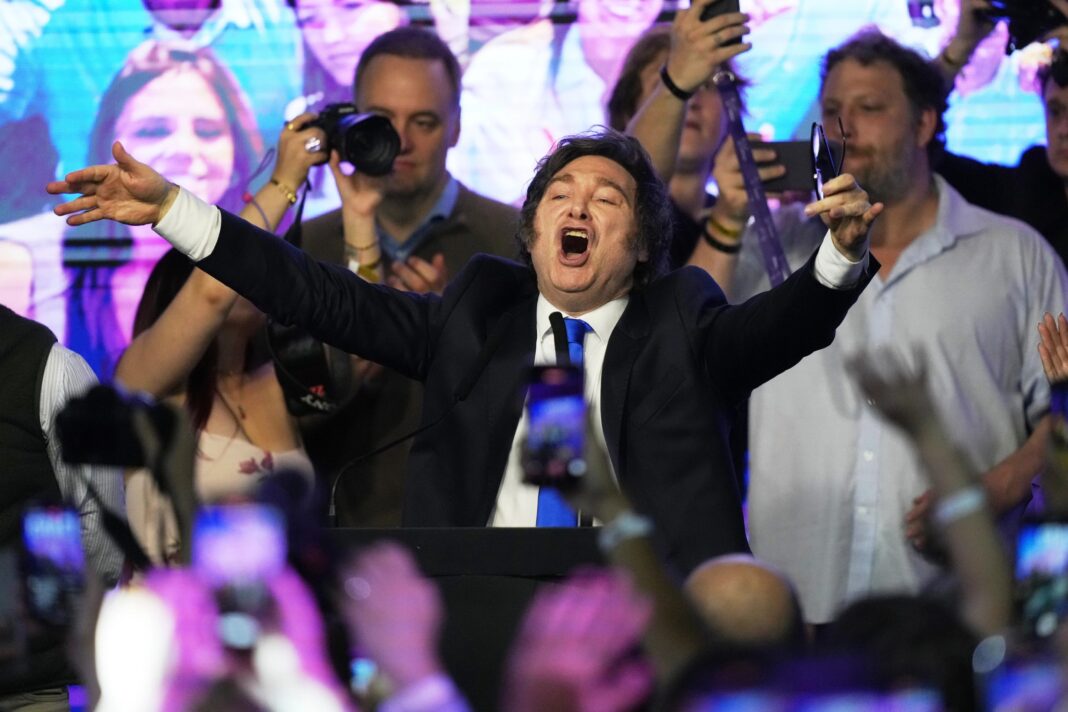
Milei celebrated the victory as validation of his audacious program to slash spending, cut bureaucracy, and restore confidence in Argentina’s battered economy. “Today marks the beginning of building a great Argentina,” he proclaimed to thousands of supporters in downtown Buenos Aires late Sunday. “This result is nothing more and nothing less than the confirmation of the mandate we assumed in 2023. It proves our people’s determination to change the destiny of this nation irreversibly.”
The WSJ report emphasized that Milei’s stronger-than-expected showing gives him critical breathing room to press ahead with reforms that have angered unions, public-sector workers, and Peronist power brokers alike. The president’s aggressive economic “shock therapy”—characterized by massive spending cuts, the elimination of energy subsidies, and the firing of tens of thousands of government employees—has begun to stabilize Argentina’s once-chaotic fiscal picture.
In just under a year, Argentina posted its first balanced budget in more than a decade, an achievement widely cited by WSJ analysts as a remarkable milestone. Inflation, which reached a staggering 200 percent under the previous Peronist administration, has fallen to roughly 32 percent, signaling that Milei’s combination of austerity and monetary restraint is starting to take effect.
The victory also delivered an indirect win for President Trump, who has been one of Milei’s loudest international champions. Trump took to his Truth Social platform Monday morning, exclaiming: “BIG WIN in Argentina for Javier Milei, a wonderful Trump Endorsed Candidate! He’s making us all look good.”
Trump’s enthusiasm was not merely rhetorical. His administration’s diplomatic outreach in recent months helped secure a massive financial backstop for Argentina’s reforms. As reported by The Wall Street Journal, the United States unveiled a $20 billion currency-swap arrangement earlier this month to stabilize Argentina’s peso, with another $20 billion expected from private banks and sovereign-wealth funds. That infusion, analysts note, is an unmistakable vote of confidence—one that hinges directly on Milei’s ability to deliver results and maintain political stability.
The IMF, meanwhile, has tied the continuation of its $44 billion loan program to Milei’s fiscal discipline, effectively linking Argentina’s economic survival to the endurance of his reforms. Sunday’s election outcome, therefore, reassures not just domestic supporters but Washington and Wall Street alike that Milei still commands a mandate strong enough to push through painful adjustments.
Financial markets wasted no time in celebrating. The WSJ reported that Argentina’s dollar-denominated government bonds surged Monday morning, with U.S.-listed Argentine equities rising sharply in pre-market trading. Investors, long skeptical of Buenos Aires’ volatility, interpreted the results as confirmation that Milei can maintain control over his legislative agenda.
“Today’s outcome bolsters his ability to carry forward difficult but necessary reforms,” observed Alberto Ramos, head of Latin America economics research at Goldman Sachs, in remarks quoted in The Wall Street Journal report. “This should give his administration a fresh endowment of legitimacy and political capital which, if well used to build strong and reliable alliances, should strengthen governability.”
Milei’s strategy, Ramos suggested, represents “the first credible plan in a generation to restore discipline to Argentina’s finances.” Yet, even among optimists, caution lingers: success depends not only on economic arithmetic but on political endurance.
The domestic cost of Milei’s reforms has been steep. Real wages have fallen more than 20 percent since 2023, and consumer spending continues to contract, pushing roughly one-third of Argentines below the poverty line. The WSJ report observed that even as fiscal indicators improve, “the human toll of adjustment has been severe,” particularly among the working poor and pensioners.
Still, for many voters, the alternative—a return to the populist excesses of Peronism—was far worse. “Milei is putting the country back on its feet,” said Leandro Pedrozo, a 20-year-old law student who spoke to reporters after casting his ballot. “My family had the chance to leave for Europe, but no. We’re staying. We’re betting on our country.”
That optimism appears widespread. While demonstrations over layoffs and subsidy cuts have erupted in some provinces, polls suggest most Argentines accept austerity as a necessary evil. As one Buenos Aires shopkeeper told local media, “After so many false promises, we finally have a president who’s doing what he said he’d do.”
For the once-dominant Peronist movement, Sunday’s results were nothing short of a humiliation. The WSJ report noted that the populist coalition founded by Juan and Eva Perón—which has shaped Argentina’s politics for nearly eight decades—performed well below expectations, losing ground even in traditional strongholds like Buenos Aires Province.
Axel Kicillof, the left-leaning governor of that province, conceded that his party had failed to connect with voters exhausted by inflation and corruption. “The government is wrong to celebrate this result,” Kicillof said, accusing Milei of ignoring the hardship faced by millions of Argentines. “It’s wrong to ignore the suffering of businesses closing and the most vulnerable suffering more every day.”
But critics’ warnings carried little weight. As one WSJ analyst observed, “Voters may not love Milei’s methods, but they understand his logic.” That pragmatism—choosing stability over nostalgia—proved decisive in a nation long mired in economic self-sabotage.
Before the election, Milei’s Freedom Advances held only 37 deputies and six senators, roughly 15 percent of Congress. His new gains elevate the coalition to about one-third of both chambers—enough to block hostile legislation and sustain presidential decrees.
According to the report in The Wall Street Journal, that arithmetic is critical. Under Argentina’s constitution, possessing one-third of seats in either chamber gives a president effective veto power, preventing the opposition from overturning executive actions. For Milei, it means he can now pursue structural reforms—privatizations, deregulation, and tax simplification—without constant paralysis from leftist lawmakers.
Political scientist Rodrigo Zarazaga, a Jesuit priest who has long worked in Buenos Aires’ poorest neighborhoods, described the outcome as “an impressive comeback.” Despite deep recession and widespread discontent, Zarazaga told reporters that “people decided to give the president another chance because they finally believe he might be able to change things.”
Milei’s allies argue that only continued austerity will cleanse the system of corruption and inefficiency. “Rebuilding Argentina means breaking the habits that destroyed it,” declared one Freedom Advances lawmaker on election night. “And breaking habits always hurts.”
For now, global markets appear willing to believe that Milei can sustain the course. Argentina’s re-emergence as a credible borrower is itself a form of political capital: “Every bond auction that succeeds is a referendum on his ability to deliver.”
