



|
Getting your Trinity Audio player ready...
|
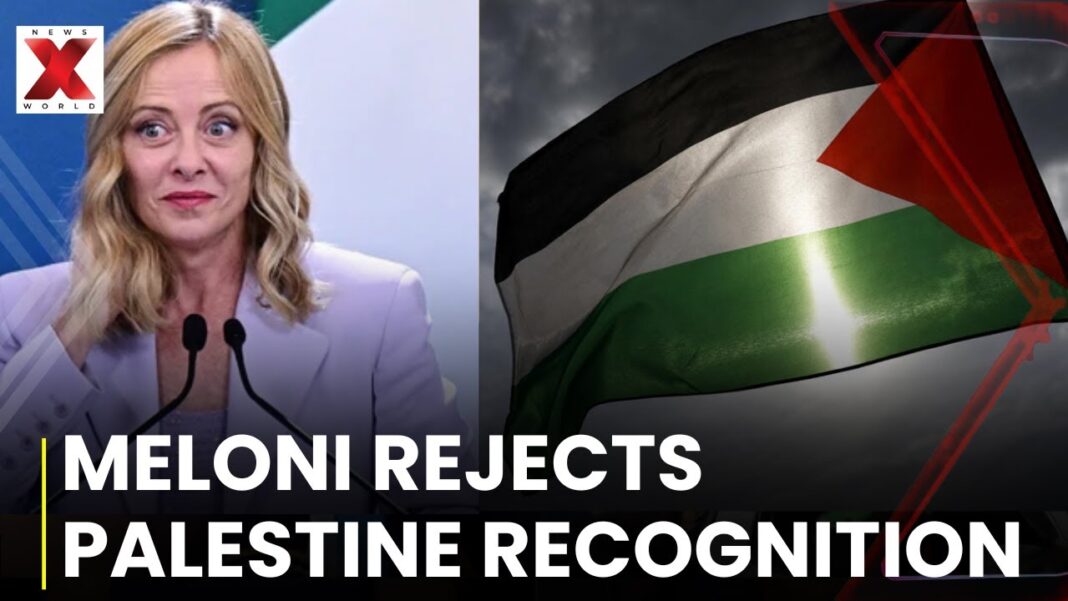
(TJV NEWS) Italian Prime Minister Giorgia Meloni voiced opposition this weekend to the idea of recognizing a Palestinian state before it has been formally established, warning that such a move could distort the path to a lasting resolution.
“I strongly support the establishment of a Palestinian state,” Meloni told La Repubblica, “but I don’t believe in recognizing something that doesn’t yet exist.” She cautioned that recognizing a state on paper without it existing in practice could give the false impression that the conflict has been resolved, Times of Israel reported.
Meloni’s remarks come amid growing international debate following France’s announcement that it intends to formally recognize Palestinian statehood at the United Nations General Assembly in September. That move has drawn sharp criticism from both Israel and the United States, especially as the war continues in Gaza between Israel and Hamas, the Iran-backed terrorist group.
According to diplomatic sources cited by the Times of Israel, Israel has warned Paris that such recognition could carry consequences — including a potential downgrade in intelligence cooperation and disruptions to French initiatives in the region. Several Israeli ministers have even suggested annexing parts of the West Bank in response.
If France follows through, it would become the first major Western power to recognize a Palestinian state — a significant step that could lend momentum to a campaign largely championed until now by smaller nations often critical of Israeli policy.
Italian Foreign Minister Antonio Tajani also weighed in, stating Friday that recognition must happen in tandem with the new Palestinian entity recognizing the State of Israel. “It’s a two-way street,” he said, stressing mutual recognition as essential for genuine progress.
British Prime Minister Keir Starmer echoed that sentiment, saying the UK’s support for Palestinian statehood must be embedded within a broader framework aimed at permanent peace and security for both sides. “Recognition must be part of a larger process that delivers a two-state solution,” Starmer said in a video statement, adding that such a move should serve as a tool to improve lives rather than as a symbolic gesture.
Germany also made its position clear on Friday. A government spokesperson said Berlin does not intend to recognize a Palestinian state in the near future, prioritizing renewed negotiations toward a long-overdue two-state solution instead.
Critics of unilateral recognition argue that it is largely symbolic and counterproductive unless done in coordination with Israel. They believe true Palestinian statehood can only come through direct negotiations. On the other hand, proponents argue that the Israeli government has shown little interest in such negotiations and that international pressure is now the only viable path forward.
As of now, at least 142 countries have recognized or expressed intent to recognize Palestinian statehood, according to an AFP tally cited by Times of Israel. Many nations—including Norway, Spain, Ireland, Slovenia, and several others outside Europe—announced recognition in the wake of the ongoing Gaza war, which erupted after Hamas’s brutal October 7, 2023, attack on Israel.
That assault left around 1,200 Israelis dead, mostly civilians, and saw 251 people taken hostage. Israel says 28 of the remaining 50 hostages in Gaza are now confirmed dead.
While the Hamas-run Gaza Health Ministry claims over 58,000 Gazans have died or are missing since the war began, those figures are unverified and do not distinguish between civilians and combatants. Israel says it has killed roughly 20,000 Hamas fighters and 1,600 terrorists inside Israeli territory on October 7 alone.
Israel has reiterated its commitment to minimizing civilian casualties and has accused Hamas of operating within densely populated areas — including homes, hospitals, and schools — using civilians as shields.
