



|
Getting your Trinity Audio player ready...
|
By: Tzirel Rosenblatt
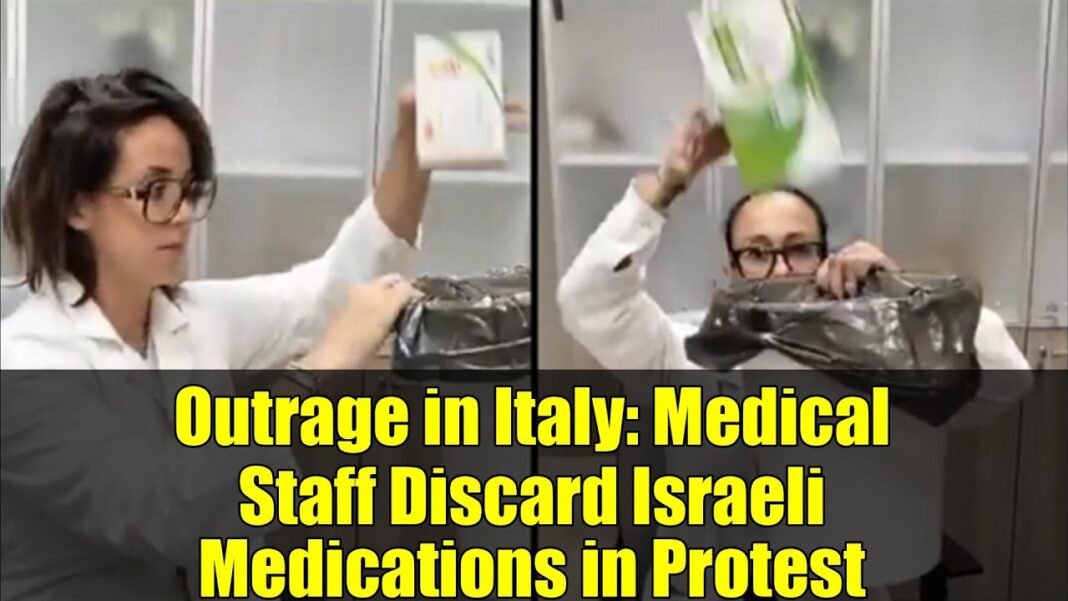
A controversy has erupted in Italy after a video surfaced showing a doctor and a nurse at a community hospital in Tuscany discarding products manufactured by Teva Pharmaceuticals, the Israeli-headquartered multinational that supplies critical medicines worldwide. The incident, which quickly spread across social media platforms, has provoked widespread condemnation, highlighting the intersection of medical ethics, political activism, and the growing wave of anti-Israel sentiment sweeping parts of Europe.
According to a report that appeared on Thursday at VIN News, the video depicted Dr. Rita Segantini and nurse Giulia Checcacci tossing Teva-branded products into a container as a form of protest. Their act—intended, they later claimed, as a “symbolic gesture for peace”—was immediately perceived by many as an anti-Israel demonstration carried out under the guise of medical authority.
The two medical professionals initially framed their actions as harmless, emphasizing that no genuine medicines were destroyed. In a statement issued after the public outcry, Dr. Segantini explained that the items thrown were limited to free promotional samples, such as wet wipes and nutritional supplements, and not life-saving drugs. She further clarified, as VIN News reported, that the demonstration occurred outside working hours and was not connected to hospital operations.
Despite these assurances, the backlash was swift and unforgiving. Online commentators and lawmakers decried the act as a reckless politicization of the medical profession. Italian parliamentarian Deborah Bergamini of the center-right Forza Italia party was among the most vocal critics, describing the display as “ideological activism” incompatible with the ethical duties of healthcare providers. She urged disciplinary measures to be taken to safeguard the neutrality and professionalism of the Italian healthcare system.
The Southeast Tuscany Health Authority, responsible for the hospital where Segantini and Checcacci are employed, moved quickly to contain the reputational fallout. As the VIN News report detailed, the authority launched an internal inquiry into the matter, underscoring the need to protect both the hospital’s credibility and the trust of patients.
Hospital administrators emphasized that the protest was a private action, conducted off-duty, and did not involve the destruction of essential medical supplies. Nevertheless, the association between a public health institution and an overtly political display has drawn attention to the fragility of trust in healthcare environments, particularly during a period of heightened geopolitical tensions.
Teva Pharmaceuticals, the world’s largest producer of generic drugs, is headquartered in Israel and plays a pivotal role in global healthcare. Its medicines—including treatments for neurological disorders, cancer, and respiratory conditions—are relied upon by millions of patients. The company also has a significant presence in Italy, where it supplies hospitals and pharmacies with a broad portfolio of affordable treatments.
As the VIN News report observed, the targeting of Teva in this case illustrates a disturbing trend: the extension of political disputes into the realm of medicine, where the stakes can involve human lives. Even if no critical drugs were destroyed in this instance, the symbolism of discarding products from a company that manufactures essential therapies raises profound ethical questions about the weaponization of medical authority for ideological causes.
Observers have pointed out that healthcare professionals hold a unique position of trust, tasked with the delivery of life-saving services without prejudice or bias. By publicly aligning their professional identities with a protest against an Israeli company, Segantini and Checcacci risked undermining that neutrality.
The report at VIN News noted that critics argued the video reinforced the perception of an alarming “politicization of medicine” in Europe, where gestures against Israel are increasingly taking the form of symbolic boycotts. Such acts, critics warn, threaten to erode public confidence in the impartiality of healthcare providers, a cornerstone of the doctor-patient relationship.
The timing of the incident has intensified the outrage. As VIN News has consistently reported, Italy—like much of Europe—has witnessed a rise in antisemitic rhetoric and actions since the October 7 Hamas massacre in Israel and the subsequent war in Gaza. Public demonstrations, boycotts of Israeli goods, and online hostility toward Jewish communities have surged, creating a climate of heightened tension and fear.
Within this context, a protest by medical professionals against an Israeli company was bound to be interpreted as more than an isolated gesture. For many observers, it became emblematic of how deeply anti-Israel sentiment has penetrated public life, even into spaces traditionally associated with neutrality and humanitarian concern.
The reaction from lawmakers across the Italian political spectrum demonstrates how sensitive the subject has become. While some framed the protest as misguided but minor, others insisted that public servants in positions of responsibility must be held to a higher standard.
Bergamini, in particular, stressed the need for disciplinary action not only to restore public trust but also to send a message that Italy’s healthcare system will not tolerate the injection of divisive political messaging into its ranks. As VIN News reported, she warned that acts of “performative activism” in hospitals risk creating an atmosphere of intimidation for both patients and colleagues.
Following the uproar, both Segantini and Checcacci issued public apologies, reiterating that no patients were affected and that the gesture was intended merely as an expression of hope for peace. They emphasized that the products discarded were trivial promotional samples, not prescribed medication.
Nonetheless, the apologies have done little to quell criticism. As the VIN News report highlighted, many commentators see the controversy as a microcosm of a larger problem: the blurring of lines between personal political convictions and professional responsibilities, especially in sensitive sectors such as healthcare.
Ultimately, the Tuscany incident serves as a cautionary tale about the perils of symbolic activism within professions bound by codes of impartiality and trust. For Teva Pharmaceuticals, the controversy is yet another reminder of how the company’s Israeli identity makes it a target, even though its products serve patients of every background.
For Italy, the incident underscores the challenges of maintaining professional integrity in a polarized climate. And for the global medical community, it raises critical questions about whether healthcare can remain a refuge from ideological battles—or whether even hospitals are destined to become stages for political theater.
The case of Dr. Segantini and nurse Checcacci reflects more than a local scandal. It is part of a broader struggle to safeguard the sanctity of healthcare from the corrosive effects of geopolitics—a struggle that is likely to intensify as international tensions continue to escalate.

Did they destroy pharmaceuticals manufactured in Communist China, which uses slave labor and targets Falun Gong for forced organ transplants? How about Syria which has conducted a genocide against Kurds and Druze?
A bunch of antisemitic hypocrites!
People such as these demonstrate what baseless hatred in one’s heart does to one’s humanity. They are showing that their brains react to propaganda and cannot process both sides of a story. They are choosing to follow lies pushed by violence. They will bring upon themselves their own curses. Israel, like all other nations, isn’t perfect, but it has been our desire to save lives and souls by using the gifts our Creator has given us. And by the way, this has saved me 1000s of dollars, as I no longer have the desire to visit Tuscany, which looked to be a beautiful place.