



|
Getting your Trinity Audio player ready...
|
By: Fern Sidman – Jewish Voice News
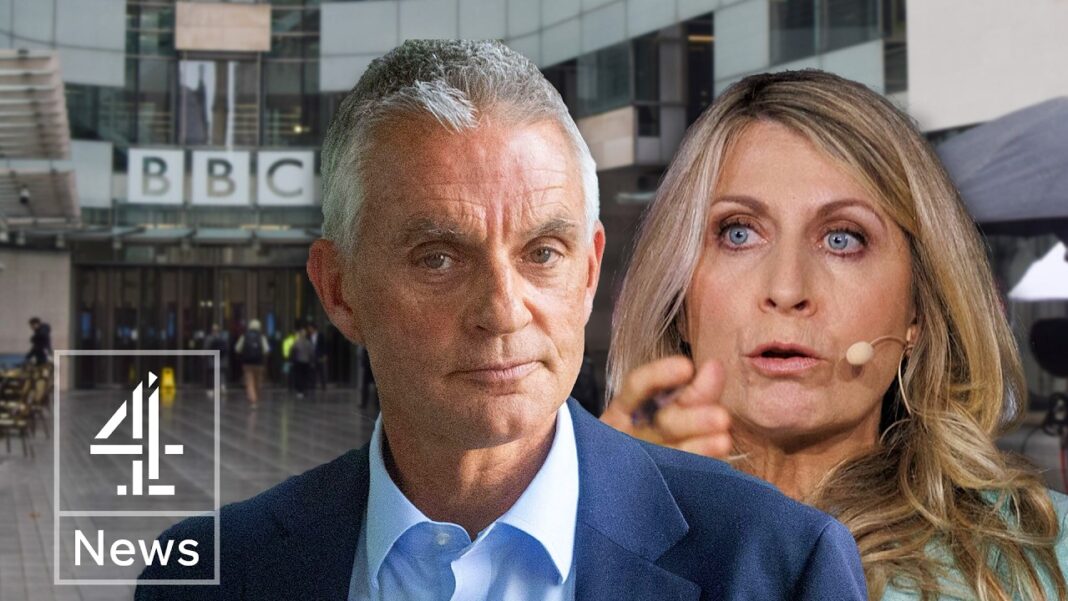
In a stunning development that has reverberated across the international media landscape, both BBC Director-General Tim Davie and BBC News CEO Deborah Turness resigned this week following revelations of profound editorial misconduct, including biased coverage of Israel and manipulated reporting of President Donald Trump’s January 6, 2021, address. The dual resignations, long demanded by critics of the British Broadcasting Corporation, have been hailed by Israel as a moment of long-overdue reckoning for an institution accused of systemic bias against the Jewish state.
In a strongly worded statement issued Tuesday by the Embassy of Israel in the United Kingdom, they said it “takes note” of the resignations and views them as “a long-awaited response to serious and longstanding concerns about the BBC’s biased and deeply flawed coverage of Israel, particularly during the war against Hamas.” The embassy’s remarks drew attention to years of diplomatic frustration with the BBC’s Arabic-language service and its active role in distorting facts, downplaying Israeli suffering, and amplifying antisemitic or extremist narratives.
“For years, we have repeatedly warned about the BBC’s consistent failures to uphold the standards of accuracy, impartiality, and integrity expected from a public broadcaster,” the embassy said. “The BBC’s reporting, especially by BBC Arabic, has too often distorted reality, omitted vital context, and provided a platform for antisemitic and extremist narratives.”
The embassy added that such distortions had “contributed to public misinformation, hostility towards Israel and Jewish people, and, tragically, to the radicalization of audiences in the UK and across the Middle East.” The statement urged that “this moment must serve as a turning point,” pressing the broadcaster to undertake comprehensive reform and “rebuild public trust through accountability and transparency.”
The crisis engulfing the BBC traces its origins to the leaking of the Michael Prescott dossier—a classified internal report commissioned by the BBC to review its editorial practices. The dossier, which came to light through The Daily Telegraph, exposed pervasive political and ideological bias within the network, including evidence of antisemitism and misleading coverage of both Israeli and U.S. affairs.
The dossier found that the BBC had edited portions of Donald Trump’s January 6 speech to create the false impression that he incited insurrection—an act now characterized as a “gross ethical violation.” The manipulation, the dossier stated, was “deliberate and ideologically motivated.”
Beyond that explosive revelation, the Prescott dossier described a pattern of institutional bias across multiple BBC divisions, particularly in BBC Arabic, which was accused of framing Israel as an aggressor while minimizing or omitting Israeli civilian suffering. The report cited “unverified claims, emotive framing, and skewed language” that, in aggregate, created “a persistent narrative of Israeli culpability divorced from factual context.”
On Tuesday, Israel National News reported that such findings also prompted an immediate outcry from Jewish organizations, including CJV UK, the British branch of the Coalition for Jewish Values, which called for the BBC to “clean house” and rebuild its moral credibility.
“This is not a political matter—it is a profound moral failing,” said Rabbi Jonathan Guttentag, chairman of CJV UK, in remarks reported by Israel National News. “The BBC is funded by every household in Britain. When it gives more credibility to terrorists than to their victims, it betrays the trust of the British public.”
Rabbi Guttentag and other Jewish leaders argued that the BBC’s coverage has had far-reaching social consequences, fueling antisemitism both in the United Kingdom and abroad. “When the world’s most influential broadcaster portrays the victims of genocidal terrorism as the oppressors and excuses terror as resistance, it spreads prejudice from Manchester to Melbourne,” Guttentag said. “Words have consequences—and misinformation can cost lives.”
He cited the surge in antisemitic incidents in Britain since the October 7, 2023, Hamas attacks, including the Yom Kippur assault on Heaton Park Shul in Manchester, as a direct manifestation of a toxic media environment that vilifies Israel. “Demonizing Israel provides a pretext for violence against Jews,” Guttentag added, calling on the BBC’s new leadership to “commit to a full and transparent reckoning.”
The Michael Prescott dossier, as described in the Israel National News report, reads as a damning indictment of editorial culture at the BBC. It catalogues years of ignored warnings from internal whistleblowers and external observers regarding political bias, double standards in Middle East reporting, and ethical breaches. Among the dossier’s most startling findings were:
Editorial manipulation of Trump’s January 6 speech, splicing together remarks from different points in time to imply a continuous incitement narrative.
Repeated omission of Israeli civilian casualties in coverage of military conflicts, replaced by disproportionate emphasis on Palestinian fatalities without contextual attribution to Hamas’s tactics of embedding within civilian populations.
The use of antisemitic tropes in BBC Arabic broadcasts, including the amplification of conspiracy theories that portray Jews as global manipulators or aggressors.
Institutional disregard for oversight, with senior executives reportedly dismissing internal audits that identified these biases.
The report at Israel National News noted that BBC leadership repeatedly rebuffed diplomatic overtures from the Israeli Embassy and Jewish advocacy groups calling for corrections or accountability. “For years, polite dialogue was met with silence,” one embassy official told the outlet. “When that failed, we resorted to formal complaints, which were ignored. The resignations now validate what we have been saying all along.”
The resignations of Davie and Turness, who had both been appointed to restore trust in the BBC after previous scandals, represent the culmination of what many observers see as a crisis of moral leadership. The institution, once regarded as the gold standard for journalistic impartiality, now faces calls for parliamentary investigation into its governance structure.
The embassy’s statement emphasized that Israel “values the role of a free and responsible press,” but stressed that freedom of expression cannot be an excuse for falsehood or bias. The embassy added that “accountability for those responsible for the editorial failings of BBC Arabic” must be non-negotiable.
British lawmakers have echoed these sentiments, with several MPs urging Ofcom, the UK’s communications regulator, to open a formal inquiry into whether the BBC breached its charter obligations. “Public trust has been broken,” said one senior Conservative MP, “and without reform, it cannot be rebuilt.”
For Israel and the global Jewish community, the resignations signal what the Israel National News report described as “a rare moment of institutional accountability” in an era where media bias has increasingly normalized antisemitic narratives. The outlet’s analysis emphasized that the episode could mark a turning point in Western media ethics, especially regarding coverage of Israel and global Jewry.
“Israel does not seek to dictate media content,” one Israeli diplomat told Israel National News, “but it expects accuracy, fairness, and context. When a publicly funded institution misinforms millions and fuels hatred, it ceases to serve democracy—it undermines it.”
The Embassy of Israel’s statement called on the BBC to enact comprehensive reforms, beginning with editorial transparency, external oversight of Arabic-language programming, and stricter enforcement of accuracy standards across all divisions. “Accountability and transparency must replace denial and defensiveness,” it declared. “Only then can the BBC rebuild a relationship with its audiences based on truth, integrity, and respect.”
The broader implications of the BBC scandal, as analyzed by Israel National News, extend far beyond Britain. The network’s global reach—especially through BBC World Service and BBC Arabic, which together broadcast to tens of millions across the Middle East and North Africa—means that its editorial slant has the power to shape regional narratives about Israel and the Jewish people.
When those narratives are skewed, the consequences ripple through diplomatic relations, security perceptions, and even grassroots attitudes toward Jews worldwide. Israeli officials contend that this is not merely a matter of reputational harm but a tangible security issue, as biased reporting can “legitimize terrorism and delegitimize self-defense.”
As the Israel National News report observed, the BBC’s crisis has laid bare an uncomfortable truth: that journalistic power, when unmoored from moral accountability, can become a tool of distortion rather than enlightenment. The resignations of Tim Davie and Deborah Turness, while significant, are only the first step toward what Israel and Jewish advocacy groups hope will be a wholesale moral recalibration of one of the world’s most influential news institutions.
“Israel values a free press,” the embassy reiterated, “but freedom comes with responsibility. We hope this moment marks the beginning of a renewed BBC—one that remembers its duty not only to report but to tell the truth.”
For now, the world watches as the venerable broadcaster confronts its reckoning. Whether this crisis becomes a moment of transformation or simply another chapter in a long history of denial will depend on whether the BBC, at last, chooses transparency over obfuscation—and truth over ideology.
As the Israel National News report noted, “For the BBC, this is not just a scandal—it is a test of conscience.”