



|
Getting your Trinity Audio player ready...
|
\
By: Fern Sidman
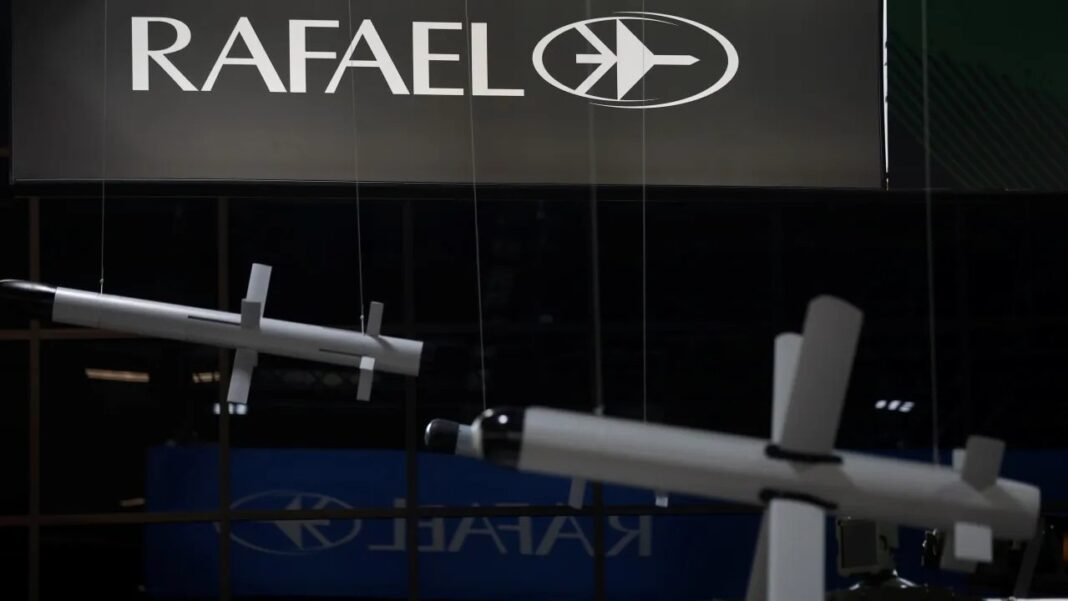
In a dramatic diplomatic and legal escalation, Rafael Advanced Defense Systems, one of Israel’s premier defense manufacturers, announced it will pursue legal action against the French government after its exhibit was abruptly sealed off during the 55th Paris Air Show, allegedly for displaying “offensive” weapons amid Israel’s ongoing military operations against Hamas terrorists in Gaza.
As The Algemeiner (algemeiner.com) reported on Wednesday, four Israeli defense firms—Rafael, Elbit Systems, Israel Aerospace Industries (IAI), and UVision—were effectively banned from public view at this year’s show, with exhibition organizers erecting black barriers around their booths in the dead of night, reportedly under pressure from French authorities.
According to the information provided in The Algemeiner report, the French government justified the move by citing concerns about the exhibition of offensive weapons systems while the conflict in Gaza continues. French Prime Minister François Bayrou, speaking at the air show, claimed the government’s actions were guided by humanitarian concerns: “France considers that this is a terrible situation for the Gazans… France wanted to demonstrate that offensive weapons should not be present in this show.”
But for Israeli officials and defense executives, the move is not only unjust—it is being labeled a form of politically motivated discrimination and economic sabotage.
“We will sue the French government for what they have done to us,” declared Shlomo Toaff, Executive Vice President of Rafael, in a statement to Euronews, which was later quoted by The Algemeiner. “We are going to sue them for causing financial damage, for not giving us access to the property that we had rented. We think this is an unjust decision.”
Toaff emphasized that Rafael had met all regulatory requirements, rented its booth a year in advance, and passed French customs clearance with all of its displayed technology. The company has invested millions of euros in logistics and marketing for the air show, which is one of the largest defense and aerospace expos in the world.
Other Israeli firms echoed Rafael’s frustration. Sasson Meshar, a senior executive at Elbit Systems, told Euronews, “We don’t understand the logic of the decision, because from our perspective, it’s discrimination… We are not here for some kind of flower exhibition.”
As reported by The Algemeiner, Major General (Res.) Amir Baram, Director General of Israel’s Ministry of Defense (IMOD), condemned the French government’s actions as “absolutely, bluntly antisemitic,” accusing it of commercial exclusion and protectionism aimed at curbing Israeli competition in the global defense sector.
“It’s regrettable and immoral to see discrimination based on extraneous considerations that mask French economic interests,” Baram said. “Despite the French attempt to harm us, visitors, including heads of state and military leaders from around the world, flocked to the Israeli industry pavilions… Battlefield performance speaks for our products far better than any exhibition on French soil.”
The IMOD argued that France was “hiding behind supposedly political considerations” to protect its own defense industries from Israeli competitors, especially given the increasing global demand for Israeli defense technologies following the conflict with Iran and ongoing operations in Gaza.
The Algemeiner report further highlighted that although a French court was petitioned by Israeli companies earlier this week to reverse the booth closures, the court ruled that it had no jurisdiction to overturn the French government’s decision, effectively leaving the companies without recourse inside France.
According to the information contained in The Algemeiner report, Israeli executives have raised the question of why their defense systems were singled out when thousands of other companies from 48 countries, many of them displaying similar weapons systems, were not subjected to similar restrictions. With more than 2,500 exhibitors attending the Paris Air Show, only the Israeli firms were entirely cordoned off, drawing accusations of selective enforcement and political targeting.
“Everybody around is showing the same systems,” said Elbit’s Meshar. “We are not showing something different from what NATO countries and major defense firms are displaying. Yet we are the ones behind black walls.”
The ban has ignited criticism far beyond Israel. Arkansas Governor Sarah Huckabee Sanders, speaking to Reuters, called the move “pretty absurd,” and warned that France’s reputation as a fair broker in the defense market could be at risk.
The incident is only the latest example of rising political hostility in Europe toward Israeli industry, often disguised in humanitarian language but widely perceived as a form of economic isolation, as was indicated in The Algemeiner report.
Notably, a Paris court earlier this month rejected an attempt by several activist groups to ban Israel entirely from participating in this year’s air show, emphasizing how politically charged Israel’s presence has become in certain European venues.
Despite the setback, The Algemeiner reported that Israel’s presence remained highly visible, with international delegations, defense ministers, and military leaders making direct visits to the blocked booths. While they had to view the displays through limited access points, interest in Israeli defense technology—such as precision-guided missiles, advanced drone systems, and missile defense platforms—remained strong.
“The whole world is watching the battlefield effectiveness of our systems, from Gaza to Tehran,” said an Israeli defense official to The Algemeiner. “France can try to cover our booths with walls, but they can’t block our reputation.”
The confrontation at the 55th Paris Air Show has quickly transformed from a trade show dispute into a diplomatic incident with legal ramifications. As Rafael prepares its lawsuit and Israeli officials weigh their next moves, questions about fairness, economic protectionism, and antisemitic bias swirl around the French government’s decision.
As The Algemeiner report observed, the damage may extend far beyond euros and exhibition space—it has touched on deeper tensions about how Israeli innovation is perceived, policed, and, increasingly, politicized on the world stage.
