



|
Getting your Trinity Audio player ready...
|
By: Chaya Abecassis
The Israeli government has approved an ambitious and controversial plan to establish a temporary terminal at Chisinau Airport in Moldova to accommodate thousands of ultra-Orthodox Jews traveling to Uman, Ukraine, for the upcoming Rosh Hashanah pilgrimage. The initiative, reported by VIN News on Thursday, carries an estimated cost of NIS 20 million ($5.3 million) and has already triggered heated political debate in Israel over the propriety of devoting public funds and manpower to the effort during wartime.
According to figures cited in the VIN News report, the government’s project will include the construction of a dedicated terminal designed to process as many as 500 passengers per hour, staffed with dozens of Israeli aviation security officers, police, and interpreters to ensure the smooth handling of travelers. The plan underscores the deep cultural and religious significance of the annual pilgrimage while also laying bare the tensions between Israel’s commitments to its diverse citizenry and its ongoing national security and financial priorities.
The breakdown of costs reveals the scale of Israel’s commitment. Construction of the temporary terminal alone is projected to consume roughly $2.6 million, with the remaining budget earmarked for operational expenses including security, policing, catering, medical services, and other logistical support.
Outbound flights for the pilgrims are scheduled to depart between mid- and late September, with return flights clustered in the final week of the month. To manage the expected surge, Israel will dispatch an extensive team of 90 aviation security officers, 24 police officers, and 50 interpreters to Chisinau, ensuring communication between Israeli authorities and Moldovan airport officials.
Officials told VIN News that the special arrangement was necessary given the large numbers of worshippers expected to attend the annual pilgrimage to the grave of Rabbi Nachman of Breslov, located in Uman. Despite the war in Ukraine and ongoing hostilities in Israel, demand for the pilgrimage has remained robust, particularly among Breslov Hasidim, who view the journey as a spiritual obligation.
The project, however, has drawn sharp criticism from lawmakers, legal authorities, and sections of the Israeli public. In August, the government had already allocated NIS 10 million in direct support for the pilgrimage, sparking outrage that state funds were being directed to subsidize religious travel at a time when much of the national budget is strained by war expenses and economic downturns.
According to the information provided in the VIN News report, the Deputy Attorney-General issued a ruling cautioning that permitting yeshiva students who have failed to report for mandatory military service to travel abroad would be unlawful. This decision casts doubt on whether all prospective pilgrims will even be allowed to make the journey, particularly given the heightened scrutiny of draft evasion during Israel’s ongoing conflict with Hamas and other Iranian-backed groups.
Political opposition has been especially vocal. Yair Lapid, head of the Yesh Atid party, denounced the government’s decision as a distortion of national priorities, declaring that “public funds must not be used to underwrite private religious travel while Israeli soldiers are sacrificing their lives.” Former Finance Minister Avigdor Liberman echoed the sentiment, accusing the government of “subsidizing draft dodgers with taxpayer money” and warning that the move risks deepening societal rifts.
The controversy is magnified by the broader national context. Israel is currently engaged in what Prime Minister Benjamin Netanyahu has called the “decisive stage” of the war against Hamas, with tens of thousands of reservists called up for duty. Against this backdrop, the optics of allocating millions of shekels and significant state manpower to support religious pilgrims abroad have struck many as tone-deaf.
VIN News reported that critics view the government’s decision as sending the wrong message at a time of national crisis — particularly when Israeli soldiers are on the front lines and families of hostages continue to wait anxiously for news of their loved ones. For opponents of the plan, facilitating the departure of thousands of men — many of them of military age — undermines solidarity and exacerbates tensions between the secular and ultra-Orthodox sectors of society.
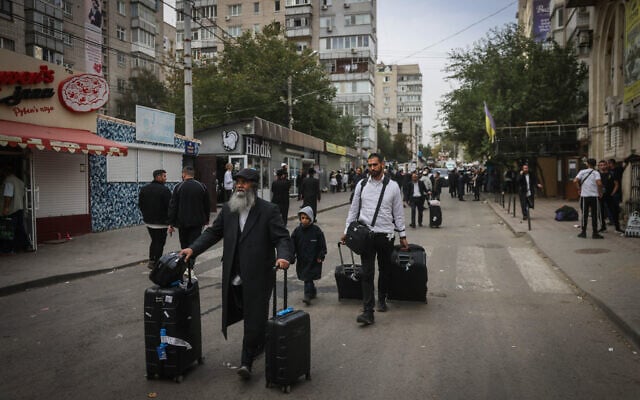
Supporters of the initiative, however, point to the profound spiritual importance of the annual pilgrimage to Uman. For Breslov Hasidim, traveling to the resting place of Rabbi Nachman is not merely a custom but a sacred act tied to their religious identity. The pilgrimage has drawn tens of thousands each year, even under difficult circumstances, symbolizing a global Jewish unity that transcends politics.
The report at VIN News noted that Israeli officials sympathetic to the project argue that by investing in a temporary terminal and overseeing the logistics themselves, the government can ensure that the operation proceeds safely and efficiently, minimizing risks both to the pilgrims and to Israel’s international reputation. By coordinating with Moldovan authorities and securing the airport infrastructure, Israel hopes to avoid chaotic scenes or security breakdowns that might otherwise occur with unmanaged mass travel.
Security remains a central concern. With the war in Ukraine continuing and the region unstable, Israeli authorities are determined to mitigate risks for travelers passing through Moldova en route to Uman. The deployment of 90 security officers draws attention to the seriousness with which Israel is approaching potential threats, while the addition of interpreters aims to prevent miscommunications in a high-pressure environment.
According to the information contained in the VIN News report, Israeli security agencies have warned repeatedly that mass gatherings of pilgrims in Ukraine could become targets for terrorist attacks or even opportunistic criminal activity. The government insists that constructing the terminal in Chisinau is the most prudent way to control the flow of travelers and reduce exposure to risk.
The debate over the Moldova terminal is emblematic of Israel’s broader struggle to reconcile competing demands: the protection of religious freedoms and cultural traditions on one hand, and the imperatives of national security, fiscal responsibility, and social equality on the other.
For many Israelis, particularly secular citizens and bereaved military families, the decision feels like a betrayal of shared sacrifice. As VIN News reported, opposition figures have charged that the government is privileging the political clout of ultra-Orthodox parties — key partners in Netanyahu’s coalition — over the country’s pressing wartime needs.
At the same time, the government’s willingness to devote resources to the project reflects the enduring political power of the Haredi bloc, whose support is often decisive in maintaining governing coalitions. The controversy over the terminal, therefore, is not merely about logistics or finance, but about the delicate balance of power that shapes Israeli politics.
As thousands of Breslov Hasidim prepare for their annual journey to Uman, the Israeli government’s decision to build a temporary terminal in Moldova at a cost of NIS 20 million emphasizes both the centrality of faith in Jewish life and the contentious debates over state responsibility in times of war.
As was reported by VIN News, the plan has ignited a storm of criticism from political leaders, legal authorities, and sections of the Israeli public who argue that public resources should not be used to facilitate religious travel for draft-age men while Israel wages one of its most consequential wars in decades. Supporters, by contrast, stress the spiritual necessity of the pilgrimage and the government’s duty to safeguard its citizens abroad.
The clash highlights an enduring fault line in Israeli society: the tension between religious tradition and secular governance, between communal obligations and individual faith. Whether the Moldova terminal is remembered as a gesture of state support for religious devotion or as a misallocation of resources during wartime, its legacy will likely shape debates over religion, politics, and national priorities for years to come.
