



|
Getting your Trinity Audio player ready...
|
By: Fern Sidman
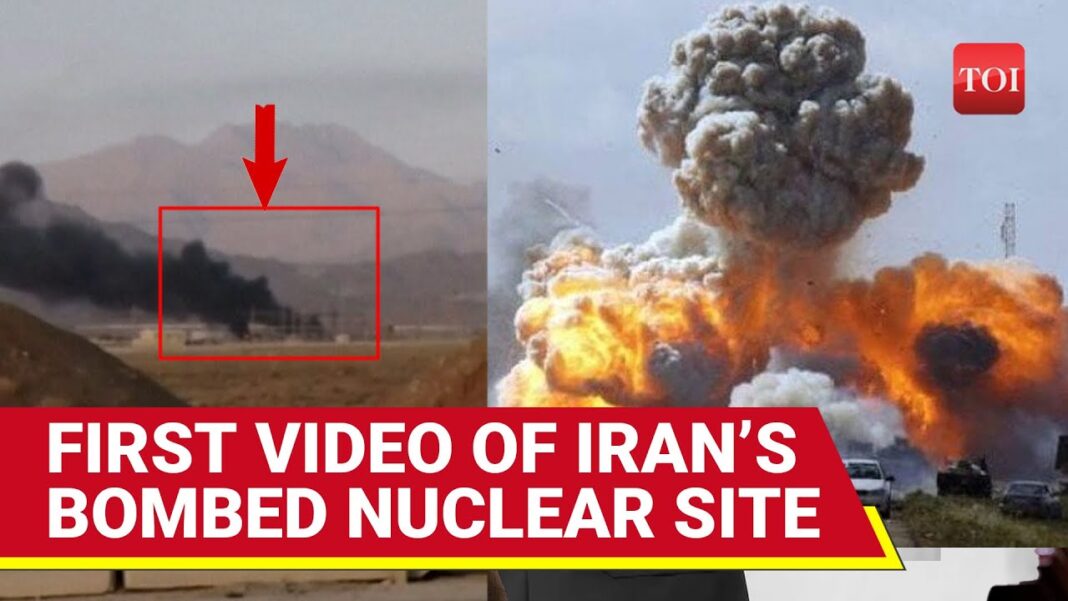
In what Prime Minister Benjamin Netanyahu called “a decisive blow” to Iran’s nuclear ambitions, the Israeli Air Force has reportedly struck the highly fortified Natanz Nuclear Facility—long considered the cornerstone of Tehran’s uranium enrichment program. As first confirmed in Netanyahu’s live address Thursday night and reported by Fox News Digital, the targeted airstrike is believed to have reached the core of Iran’s most sensitive and protected nuclear infrastructure.
“This is a critical moment not only for Israel’s security but for the global effort to stop nuclear proliferation in the hands of terrorists,” Netanyahu declared. “We struck at the heart of Iran’s nuclear enrichment program. We struck at the heart of Iran’s nuclear weaponization program. We targeted Iran’s main enrichment facility in Natanz. We targeted Iran’s leading nuclear scientists working on the Iranian bomb.”
According to the information provided in the Fox News Digital report, the Natanz complex—widely understood to be operating in tandem with Iran’s Fordow Fuel Enrichment Plant—has the capacity to generate enough highly enriched uranium to build up to 11 nuclear warheads within a matter of weeks. Intelligence sources believe that Iran already possesses enough enriched uranium for nine atomic bombs. The question of “breakout time”—how quickly Iran could assemble a functional nuclear weapon—has thus moved from theoretical concern to immediate strategic threat.
Located about 200 miles south of Tehran, the Natanz facility has long been regarded as the centerpiece of Iran’s nuclear ambitions. It has survived cyberattacks, sabotage operations, and previous airstrikes—most notably in 2020, when an explosion partially destroyed surface-level structures. But as Fox News Digital and nuclear watchdog sources have reported, Iran responded by reinforcing the facility through the construction of deep subterranean tunnels meant to shield enrichment activities from aerial and cyber intrusion.
While the extent of the damage from Thursday night’s strikes remains under evaluation, military analysts cited by Fox News Digital suggest that the scale and precision of the operation reflect Israel’s determination to significantly degrade Iran’s ability to enrich uranium to weapons-grade levels. It remains unclear whether the newly fortified underground bunkers were penetrated, but Netanyahu’s unusually explicit remarks signal confidence in the strike’s impact.
Netanyahu’s speech, delivered against a backdrop of rising regional tensions, emphasized the urgency of Israel’s actions. “Iran is taking steps it has never taken before,” he warned. “If not stopped, Iran could produce a nuclear weapon in a very short time.”
The prime minister framed the strike not merely as an act of national defense but as a necessary measure to prevent nuclear terrorism. “We will not let the world’s most dangerous regime get the world’s most dangerous weapons,” Netanyahu said. “Iran plans to give those weapons—nuclear weapons—to its terrorist proxies. That would make the nightmare of nuclear terrorism all too real.”
According to the information contained in the Fox News Digital report, Israeli intelligence has long assessed that Iran intended to eventually export nuclear capabilities to non-state actors such as Hezbollah in Lebanon or militias in Iraq and Syria. Netanyahu underlined this concern in his address, stating that the growing range of Iran’s ballistic missiles makes a future nuclear exchange not only plausible but imminent—threatening not just Israel but European and American cities as well.
Despite Israel’s emphasis on strategic precision, Iran’s Supreme Leader Ayatollah Ali Khamenei and various IRGC-affiliated media outlets have claimed that the strikes hit residential zones and civilian infrastructure—an accusation that Israel flatly denies. The Fox News Digital report emphasized that these allegations remain unverified, with the IDF maintaining that all targets were selected strictly on the basis of high-value intelligence linking them to Iran’s nuclear and military-industrial complex.
In addition to Natanz, The New York Times and Fox News Digital reported that the Parchin military complex was also targeted—although Fox News noted it could not independently verify the strike. Parchin has previously housed research programs tied to warhead development and has been subject to multiple Israeli attacks, including one last October. Five other military bases near Tehran were also reportedly hit in the operation now known as “Operation Rising Lion.”
In response, Iranian authorities closed national airspace and placed their air defense systems on high alert. Israel, meanwhile, canceled all outgoing and incoming flights at Ben Gurion Airport. Defense Minister Yoav Gallant issued orders for a full nationwide emergency posture, preparing for a possible wave of ballistic missile and drone retaliations from Iranian soil or its regional proxies.
The international community has reacted with measured concern. While Israel has emphasized that the operation was conducted unilaterally, Secretary of State Marco Rubio issued a statement acknowledging the Israeli strike. “We are not involved in strikes against Iran and our top priority is protecting American forces in the region,” he stated. “Iran should not target U.S. interests or personnel.”
For now, there appears to be broad bipartisan consensus in Washington recognizing Israel’s right to self-defense against existential threats.
Israel’s decision to strike Natanz represents a high-stakes gamble aimed at decisively shifting the balance of power in the region. It marks a return to the Begin Doctrine—a national policy that asserts Israel will not tolerate the emergence of nuclear weapons in hostile states.
As Fox News Digital emphasized in its report, this moment could mark either the apex of Israeli deterrence or the opening salvo in a broader conflict. While Netanyahu has framed the strikes as a protective necessity, Iran’s forthcoming response—military, diplomatic, or both—will determine whether the region edges closer to confrontation or recalibrates toward renewed, if fragile, deterrence.
In the words of Netanyahu: “This operation will continue for as long as necessary. We have reached the moment when doing nothing is not an option.” The Natanz facility may now lie in ruins, but the political and military consequences of its destruction are only just beginning.
