



|
Getting your Trinity Audio player ready...
|
By: Fern Sidman
The massacre that unfolded on Sydney’s iconic Bondi Beach on the first night of Hanukkah has sent shockwaves far beyond Australia’s shores, forcing a renewed reckoning with the evolving threat of Islamist extremism, the limits of intelligence assessments, and the unsettling ease with which radical ideology can metastasize in plain sight. As details continue to emerge, Australian authorities now say the father-and-son team responsible for the bloodshed were “driven by Islamic State ideology,” a conclusion underscored by evidence uncovered in the days following the attack.
According to a report on Tuesday at CNN, the two suspects—50-year-old Sajid Akram and his 24-year-old son, Naveed Akram—targeted Jewish Australians gathered to celebrate the first night of Hanukkah, killing 15 people and wounding dozens more in what officials describe as the country’s worst mass shooting in nearly three decades. Sajid Akram was killed during a firefight with police, while Naveed Akram remains hospitalized under police guard and is expected to face a litany of serious terrorism-related charges.
What distinguishes the Bondi Beach massacre from other lone-actor attacks is not only its staggering human toll, but the emerging picture of deliberate ideological motivation, overseas travel to extremist hotbeds, and the unsettling reality that the younger suspect had previously been assessed by Australia’s domestic intelligence services and deemed not to pose a threat. CNN has been at the forefront of detailing how these elements converged with catastrophic consequences.
Australian officials have been unequivocal in their assessment that the attack was antisemitic in nature. The victims were Jewish families and community members gathered in a public space to observe Hanukkah, a festival that symbolizes perseverance in the face of persecution. Prime Minister Anthony Albanese, speaking to public broadcaster ABC and quoted by CNN, said the shooting was inspired by extremist Islamic State ideology and constituted an act of terrorism.
“Antisemitism, of course, has been around for a very long period of time,” Albanese said, according to the CNN report. “Islamic State is an ideology that, tragically, over the last decade, particularly since 2015, has led to a radicalization of some people to this extreme position, and it is a hateful action.”
The attack has intensified fears within Australia’s Jewish community and prompted urgent questions about whether warning signs were missed, particularly given the suspects’ prior interactions with authorities and their recent overseas travel.
CNN reported that Sajid Akram, a licensed firearms owner and fruit shop operator, immigrated to Australia in 1998 on a student visa before later transitioning to a partner visa. His son, Naveed Akram, was born in Australia and worked as a bricklayer. The family lived in the western Sydney suburb of Bonnyrigg, where police raided a home linked to the pair in the aftermath of the attack.
While the image of a father and son carrying out a mass killing has shocked the public, counterterrorism officials believe the duo acted alone and were not part of a broader operational cell—an assessment that may help explain how they evaded detection. As the CNN report noted, Albanese told ABC that the lack of an identifiable network made it more difficult for intelligence agencies to track the pair’s evolving radicalization.
Yet the absence of a larger cell does little to mitigate the gravity of the ideological commitment allegedly driving the attackers.
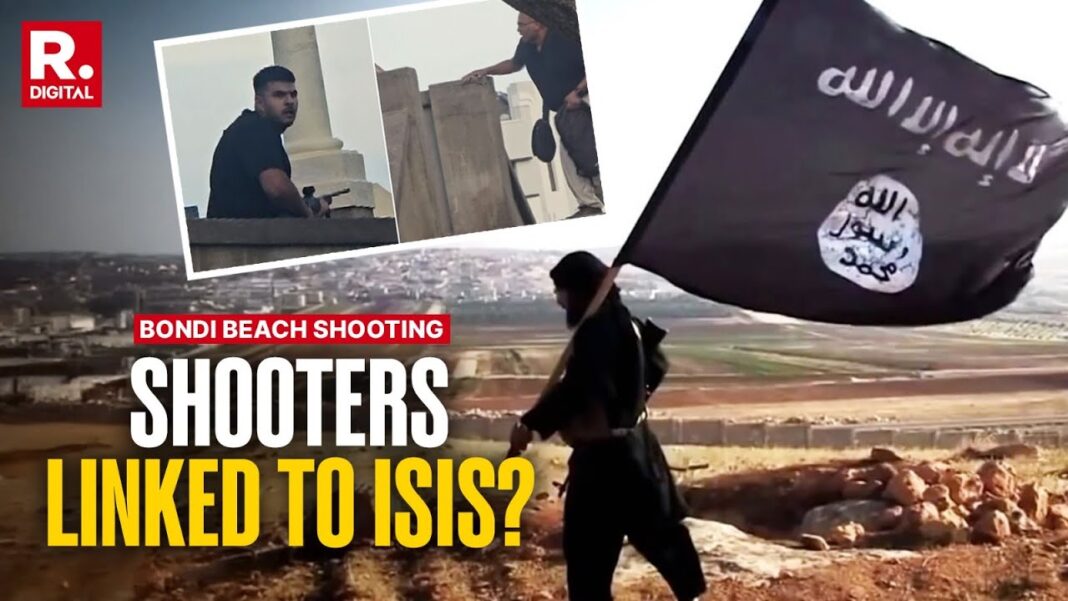
Among the most damning pieces of evidence cited by authorities, and detailed in the CNN report, were items discovered in a vehicle registered to Naveed Akram. Police found two homemade Islamic State flags—symbols that Australian officials say directly link the attack to ISIS-inspired extremism. Additionally, improvised explosive devices were recovered, raising fears that the death toll could have been even higher.
“These flags show that the radical perversion of Islam is absolutely a problem,” Albanese said, according to the CNN report, emphasizing that the ideology motivating the attackers is a global phenomenon rather than an isolated domestic issue.
The discovery of ISIS symbols has underscored the ideological clarity of the perpetrators’ motivations, rebutting early speculation that the attack might have been driven by personal grievance or mental instability alone.
One of the most disturbing aspects of the Bondi Beach massacre is the revelation that Naveed Akram had previously been investigated by the Australian Security Intelligence Organisation (ASIO). In 2019, ASIO monitored the younger Akram for six months due to his associations with two individuals who were later imprisoned on terrorism-related charges.
That investigation ultimately concluded there was no evidence Naveed had been radicalized at the time, and he was not placed under ongoing surveillance once the probe ended. Sajid Akram was also interviewed during that period and similarly showed no outward signs of extremism, Albanese said.
Authorities are now scrambling to determine whether Naveed Akram was radicalized in the years following that assessment—a question that has ignited fierce debate about the adequacy of current counterterrorism frameworks. CNN reported that Albanese has stressed there is no indication of an intelligence failure, but critics argue that the case illustrates the inherent difficulty of predicting ideological evolution, particularly when individuals radicalize quietly and without online bravado.
A crucial new dimension to the investigation emerged when authorities confirmed that the Akrams had traveled to the southern Philippines just weeks before the attack. CNN reported that Philippine immigration officials confirmed the pair arrived together on November 1, 2025, listing Davao—a major city on the island of Mindanao—as their destination. They departed the country from Manila on November 28.
Mindanao has long been a locus of Islamist insurgency and terrorism. It is home to groups such as Abu Sayyaf and the Maute group, which have pledged allegiance to the Islamic State and carried out attacks against civilians and government forces. In 2017, those groups captured the city of Marawi in a siege that displaced more than 350,000 residents and required months of military operations to resolve.
Australian counterterrorism officials believe the Akrams may have undergone military-style training during their time in the Philippines, a claim first reported by ABC and corroborated in CNN’s coverage. While police have not confirmed whether the pair had direct contact with extremist groups, ASIO has previously warned that the Philippines remains a hotspot for Islamic State East Asia (ISEA), an ISIS offshoot.
“ISEA remains a deadly terrorist threat in the Philippines,” ASIO states on its website, language cited in the CNN report. “While there are no known links between ISEA and Australia, there have previously been links between Australians and terrorist groups in the Philippines.”
Another deeply unsettling element of the case is Sajid Akram’s legal access to firearms. Police seized six guns owned by the elder Akram, who held a recreational hunting license. According to New South Wales Police Commissioner Mal Lanyon, Sajid Akram met all eligibility criteria for gun ownership under Australian law.
His initial application for a firearms license in 2015 lapsed due to incomplete documentation, but a subsequent application in 2020 was approved, and the license was issued in 2023. The weapons seized were all registered appropriately, Lanyon said.
Footage verified by CNN shows Naveed Akram firing a bolt-action rifle from a pedestrian bridge overlooking Bondi Beach, discharging four rounds in just over five seconds. The proficiency displayed has fueled concerns that the suspects received training beyond casual recreational shooting—concerns that now intersect ominously with their recent travel to Mindanao.
In the wake of the attack, Muslim leaders have moved swiftly to condemn the violence and distance their faith from extremist interpretations. Sheikh Adam Ismail, an imam who provided Quran lessons to Naveed Akram in 2019, told CNN he was horrified by the events.
“I condemn this act of violence without any hesitation,” Sheikh Ismail said in a video message shared with CNN. “Not everyone who recites the Quran understands it or lives by its teachings, and sadly, this appears to be the case here.”
Ismail said Naveed Akram had approached the Al Murad Institute seeking lessons in Quran recitation and Arabic and continued his studies for about a year. There were no indications at the time, he said, that the young man harbored extremist beliefs.
As Australia mourns the victims of the Bondi Beach massacre, the attack has laid bare the persistent and evolving threat posed by Islamist extremism, even in countries with robust gun laws and sophisticated intelligence services. CNN’s reporting has painted a sobering portrait of how ideology, opportunity, and missed warning signs can converge with devastating speed.
The massacre has also reignited debates about antisemitism, community protection, and the global reach of extremist movements. For many Jewish Australians, the attack represents not only a personal tragedy but a chilling reminder that hatred rooted in distant conflicts and ideologies can erupt violently at home.
As investigators continue to piece together the final days and motivations of Sajid and Naveed Akram, one conclusion already appears inescapable: the Bondi Beach massacre was not an isolated spasm of violence, but part of a broader global pattern in which Islamic State ideology continues to inspire acts of terror long after the group’s territorial defeat.
In chronicling this tragedy, CNN has underscored the central challenge confronting modern democracies: how to detect and disrupt radicalization that unfolds quietly, across borders, and within families—before ideology once again translates into mass murder on a public shore.