



|
Getting your Trinity Audio player ready...
|
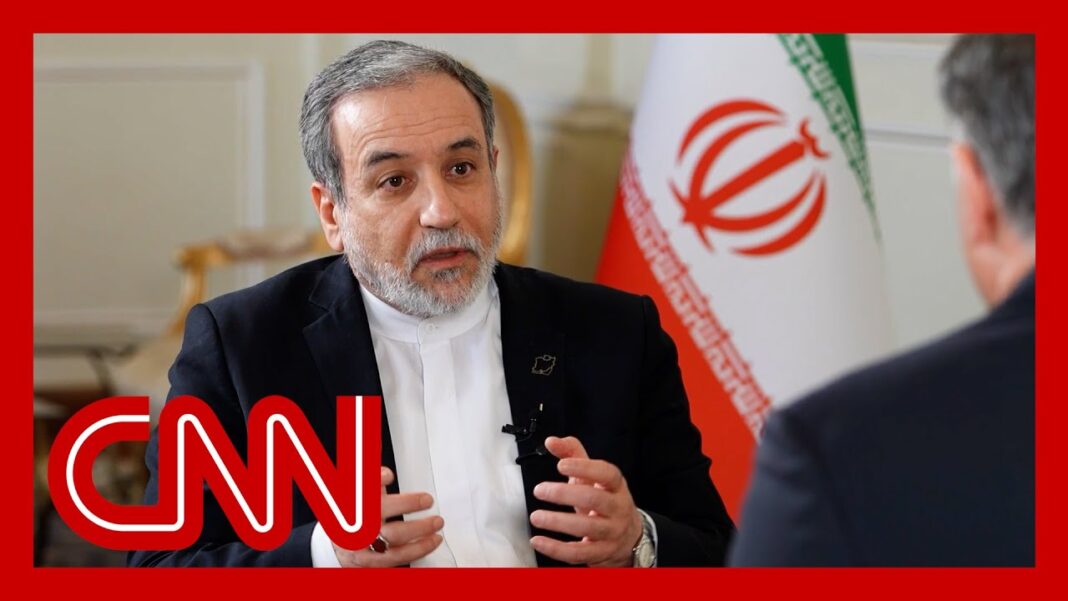
Iran’s Top Diplomat Blasts Adelson-Backed Paper Over Alleged Secret Executions
By: Fern Sidman
In a moment that crystallized the increasingly caustic rhetoric surrounding Iran’s fraught relationship with the United States and Israel, Iran’s foreign minister, Abbas Araghchi, publicly lashed out this week at American billionaire Miriam Adelson, accusing her media empire of advancing what he described as a politically motivated narrative designed to inflame tensions on the eve of a pivotal diplomatic encounter. The episode, reported on Wednesday by VIN News, underscores how the battle over Iran’s international image is now being waged not only in negotiating rooms and security councils, but also across the global information battlefield, where narratives are sharpened into instruments of strategic pressure.
Araghchi’s remarks were directed at a report published by Israel Hayom, the widely circulated Israeli daily owned by Adelson, which alleged that Tehran had covertly carried out mass executions despite assurances to the contrary made during back-channel communications. According to the foreign minister, such claims were not merely erroneous but deliberately constructed to erode trust between Washington and Tehran at a delicate juncture, as Israeli Prime Minister Benjamin Netanyahu prepared for a high-profile visit to the White House. The VIN News report noted that Araghchi’s unusually pointed language reflected not only irritation with the substance of the claims, but also an acute awareness of the political influence wielded by Adelson within Republican circles and the broader pro-Israel policy ecosystem in the United States.
In a social media post that rapidly reverberated across diplomatic and media circles, Araghchi questioned the motives behind what he termed “dramatic claims” about Iran’s conduct. He implied that Israel Hayom functions as a mouthpiece for Adelson’s political worldview, suggesting that its reporting on Iran cannot be disentangled from her well-documented ideological commitments. “Whenever Miriam Adelson’s outlet advances sensational allegations about Iran,” Araghchi wrote, according to excerpts circulated by VIN News, “it is worth asking who stands to gain from such a narrative.” The insinuation was unmistakable: that the portrayal of Iran as duplicitous and bloodthirsty serves strategic agendas aimed at hardening U.S. policy against Tehran.
The Iranian foreign minister went further, attaching a screenshot of the Israel Hayom article to his post and categorically denying its central claim. He asserted that no executions had been carried out in the period in question and that no court proceedings leading to capital punishment had been finalized. In what he framed as evidence of Iran’s supposed restraint, Araghchi added that more than two thousand prisoners had recently been pardoned. While independent verification of such figures remains elusive, the assertion was clearly intended to counter the narrative of clandestine brutality that the Israeli newspaper had advanced. Iranian officials quickly amplified Araghchi’s comments through state-affiliated channels, transforming a single post into a coordinated rebuttal of the allegations.
This rhetorical clash cannot be divorced from the broader geopolitical context in which it unfolded. Relations between Tehran and Washington remain deeply strained, defined by protracted disputes over Iran’s nuclear ambitions, its ballistic missile program, and its support for armed proxy groups across the Middle East. Against this backdrop, any suggestion that Iran is engaging in secret executions, particularly after purported assurances to the contrary, feeds into a longstanding Western perception of the Islamic Republic as a state that negotiates in bad faith. The VIN News report observed that such portrayals resonate strongly within segments of the U.S. political establishment that are predisposed to skepticism toward diplomatic engagement with Tehran.
Adelson’s prominence adds a further layer of complexity to the dispute. As one of the most influential donors in American conservative politics and a steadfast supporter of President Donald Trump, she is widely regarded as a consequential voice in shaping discourse on Israel and Middle Eastern policy. Her ownership of Israel Hayom has long been a subject of debate within Israel itself, where critics argue that the newspaper’s editorial line has often mirrored the positions of right-leaning political leaders. VIN News has previously chronicled how Adelson’s media and philanthropic ventures have positioned her as a formidable force in transnational political conversations, making her an attractive target for Tehran’s rhetorical counteroffensives.
The timing of Araghchi’s remarks was particularly striking. They came just days before Netanyahu’s anticipated meetings in Washington, which are expected to focus heavily on Iran’s nuclear file and the contours of any future diplomatic or coercive strategy. By challenging the credibility of Israel Hayom’s reporting, Tehran appeared to be attempting to blunt what it perceives as a coordinated effort to shape the narrative environment surrounding those talks. Iranian officials fear that stories alleging secret executions could be marshaled as evidence of Tehran’s duplicity, thereby stiffening U.S. resolve to pursue harsher measures rather than renewed negotiations.
At the same time, the exchange reveals how deeply media narratives have become entangled with the machinery of diplomacy. In an era of instantaneous communication, allegations published in a prominent newspaper can ricochet across social platforms and policy circles within hours, acquiring a momentum that formal diplomatic channels may struggle to counter. Araghchi’s decision to respond publicly, rather than through traditional diplomatic protest, reflects an acknowledgment that reputational battles are increasingly fought in the open arena of global media. The VIN News report emphasized that this trend poses profound challenges for diplomats, who must now contend not only with their counterparts across the negotiating table but also with the relentless churn of public opinion shaped by headlines and viral posts.
The Iranian foreign minister’s invocation of Adelson’s “primary loyalties,” a phrase he attributed to comments previously made by President Trump, introduced yet another layer of provocation. By framing the dispute in terms of alleged dual allegiances, Araghchi touched on a sensitive theme that has long animated political controversies in the United States, particularly in debates over foreign influence and lobbying. Such rhetoric is likely to be interpreted by some American observers as an attempt to delegitimize pro-Israel advocacy by casting it as fundamentally at odds with U.S. national interests. Whether intentional or not, the remark risked further inflaming an already polarized discourse.
From Tehran’s perspective, however, the stakes are existential. Iranian officials have repeatedly argued that their country is subjected to a relentless campaign of misrepresentation designed to justify sanctions, isolation, and, potentially, military action. The claim that Iran secretly carried out executions after promising not to do so fits neatly into this narrative of bad faith, reinforcing the image of a regime that cannot be trusted. By forcefully rejecting the allegation, Araghchi sought to reclaim a measure of narrative control, presenting Iran as a state unjustly maligned by hostile actors. Such defensive postures are a recurring feature of Iranian diplomacy, particularly when international scrutiny intensifies.
Yet the episode also highlights the limitations of Tehran’s communicative strategy. While Araghchi’s rebuttal may resonate with domestic audiences and sympathetic international observers, it is unlikely to sway critics who already view Iranian official statements with skepticism. The absence of independent verification for the claims regarding pardons and the non-occurrence of executions leaves ample room for doubt, particularly among human rights advocates who have documented Iran’s extensive use of capital punishment in previous years. In the absence of transparent data and access for international monitors, Iran’s denials may struggle to overcome the weight of its own historical record.
For Adelson and her media enterprise, the confrontation may have the paradoxical effect of amplifying the very allegations that Tehran seeks to suppress. The public spat draws renewed attention to Israel Hayom’s reporting and situates it within a broader geopolitical drama, ensuring that the claims circulate far beyond the newspaper’s traditional readership. VIN News reported that the controversy has already sparked vigorous debate across social media, with commentators parsing the motivations of both Tehran and Adelson’s media outlets, and questioning the reliability of competing narratives.
Ultimately, the episode serves as a vivid illustration of how contemporary geopolitics unfolds across overlapping domains of diplomacy, media, and personal influence. The clash between Araghchi and Adelson’s newspaper is not merely a dispute over the veracity of a single report; it is a microcosm of the broader struggle to define Iran’s image at a moment when the contours of U.S.–Iran relations remain uncertain. As the VIN News report underscored, the outcome of such narrative contests can have tangible consequences, shaping public opinion, influencing policymakers, and constraining the range of options available to leaders on both sides of the negotiating table.
As Washington and Tehran continue to navigate their uneasy standoff, the war of words unleashed this week is unlikely to be the last. In a geopolitical environment saturated with competing claims and counterclaims, each side seeks not only strategic advantage but moral vindication. The exchange between Iran’s foreign minister and a prominent American media proprietor thus stands as a reminder that, in the modern era, the struggle for influence is waged as fiercely in the realm of perception as it is in the corridors of power.

G_d Bless Miriam Adelson.