



|
Getting your Trinity Audio player ready...
|
Iran’s Supreme Leader Briefs Putin on US Nuclear Negotiations as Talks Continue
Edited by: Fern Sidman
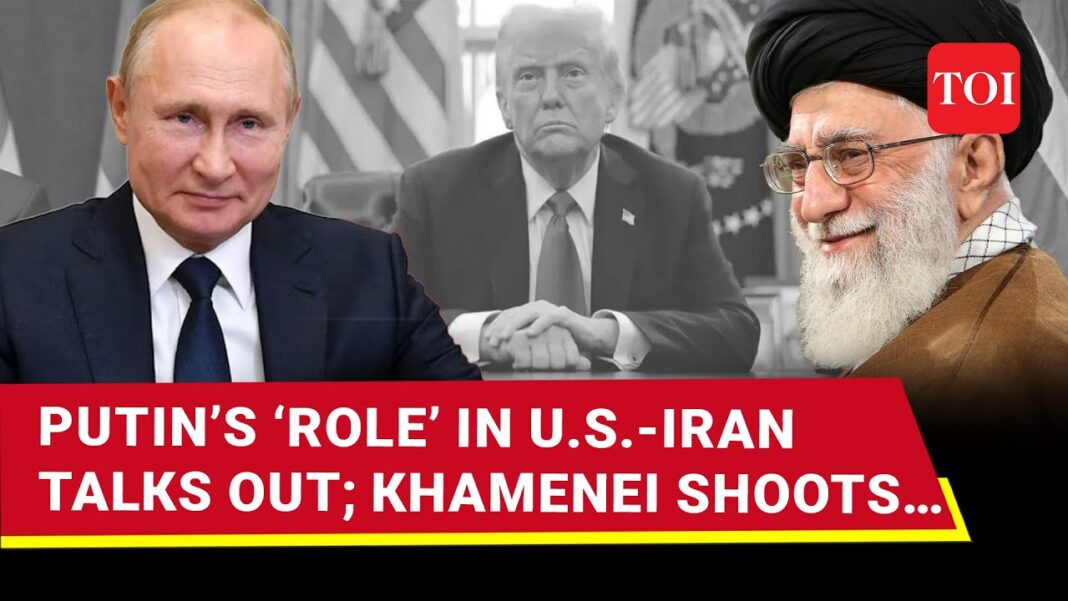
In a significant diplomatic development closely tracked by The Algemeiner, Iran’s Supreme Leader Ayatollah Ali Khamenei has sent a letter to Russian President Vladimir Putin regarding ongoing nuclear negotiations between Tehran and Washington. The communication marks an important step in the complex diplomatic dance surrounding Iran’s controversial nuclear program.
According to a report that appeared on Thursday in The Algemeiner, Khamenei dispatched his top diplomat, Foreign Minister Abbas Araghchi, to Moscow on Thursday. During this high-level visit, Araghchi met with both Putin and Russian Foreign Minister Sergey Lavrov to deliver Khamenei’s letter personally. The Algemeiner report noted that their discussions encompassed Iran’s nuclear program, recent US-Iran negotiations in Oman, bilateral cooperation expansion efforts, and regional developments.
This Moscow meeting, as highlighted in The Algemeiner report, comes at a particularly critical juncture—just days before Tehran and Washington are scheduled to enter a second round of talks in Rome this weekend.
Since returning to office in January 2025, President Trump has reinstated his “maximum pressure” campaign against Iran. As The Algemeiner reported, this strategy aims to eliminate Iran’s crude exports and prevent the country from obtaining nuclear weapons capabilities.
Despite this pressure, Tehran has maintained its position that the right to enrich uranium is non-negotiable, refusing to halt its enrichment program. The Algemeiner report indicated that tensions escalated significantly last month when President Trump threatened military action against Iran and secondary tariffs if an agreement to restrict its nuclear ambitions isn’t reached.
The Algemeiner’s coverage emphasized Russia’s increasingly important role in these negotiations. Moscow has firmly stated that any military strike against Iran would be “illegal and unacceptable,” positioning itself as a key ally to Tehran. As The Algemeiner report noted, Russia’s status as both a veto-wielding UN Security Council member and a signatory to the now-defunct 2015 nuclear deal gives it significant leverage in the ongoing diplomatic efforts.
“The Russian Federation remains ready to do everything within our capabilities to contribute to the settlement of the situation by political and diplomatic means,” Kremlin spokesman Dmitry Peskov said in a statement reported by The Algemeiner.
The Algemeiner’s reporting provided important context on the history of US-Iran nuclear diplomacy. During his first term, Trump withdrew the United States from the 2015 Joint Comprehensive Plan of Action (JCPOA), which had temporarily limited Tehran’s nuclear activities in exchange for economic sanctions relief.
“Regarding the nuclear issue, we always had close consultations with our friends China and Russia. Now it is a good opportunity to do so with Russian officials,” Araghchi told Iranian state media before his Moscow meeting, as reported by The Algemeiner.
In a notable development tracked by The Algemeiner, US special envoy Steve Witkoff recently clarified the American position, stating that any deal with Iran must require the complete dismantling of its “nuclear enrichment and weaponization program.” This represents a reversal from earlier comments indicating the White House might allow Iran to enrich uranium to a 3.67 percent threshold for a “civil nuclear program.”
The International Atomic Energy Agency (IAEA) issued a stern warning regarding the Islamic Republic’s accelerating uranium enrichment activities. As reported by The Algemeiner, the Vienna-based nuclear watchdog revealed that Tehran is now enriching uranium to 60 percent purity—just shy of the 90 percent threshold required for weapons-grade fissile material.
While Iran continues to assert that its nuclear program is purely for civilian purposes, international experts and Western governments remain unconvinced. According to The Algemeiner report, the IAEA’s assessment underscores that the current stockpile of highly enriched uranium could potentially be sufficient to produce up to six nuclear bombs, should Iran decide to cross that critical line.
Western powers have responded to the IAEA’s findings with deepening concern. “There is no credible civilian justification for the scale and scope of Iran’s uranium enrichment activities,” a Western diplomat told The Algemeiner, echoing fears that Iran is edging ever closer to possessing a rapid breakout capability—the ability to produce a nuclear weapon within a very short timeframe.
This latest development adds urgency to already fragile negotiations aimed at curbing Tehran’s nuclear program. Iran’s insistence that its efforts are purely peaceful is increasingly being challenged not only by the U.S. and Europe but also by nonproliferation experts who view the technical capabilities being developed as unambiguously military in nature.
At the same time that Iran’s nuclear program is escalating, its strategic partnership with Russia is deepening. In a major development highlighted by The Algemeiner, the Russian Federation’s upper house of parliament ratified a sweeping 20-year strategic cooperation treaty with the Islamic Republic earlier this week.
Originally signed in January by President Vladimir Putin and Iranian President Masoud Pezeshkian, the agreement encompasses a broad array of collaborative ventures in the realms of military training, counterterrorism, security cooperation, warship visits, and intelligence sharing. According to Iran’s Ambassador to Moscow, Kazem Jalali, the treaty marks a “historic achievement” in bilateral relations and is designed to push back against what he termed the “deep wounds inflicted by the West’s unrestrained unilateralism,” The Algemeiner reported.
One of the agreement’s key provisions includes a pledge by both nations not to allow their territory to be used for military operations that threaten the other. While this does not constitute a full mutual defense treaty, such as the one Russia recently entered into with North Korea, it significantly elevates the strategic alignment between Moscow and Tehran.
The strengthening alliance with Russia comes as Iran grapples with mounting U.S. sanctions, particularly targeting its lucrative oil sector. These sanctions, designed to cripple Iran’s economic backbone and deter its nuclear progress, have pushed Tehran further into the arms of alternative powers such as Russia and China.
As The Algemeiner report noted, Iran’s observer status in the Eurasian Economic Union (EAEU) and its pending free trade agreement with the bloc represent another pillar of its eastward economic pivot. When the agreement goes into effect next month, over 80 percent of traded goods between Iran and the EAEU’s member states—Russia, Armenia, Belarus, Kazakhstan, and Kyrgyzstan—will be exempt from customs tariffs. This economic lifeline could provide Tehran with the resilience needed to weather future sanctions while expanding its regional influence.
Moreover, the Iran-Russia treaty also promises increased cooperation in arms control and “peaceful” nuclear energy. Critics argue that such vague terms often mask more nefarious undertakings, particularly as Russia continues to supply Iran with dual-use technology that can have both civilian and military applications.
The developments reported by The Algemeiner present a troubling convergence: Iran’s nearing weapons-grade enrichment capability on one hand, and its increasing military and economic integration with Russia on the other. This dynamic threatens not only the stability of the Middle East but also global nonproliferation norms, especially as traditional Western leverage over Iran continues to erode.
The possibility that Iran could leverage its enriched uranium stockpile into an actual nuclear arsenal is no longer a theoretical concern but a mounting reality. With the support of a powerful geopolitical patron in Moscow, Tehran may be emboldened to resist international pressure and accelerate its nuclear timetable.
The Algemeiner report revealed a critical inflection point in the standoff over Iran’s nuclear future. The fusion of Iranian ambition and Russian partnership presents a multifaceted challenge that will require urgent, coordinated responses from the international community—not only to prevent nuclear proliferation but to maintain the fragile balance of power across the Middle East and beyond.
