



|
Getting your Trinity Audio player ready...
|
By: Fern Sidman
A darkening storm is gathering over the Middle East, and according to a report on Wednesday at Israel National News, the epicenter of the coming turbulence is Tehran itself. In an unusually stark and openly bellicose statement released Tuesday, Iran’s newly established Defense Council warned that the Islamic Republic may launch preemptive strikes against its enemies if it discerns what it deems to be “objective signs of threat.” The declaration comes at a moment when Iran is simultaneously grappling with mounting internal rebellion, intensifying military drills, and increasingly explicit warnings from Israel and the United States.
As Israel National News has emphasized in its ongoing coverage, the tone and timing of the Defense Council’s pronouncement are unlike anything heard in recent years, suggesting a regime that feels cornered, vulnerable, and perhaps desperate.
The Defense Council was created in the aftermath of last summer’s devastating 12-day war with Israel, a conflict that exposed alarming vulnerabilities in Iran’s military posture. Its statement this week reads like a manifesto of defiance, insisting that Iran’s “security, independence and territorial integrity are an uncrossable red line,” and that any aggression would be met with a response described—tellingly—twice as “decisive.”
But the most ominous clause was its assertion that Tehran no longer confines itself to reacting after the fact. Instead, it now considers “objective signs of threat” as grounds for immediate action. As Israel National News analysts have pointed out, this is a doctrinal shift: Iran is no longer merely threatening retaliation—it is laying the rhetorical groundwork for preemption.
Such language, in a region where miscalculation can trigger war, is nothing short of combustible.
Only a day before the Defense Council’s warning, Israeli Prime Minister Benjamin Netanyahu addressed the Knesset in remarks that the Israel National News report described as among the most unequivocal of his tenure. Responding to a petition from opposition lawmakers, Netanyahu made clear that Israel has delivered a blunt message to Tehran.
“If Israel is attacked,” he declared, “the consequences will be severe.”
Netanyahu revealed that he and President Donald Trump are aligned in a strategic compact to prevent Iran from rebuilding its ballistic missile infrastructure or reconstituting its nuclear program. “Trump and I will not allow Iran to restore its ballistic missile industry and nuclear program,” Netanyahu said, a formulation repeatedly highlighted by Israel National News as an unmistakable red line.
This public convergence between Jerusalem and Washington is particularly significant. In previous crises, Tehran could exploit perceived rifts between Israel and its allies. Now, according to the report at Israel National News, that room for maneuver appears to be rapidly disappearing.
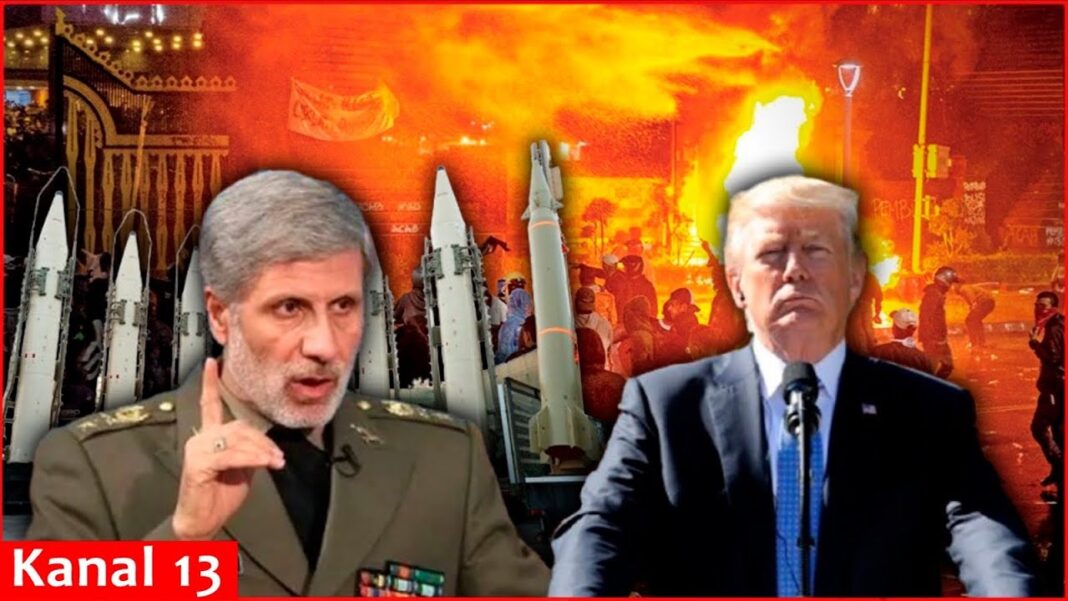
The Defense Council’s statement did not emerge in a vacuum. Iranian state television reported Sunday night that the Islamic Revolutionary Guards Corps had launched large-scale military exercises involving missile launches and air-defense tests across multiple cities, including Tehran and Shiraz.
Two weeks earlier, Axios journalist Barak Ravid reported that Israeli officials had warned the Trump administration that such drills might serve as preparations for an actual strike on Israel. A day before that, Iran International cited Western intelligence sources describing “unusual aerial activity” by the IRGC Aerospace Force.
Israel National News has pieced these signals together into a disturbing mosaic: a regime that is both posturing militarily and shoring up its domestic defenses, bracing for a moment it fears is approaching.
And while missiles streak across the Iranian sky, the ground beneath the regime is rumbling.
Over the past 24 hours alone, large-scale demonstrations have erupted across Tehran and several provinces. Thousands gathered in southern Tehran, chanting slogans denouncing senior clerics, Islamist militias, and the ruling elite. Protesters adopted language recently used by Elon Musk in condemning the regime, labeling Supreme Leader Ayatollah Ali Khamenei a “murderer.” One protester in central Tehran hung a handmade sign reading “President Trump Street”—a symbolic slap in the face of the Islamic Republic.
According to Iranian opposition sources cited in the Israel National News report, unrest spread well beyond the capital. In Abdanan, in Ilam Province, police were reportedly seen siding with demonstrators—an act that would have been unthinkable just a few years ago. In Kermanshah, crowds torched government buildings, while the municipal headquarters in Pardis, near Karaj, was also set ablaze.
Chants calling for the return of the monarchy echoed through the streets. “This is the final battle,” demonstrators shouted, invoking the legacy of the Pahlavi dynasty and openly rejecting the Islamic Republic.
Israel National News observers have described these scenes as the most openly revolutionary since the 1979 uprising—except this time, the anger is directed squarely at the clerical establishment itself.
What makes this moment so perilous is the convergence of three destabilizing forces: external military brinkmanship, internal revolt, and a leadership that increasingly frames compromise as betrayal.
The Defense Council’s language about “dismembering our beloved Iran” reflects a regime narrative that sees every protest, every Western statement, and every Israeli warning as part of a single conspiracy. Yet as the Israel National News report indicated, it is precisely this paranoia that may drive Tehran toward the very preemptive strike it now threatens.
Netanyahu’s comments suggest Israel is preparing for that possibility. His assertion that Israel “identifies with the struggle of the Iranian people” is not merely rhetorical; it signals that Jerusalem views Iran’s internal unrest as strategically significant. If the regime lashes out in desperation, Israel is making clear it will respond with overwhelming force.
The Defense Council concluded its statement by warning that Iran’s enemies are pursuing a “targeted approach” to undermine its identity and integrity. But the Israel National News report suggests a far simpler explanation: the regime is confronting the accumulated consequences of decades of repression, corruption, and militarism.
In Tehran’s streets, the chants for monarchy are not expressions of nostalgia so much as indictments of failure. In Abdanan, where police reportedly stood with protesters, the fear that once paralyzed society is beginning to erode.
And yet, paradoxically, this internal fragility may make Iran more dangerous, not less. History is replete with regimes that, facing collapse, chose war over reform.
For Israel, the calculus is stark. As Netanyahu told the Knesset, any Iranian attempt to rebuild its missile or nuclear programs will be met with decisive action. For Washington, the alignment with Jerusalem is now explicit. And for Tehran, boxed in by sanctions, unrest, and strategic isolation, the Defense Council’s words sound less like deterrence and more like a prelude.
As Israel National News continues to document, the Middle East is entering a phase where the margin for error is vanishingly small. A single misread signal—an exercise mistaken for an attack, a protest suppressed too violently, a preemptive strike launched too soon—could ignite a regional inferno.
The signs are everywhere: missiles in Shiraz, flames in Kermanshah, chants in Tehran, warnings in Jerusalem.
Iran’s rulers insist that their red lines are inviolable. Israel insists the same. Between them stands a restless population and a world watching nervously as history accelerates once more.