



|
Getting your Trinity Audio player ready...
|
Iran’s Campuses Erupt in Nationwide Student Protests as Clashes Break Out
By: Fern Sidman
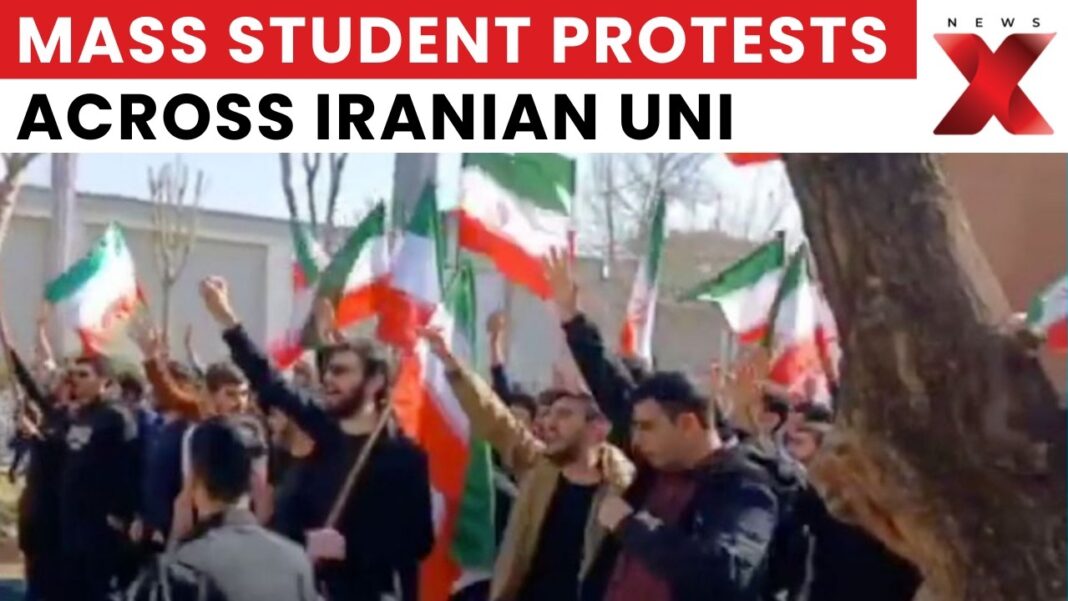
The great courtyards and lecture halls of Iran’s most storied universities, long cultivated by the state as sanctuaries of managed dissent and carefully circumscribed debate, were on Saturday transformed into arenas of mourning, defiance, and raw confrontation. As students gathered to mark the fortieth day of mourning for those killed in last month’s brutal crackdown, campuses across the country once again became crucibles of political struggle, where grief fused with fury and remembrance hardened into resistance.
According to Iranian and diaspora media, as well as footage verified by AFP, confrontations unfolded in Tehran and Mashhad between protesters, regime supporters, and security forces. World Israel News, citing these streams of reporting and verified visual evidence, described in a report on Sunday a nationwide tremor that ran through Iran’s academic heartlands, underscoring how the regime’s efforts to pacify universities have failed to extinguish the spirit of dissent that continues to animate them.
At Tehran’s principal engineering university, video geolocated by AFP captured the claustrophobic density of crowds pressed into narrow corridors and courtyards, where chants of “bi sharaf”—the Farsi epithet for “disgraceful”—rose in waves. The term, hurled at regime enforcers and loyalists alike, carried the weight of moral indictment rather than mere insult. World Israel News reported that the scene, with its heaving mass of students and the visible presence of security elements, embodied a stark tableau: the collision of a generation’s aspirations with the state’s apparatus of control. The atmosphere was not that of a conventional protest but of a collective catharsis, where mourning rituals traditionally meant to soothe communal pain were instead repurposed as instruments of political mobilization.
Elsewhere in the capital, Sharif University of Technology, long regarded as a jewel in Iran’s scientific crown, became a focal point of dissent. Footage aired by the dissident broadcaster Iran International showed large gatherings of students chanting slogans directed squarely at the clerical leadership.
The World Israel News report, referencing these images, noted the audacity of the slogans, which pierced the aura of inviolability surrounding the supreme leadership. Students reportedly confronted members of the Basij paramilitary force, an auxiliary arm of the state that has been instrumental in suppressing unrest, shouting “death” to Supreme Leader Ayatollah Ali Khamenei while invoking the specter of Iran’s pre-1979 monarchy with cries of “long live the king.” In the charged lexicon of Iranian politics, such slogans constitute more than provocation; they signal a rupture with the ideological foundations of the Islamic Republic and a willingness to articulate tabooed alternatives to the existing order.
The contagion of unrest did not confine itself to Sharif. At Amirkabir University of Technology, similar chants echoed through the campus, as reported by Iran International and relayed by World Israel News. Later, a student union statement cited by the outlet alleged that security forces blocked campus exits and detained students, converting academic spaces into sites of de facto confinement. The image of universities—institutions ostensibly devoted to intellectual freedom—being encircled and sealed by security forces resonated powerfully in the narratives circulated by World Israel News, reinforcing the perception of a state that views its own educated youth less as citizens to be engaged than as threats to be contained.
State-aligned media, however, offered a counter-narrative that sought to domesticate the unrest within the language of order and decorum. The Fars news agency characterized the events as a planned “silent and peaceful sit-in” to commemorate students killed last month, disrupted by anti-regime chanting. Footage published by Fars depicted two opposing groups facing one another, some waving Iranian flags while others wore masks, with men in suits attempting to keep them apart.
Both sides appeared to hold memorial photographs, a visual symmetry that suggested a struggle not merely over political power but over the ownership of grief itself. World Israel News highlighted the symbolic potency of these images: mourning had become a contested terrain, with the state striving to channel sorrow into ritualized, non-threatening forms, while protesters insisted on translating grief into an indictment of the regime.
The administration of Sharif University itself entered the fray rhetorically. Iran International quoted the university’s president, Masoud Tajrishi, as calling for a firm response to the unrest. “The enemy wants the university to become virtual, but we will not allow it,” he declared, adding that illegal acts on campus would be met with decisive measures. The World Israel News report interpreted these remarks as emblematic of the broader institutional posture adopted by university authorities, who, caught between student bodies seething with anger and a state demanding compliance, have increasingly echoed the language of securitization. The invocation of an unnamed “enemy” serves to externalize dissent, framing domestic protest as the handiwork of hostile forces rather than the organic expression of internal discontent.
Beyond Tehran, the tremors of protest rippled through other academic centers. At Beheshti University in the capital, students staged a sit-in in solidarity with those killed or imprisoned during the crackdown, according to a student union statement cited by Iran International. In Mashhad, footage showed students at the University of Medical Sciences chanting “freedom,” a word whose simplicity belies its incendiary resonance in a political system that has long sought to circumscribe its meaning. The World Israel News report emphasized that the geographical spread of these demonstrations underscores a structural reality: dissent is no longer an episodic flare-up confined to a handful of elite campuses but a recurring phenomenon embedded within the country’s educational landscape.
Hovering over these scenes of unrest is a fog of contested casualty figures that speaks volumes about the epistemic fractures within Iranian society. The US-based Human Rights Activists News Agency has recorded more than 7,000 killings during the crackdown that peaked on January 8 and 9, while Iran International has put the figure at more than 36,000. Iranian authorities, for their part, acknowledge more than 3,000 deaths, attributing the violence to what they term “terrorist acts.”
World Israel News, frequently citing these divergent claims, has called attention to how the struggle over numbers is itself a struggle over narrative authority. Each tally carries with it an implicit moral and political verdict, shaping domestic and international perceptions of the state’s conduct. In the absence of transparent, independent investigations, the true scale of the bloodshed remains obscured, but the magnitude of the discrepancy alone testifies to the depth of mistrust that now characterizes the relationship between the regime and significant segments of the population.
President Masoud Pezeshkian’s televised address on Saturday sought to situate the unrest within a familiar repertoire of defiance against external pressure. “World powers are lining up to force us to bow our heads… but we will not bow our heads despite all the problems that they are creating for us,” he declared. World Israel News reported the speech as emblematic of the regime’s enduring rhetorical strategy: to recast internal dissent as the byproduct of foreign machinations and to frame resistance to protest as a patriotic duty. Yet the scenes unfolding on university campuses suggest a more complex reality, one in which the language of sovereignty and resistance rings hollow to students who perceive their grievances as rooted in lived experience rather than imported subversion.
In the end, the renewed demonstrations on Iran’s campuses reveal a polity in which memory itself has become a site of contestation. The fortieth-day mourning ritual, traditionally a moment of communal closure, has been transfigured into a catalyst for renewed confrontation. World Israel News, by chronicling these events through the prism of multiple sources and verified footage, has illuminated the extent to which Iran’s universities have become laboratories of political transformation. Whether the regime’s formidable security apparatus can indefinitely suppress this ferment remains an open question. What is clear, however, is that the elegies recited in Iran’s courtyards are no longer mere laments for the dead; they are declarations of an unresolved struggle over the future of the republic itself.
