



|
Getting your Trinity Audio player ready...
|
By: Ariella Haviv
Iran’s clerical leadership is confronting a convergence of perils rarely seen since the earliest years of the Islamic Republic: swelling internal unrest driven by economic collapse, and the unmistakable rumble of external military pressure emanating from Washington and Jerusalem. According to a report on Sunday at Israel National News, this volatile confluence has plunged Tehran into what senior officials privately describe as a “survival phase,” a moment when the calculus of repression, deterrence, and diplomacy has narrowed to a razor’s edge.
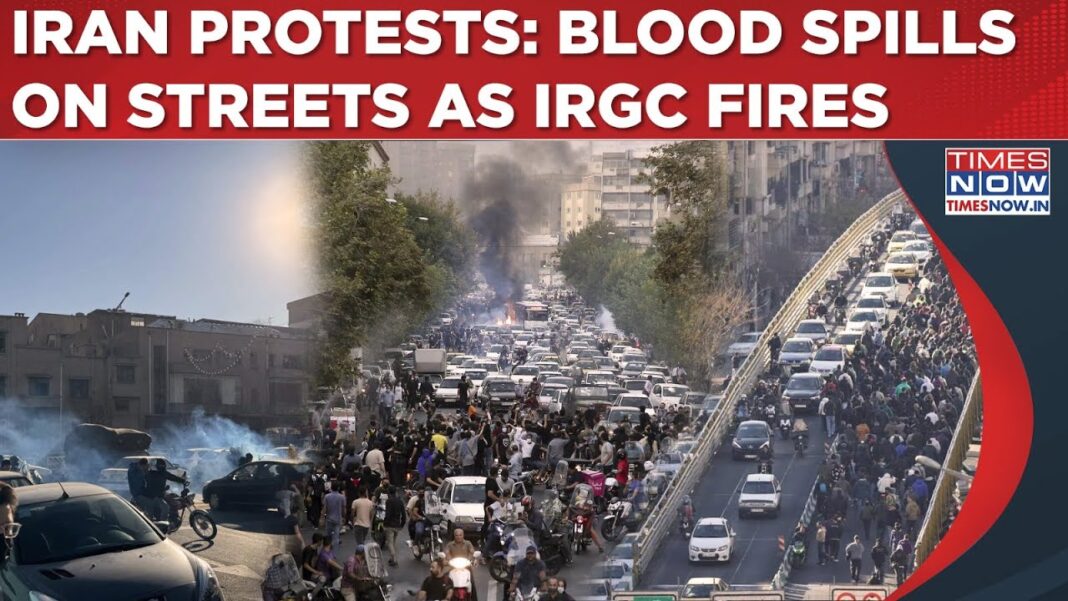
For decades, the Islamic Republic has demonstrated grim proficiency in extinguishing popular uprisings through brute force. Yet as the Israel National News report underscored, the current wave of demonstrations — now entering its second week — has unsettled the regime in ways that recall the darkest moments of 2019 and 2022, even if the present unrest has not yet reached those paroxysmal heights. What distinguishes this episode is not merely its persistence, but its timing: it is unfolding amid mounting fears in Tehran that renewed confrontation with Israel and the United States may be imminent.
The immediate catalyst for the protests is economic despair. Inflation has devoured wages, the national currency has plunged to historic lows, and basic commodities have become luxuries for millions. The New York Times, whose reporting has been relayed extensively by Israel National News, paints a portrait of a society fraying at the seams — one in which shopkeepers shutter their businesses in protest, young Iranians chant against clerical elites, and provincial cities simmer with a resentment once confined to the margins.
Yet even as the streets grow restless, Iran’s leadership finds itself geopolitically exposed. President Trump’s stark warning that the United States would intervene if Tehran killed “peaceful protesters,” declaring Washington to be “locked and loaded,” has reverberated through the Iranian political class. The Israel National News report noted that Israeli officials, too, have lent rhetorical support to the demonstrators, an extraordinary gesture that Tehran interprets as both moral encouragement and strategic signaling.
The regime’s unease has been compounded by Washington’s recent military action in Venezuela — a nation long regarded in Tehran as both ally and ideological fellow traveler. Iranian officials reportedly view the seizure of Nicolás Maduro as a chilling precedent: proof that the Trump administration is prepared to translate indictments into incursions. As Israel National News reported, this episode has become a lodestar in Tehran’s internal deliberations, stoking fears that domestic instability could embolden foreign adversaries to test Iran’s defenses.
In response, the Supreme National Security Council convened an emergency session to weigh how to contain the protests while preparing for possible escalation abroad. Officials quoted by the New York Times admitted that the leadership lacks a coherent strategy — either to alleviate the economic pressures driving unrest or to recalibrate its nuclear posture in a way that might defuse Israeli and American hostility. The regime’s entrenched refusal to compromise on its nuclear program has only narrowed its options.
This paralysis has been punctuated by unmistakable shows of force. Iranian state television announced that the Islamic Revolutionary Guard Corps has launched a wide-ranging military exercise involving missile launches and air-defense tests in multiple cities, including Tehran and Shiraz. Footage circulating online — and referenced in coverage by Israel National News — appears to show projectiles arcing over western Tehran, a display intended as both domestic reassurance and international deterrence.
The timing is hardly coincidental. Two weeks earlier, Barak Ravid of Axios reported that Israeli officials had warned Washington that similar IRGC exercises could mask preparations for an attack on Israel. Iran International soon followed with reports from Western intelligence sources describing “unusual aerial activity” by the Guards’ Aerospace Force. As the Israel National News report emphasized, these developments are being read in Jerusalem not as routine maneuvers but as part of a familiar pattern of brinkmanship.
Against this backdrop, President Trump’s remarks during his recent meeting with Prime Minister Benjamin Netanyahu in Florida have taken on new gravity. “If Iran is trying to build up again, we’re going to knock them down,” Trump said — language that the Israel National News report described as the clearest endorsement yet of preemptive action should Tehran persist with its nuclear and ballistic ambitions. When asked whether he would support an Israeli strike in the absence of a deal, Trump answered with an unambiguous “yes.”
For Iran’s rulers, the implications are stark. The regime is squeezed between an enraged populace and a hostile international environment that no longer appears content with rhetorical condemnation. Analysts cited by the New York Times warn that this compression of pressures has left Tehran with few viable pathways. Escalated repression risks provoking the very intervention Trump has threatened. Concessions on the nuclear file could unravel decades of ideological investment and expose internal fractures within the clerical elite.
The Israel National News report observed that the Islamic Republic’s habitual response to crisis — the calibrated use of violence — is now freighted with unprecedented risk. In previous uprisings, the leadership could calculate that mass arrests and lethal force would eventually restore quiescence. Today, however, every casualty reverberates beyond Iran’s borders, scrutinized by adversaries who openly weigh the merits of intervention.
This confluence of domestic fragility and external menace has ushered in what Iranian officials themselves describe as a survival phase. It is a period defined less by grand strategy than by improvisation, as Tehran oscillates between displays of military resolve and halting gestures toward restraint. Whether this balancing act can be sustained remains doubtful. As the Israel National News report indicated, the regime’s predicament is not simply that it faces protests or threats in isolation, but that these pressures are reinforcing one another, compressing the space in which Iran’s rulers can maneuver.
In the end, the Islamic Republic’s greatest vulnerability may not lie in the chants echoing through its bazaars or the missiles streaking across its skies, but in the erosion of its aura of inevitability. A government that once seemed unassailable now grapples openly with the specter of collapse — uncertain whether its next move will quell rebellion, invite reprisal, or hasten the reckoning it has spent decades deferring.