



|
Getting your Trinity Audio player ready...
|
By: Tzirel Rosenblatt
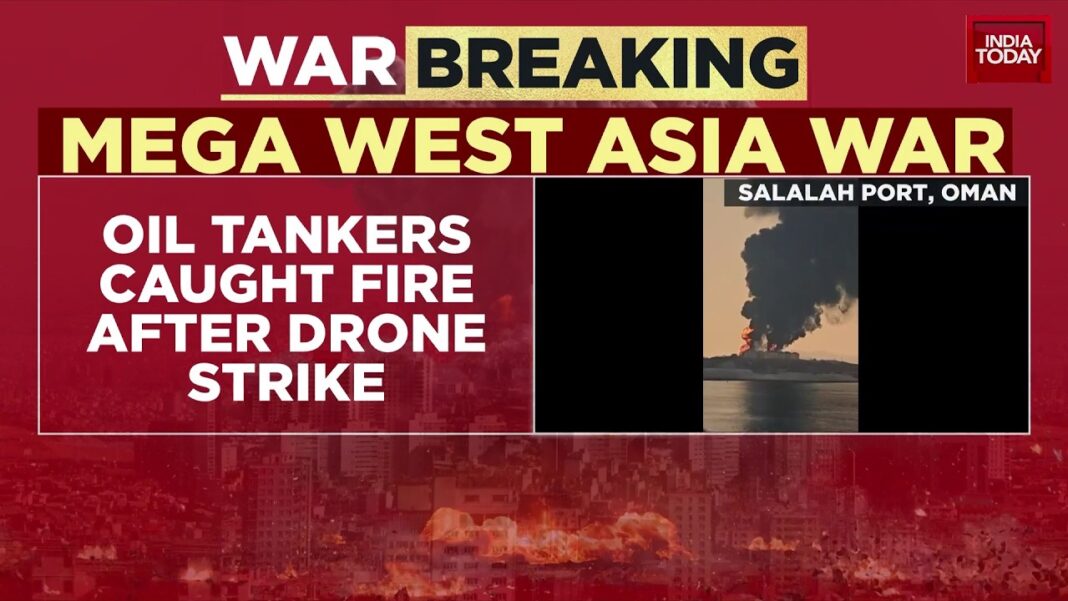
The widening conflict between Iran, the United States, and Israel has begun to cast an increasingly dangerous shadow over the broader Middle East, with the latest escalation unfolding along the strategic coastline of Oman. In a dramatic development that underscores the growing reach of the conflict, a series of drones struck fuel storage facilities at the port of Salalah on Wednesday, damaging critical infrastructure and raising alarm throughout the region’s energy and security sectors.
According to a report on Wednesday morning by Shafaq News, multiple unmanned aerial vehicles believed to be launched by Iranian forces penetrated airspace near the Omani port, reaching fuel storage tanks and causing significant structural damage. While the attack did not result in any reported casualties, the scale of the damage and the symbolic importance of the target have amplified concerns about the vulnerability of energy infrastructure across the Gulf.
Oman’s state news agency confirmed the attack, citing a security source who stated that several drones successfully reached the fuel tanks before striking the storage facilities. According to the same source, the attack caused extensive destruction within the storage area, though emergency services and port officials were able to prevent a wider disaster. The absence of injuries was described as fortunate given the potentially catastrophic consequences that could have followed if the flames had spread to adjacent fuel reserves.
Coverage from Shafaq News emphasized that the port of Salalah represents one of the most strategically important maritime facilities in the Arabian Peninsula. Located along the Arabian Sea, the port serves as a key hub for shipping, logistics, and energy storage. It lies outside the narrow Strait of Hormuz but remains closely tied to the broader network of trade routes linking Gulf oil producers to international markets.
Security analysts cited by Shafaq News have suggested that the attack reflects a deliberate attempt to broaden the battlefield beyond Iran itself, targeting infrastructure that underpins regional energy flows. By striking a major storage facility in Oman—historically one of the Gulf’s more neutral diplomatic actors—the perpetrators may have intended to send a message about the vulnerability of critical supply chains.
The drone strike occurred against the backdrop of intensifying military activity across the Gulf region. Earlier the same day, air defense systems in several neighboring countries were activated as authorities scrambled to intercept aerial threats believed to be connected to the broader conflict.
According to reports cited by Shafaq News, Qatar’s air defense forces intercepted multiple aerial targets over the capital city of Doha. Although officials did not specify the precise nature of the threats, regional media indicated that the objects were likely drones similar to those deployed in the attack on Salalah.
Meanwhile, Saudi Arabia’s Ministry of Defense announced that its air defense units had successfully shot down several drones flying over the vast Empty Quarter desert, one of the most sparsely populated yet strategically sensitive areas of the kingdom. The Empty Quarter—known in Arabic as Rub’ al Khali—spans parts of Saudi Arabia, Oman, the United Arab Emirates, and Yemen, making it a critical corridor for both military operations and energy infrastructure.
Kuwait also reported defensive actions on Wednesday. The country’s National Guard confirmed that it intercepted eight drones over areas described as “under its protection,” a phrase widely interpreted as referring to sensitive government installations and strategic facilities.
Taken together, the incidents illustrate how rapidly the war is expanding geographically. What began as a direct confrontation involving Iran, the United States, and Israel has increasingly drawn neighboring states into the orbit of the conflict, forcing them to activate defensive systems and heighten security measures.
Experts note that the proliferation of drone technology has dramatically altered the dynamics of modern warfare in the Middle East. Compared to conventional missiles or aircraft, drones are relatively inexpensive to manufacture and can be deployed in large numbers. Their ability to fly at low altitudes and evade radar detection makes them particularly difficult to intercept, especially when launched in coordinated swarms.
The attack on Salalah also highlights the vulnerability of energy infrastructure in the Gulf region. Fuel storage tanks, pipelines, and export terminals represent tempting targets for actors seeking to disrupt global oil supplies or generate economic pressure on rival states.
Although the damage at the Omani port appears to have been contained, analysts cited by Shafaq News warn that similar strikes on larger facilities could have far-reaching consequences for global energy markets. The Gulf remains the primary source of crude oil exports for much of the world, and disruptions in the region can quickly reverberate through international markets.
Omani authorities have not yet released detailed information about the extent of the damage or how long it may take to restore normal operations at the affected storage facilities. Emergency crews reportedly worked throughout the day to secure the site and prevent further explosions.
The government has also intensified security measures around other ports and energy installations as a precaution.
For Oman, the attack represents a particularly troubling development. The sultanate has historically positioned itself as a mediator in regional disputes, maintaining diplomatic relations with a wide range of actors across the Middle East. Being drawn into the orbit of the current conflict threatens that carefully balanced posture.
As the war enters its second week, the drone strike on Salalah serves as a stark reminder that the conflict’s consequences are spreading far beyond the original battlegrounds. From Qatar to Saudi Arabia and Kuwait, air defenses are now on high alert, and the specter of further attacks looms over some of the world’s most vital energy corridors.
For governments across the Gulf, the message delivered by Wednesday’s events is unmistakable: the war’s front lines are expanding, and the region’s infrastructure—and stability—are increasingly at risk.
