



|
Getting your Trinity Audio player ready...
|
By: Fern Sidman- Jewish Voice News
In a sweeping rebuke to Iran’s campaign of transnational repression, two men convicted of attempting to assassinate exiled Iranian journalist and women’s rights activist Masih Alinejad on U.S. soil were each sentenced to 25 years in federal prison on Wednesday, marking one of the most consequential counterterrorism verdicts of the year. The sentencing, which took place in a Manhattan federal courtroom, concluded a case that ABC News described as “a chilling reminder of Tehran’s long reach — and America’s growing resolve to confront it.”
The defendants, Rafat Amirov and Polad Omarov, were found guilty in March by a federal jury of murder-for-hire and attempted murder in aid of racketeering, after prosecutors presented extensive evidence linking the pair to a plot orchestrated by Iran’s Islamic Revolutionary Guard Corps (IRGC). According to the report on Wednesday at ABC News, the men were promised $500,000 in exchange for carrying out the killing of Alinejad, one of the Iranian regime’s most prominent critics and a global symbol of resistance to Tehran’s repression of women.
“This case stands as a warning to every dictatorship that believes it can export its violence to American soil,” ABC News quoted a senior Justice Department official as saying following the verdict. “Those who target dissidents, journalists, or activists in the United States will face the full force of American justice.”
For years, Alinejad has been a thorn in the side of Iran’s clerical establishment. A former journalist for state television who fled Iran in 2009, she became one of the most recognized voices of the “My Stealthy Freedom” campaign — an online movement encouraging Iranian women to remove their compulsory hijabs. From her home in Brooklyn, Alinejad has used social media to amplify stories of defiance from inside Iran, inspiring millions and enraging officials in Tehran.
According to the ABC News report, the regime’s anger toward Alinejad reached a fever pitch after she exposed systemic human rights abuses and encouraged women to publicly protest the hijab law following the 2022 death of Mahsa Amini, whose killing in police custody ignited global outrage.
Federal prosecutors alleged that Alinejad’s activism made her a “priority target” for the IRGC, which, according to the ABC News report, has increasingly turned to criminal proxies abroad to carry out kidnappings and assassinations.
As detailed by prosecutors and reported by ABC News, the murder plot began to unfold in mid-2022 when Amirov and Omarov — both members of an Eastern European crime syndicate with connections to Iran — were approached with the $500,000 bounty. The men quickly recruited a triggerman, Khalid Mehdiyev, who traveled repeatedly from Yonkers to Alinejad’s quiet Brooklyn neighborhood to conduct surveillance.
On July 28, 2022, Mehdiyev was seen loitering outside Alinejad’s home. The ABC News report recounted that when Alinejad stepped onto her porch, Mehdiyev returned to his car to retrieve an assault rifle, but by the time he returned, she had gone inside. Alarmed by the man’s presence, Alinejad contacted the FBI and temporarily left her home for safety.
Hours later, New York City police officers stopped Mehdiyev for a traffic violation — running a stop sign while driving on a suspended license. What they found in the car stunned them: an assault rifle, 66 rounds of ammunition, gloves, a ski mask, and a stack of cash.
“The discovery of the rifle and ammunition in the vehicle — just blocks from the target’s home — prevented what could have been a devastating act of political violence,” federal agents told ABC News.
Mehdiyev was immediately arrested, and evidence from his phone linked him directly to Amirov and Omarov. Texts and encrypted messages revealed that the two men had coordinated the hit from abroad, sending instructions, payment details, and surveillance images back and forth.
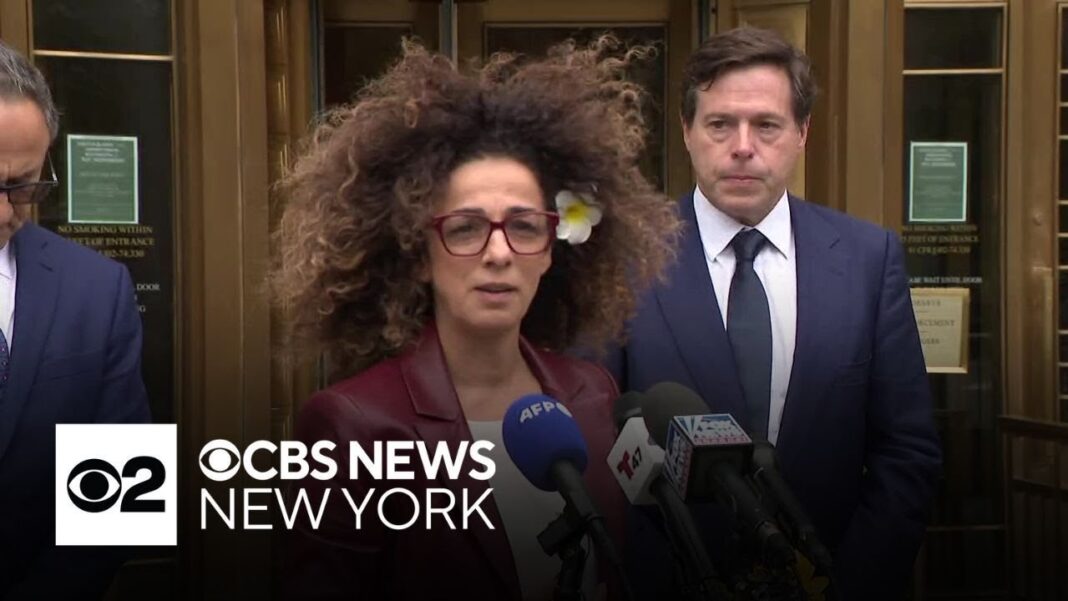
At Wednesday’s sentencing, Alinejad faced her would-be assassins directly. Dressed in red — a deliberate choice, she said, to symbolize both defiance and survival — the journalist stood before the court and delivered an emotional victim impact statement that was reported by ABC News.
“I looked these men in the eyes — men who intended to silence me for defending women’s freedom — and am still standing,” she declared. “I am alive, and I will continue to speak out for those who cannot.”
Calling the sentence a “victory for my fellow dissidents,” Alinejad thanked the FBI and federal prosecutors for their vigilance and condemned Iran’s efforts to export terror beyond its borders. “For too long, dictators have treated America as their personal playground to orchestrate transnational oppression,” she said. “It’s past time the U.S. government makes clear that U.S. residents are protected — and that if they are targeted on American soil, there will be consequences for the hitmen as well as for the regimes that sent them.”
In a video posted to social media earlier that day — and highlighted by ABC News — Alinejad announced that she was traveling with the FBI to attend the sentencing. “As you see, I’m wearing red because they were hoping to cover all over my body with blood,” she said. “I’m wearing red to celebrate my life.”
Prosecutors sought the maximum sentence of 55 years, arguing that Amirov and Omarov’s crime “was not merely an act of contract killing but an assault on the fundamental values of free expression.” Assistant U.S. Attorney Michael D. Lockard told the court that the pair had “sought to soak the Brooklyn streets with the victim’s blood” in service of a foreign authoritarian regime.
Defense attorneys, however, asked for leniency. Omarov’s lawyer argued for a sentence of no more than 10 years, while Amirov’s counsel requested 13 years, claiming their clients were manipulated by larger geopolitical forces and motivated more by financial desperation than ideology.
Judge Ronnie Abrams, presiding over the case, dismissed those arguments, stating that the defendants’ willingness to target an unarmed civilian for money “represented a profound moral collapse.” The judge imposed 25-year sentences on both men, calling the punishment a necessary deterrent against future plots.
As the ABC News report noted, the decision called attention to a broader policy stance within the Justice Department: that foreign-directed attacks on U.S. soil, regardless of whether they succeed, will be prosecuted with the same intensity as acts of terrorism.
The Alinejad case is not isolated. ABC News has previously reported that U.S. officials have disrupted multiple Iranian plots targeting journalists and dissidents, including a 2021 attempt to kidnap Alinejad and forcibly return her to Iran. In that case, four alleged Iranian intelligence operatives were indicted for conspiring to abduct her.
American and European intelligence agencies have increasingly accused Iran of waging a “shadow war” against dissidents living abroad, including targeted killings in Turkey, the Netherlands, and the United Kingdom. Analysts quoted in the ABC News report warn that Tehran’s intelligence networks frequently rely on criminal organizations to carry out such operations, allowing the regime to maintain plausible deniability while continuing its campaign of intimidation.
“The Islamic Republic views exiled activists like Masih Alinejad as existential threats,” said one counterterrorism expert interviewed by ABC News. “Their words are more powerful than weapons because they expose the regime’s hypocrisy.”
Following the sentencing, Alinejad reiterated her commitment to continuing her advocacy, telling ABC News that she refuses to live in fear. “They wanted me dead, but what they achieved is that my voice will echo even louder,” she said. “This is not just about me — it’s about every woman who dares to speak truth to power.”
The case has reignited debate in Washington over how the United States should respond to state-sponsored attempts at extraterritorial repression. Lawmakers have called for additional sanctions on the IRGC and the expansion of protection programs for dissidents residing in the U.S.
In a statement to ABC News, a senior FBI official emphasized the broader significance of the case: “This sentencing sends a clear message — no foreign government can threaten or harm people on American soil without facing consequences. The United States will defend the rights of those who come here seeking freedom.”
For Alinejad, the day’s verdict represented far more than personal vindication. As she left the courthouse flanked by federal agents, she told ABC News that she viewed the sentence as “a triumph for justice and a rebuke to fear.” Her supporters outside erupted in applause, waving Iranian flags and chanting “Women, Life, Freedom” — the slogan of the movement she helped ignite.
The 25-year sentences for Rafat Amirov and Polad Omarov mark the culmination of a case that, as ABC News reported, “symbolizes both the resilience of those who speak truth to tyranny and the continuing danger they face.”
From her Brooklyn home — once the target of an assassin’s rifle — Masih Alinejad remains undeterred. “The regime tried to silence me with fear,” she told ABC News in her final remarks. “But today, justice has spoken louder than their bullets.”
