



|
Getting your Trinity Audio player ready...
|
Jared Evan
(TJV NEWS) The escalating Middle East conflict could trigger a historic shift in the global financial system, potentially weakening the U.S. dollar’s long-standing dominance over energy markets, according to new analysis.
For decades, global demand for dollars has been anchored by the simple reality that most countries need the currency to buy oil. As Dow Jones Newswires reported, nations have traditionally accumulated dollars to pay for energy — and oil exporters, in turn, recycled those earnings into U.S. Treasurys, reinforcing the dollar’s central role in global finance.
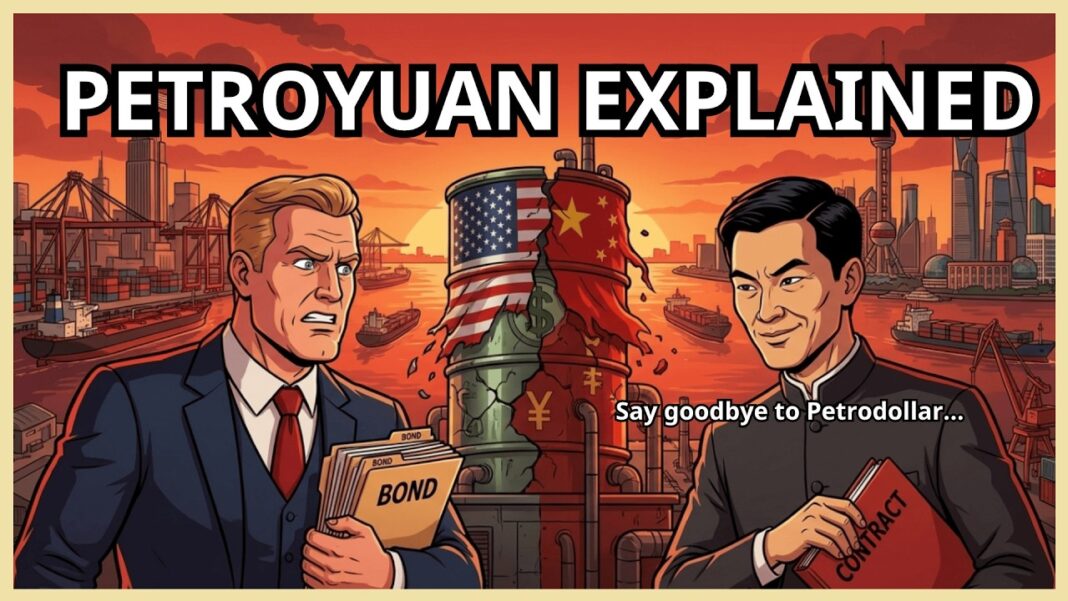
But that system — known as the “petrodollar” regime — may now be under serious threat.
As Dow Jones Newswires reported, disruptions tied to the war — particularly the effective closure of the Strait of Hormuz — could push major economies to begin trading oil in other currencies. Such a shift “could seriously undermine the dollar’s hegemony in central bank reserves and global trade.”
That warning comes from Deutsche Bank strategist Mallika Sachdeva, who described the current moment as “the perfect storm for the petrodollar” in a recent report.
As Dow Jones Newswires reported, Sachdeva argues that the dollar’s dominance in cross-border commerce is deeply tied to this system — and that those foundations may be far weaker than widely assumed. Oil, she notes, is “quoted in dollars, invoiced in dollars and settled in dollars,” a structure that dates back to a landmark 1974 agreement between the U.S. and Saudi Arabia.
Under that deal, Saudi Arabia agreed to invest its oil revenues into dollar-denominated assets — primarily U.S. Treasurys — in exchange for American security guarantees. As Dow Jones Newswires reported, this arrangement helped cement the dollar’s global role and enabled the U.S. to borrow cheaply for decades.
That advantage was famously described by former French president Valéry Giscard d’Estaing as an “exorbitant privilege.”
However, the global landscape is shifting rapidly. As Dow Jones Newswires reported, much of the Middle East’s oil now flows to Asia rather than the United States, which has become a net energy exporter itself. At the same time, sanctioned oil from Iran and Russia — accounting for roughly 13 million barrels per day, or about 14% of global consumption — has increasingly been traded “off the dollar rails,” in Sachdeva’s words.
There are also signs that key players are experimenting with alternatives. As Dow Jones Newswires reported, Saudi Arabia has explored non-dollar payment systems, including initiatives like Project mBridge, which uses central bank digital currencies. The kingdom is also selling far more oil to China than to the U.S., further shifting the balance.
The current war may accelerate those trends. Sachdeva warned that escalating conflict in the Gulf could undermine confidence in U.S. security guarantees — a cornerstone of the petrodollar system — and force countries to rethink where they store their wealth.
Recent developments suggest those changes may already be underway. As Dow Jones Newswires reported, there have been instances in which oil tankers were offered safe passage through the Strait of Hormuz if transactions were conducted in Chinese yuan instead of dollars.
“The conflict could be remembered as a key catalyst for erosion in petrodollar dominance and the beginnings of the petroyuan,” Sachdeva wrote.
Looking ahead, broader structural changes could further weaken the dollar’s grip. As Dow Jones Newswires reported, a global shift toward renewable energy, nuclear power, and domestic energy production could reduce the need for countries to hold large dollar reserves. As Sachdeva put it, “A world that becomes self-sufficient in defence and energy could also be a world that holds less dollar reserves.”
Despite these concerns, the dollar has not yet lost ground in currency markets. The U.S. Dollar Index has risen about 1% this year, though it has failed to attract its typical safe-haven demand as investors increasingly expect tighter monetary policy from other central banks, including the European Central Bank.
Still, the warning is clear: what began as a regional war could end up reshaping the foundations of global finance.
