



|
Getting your Trinity Audio player ready...
|
By: Fern Sidman – Jewish Voice News
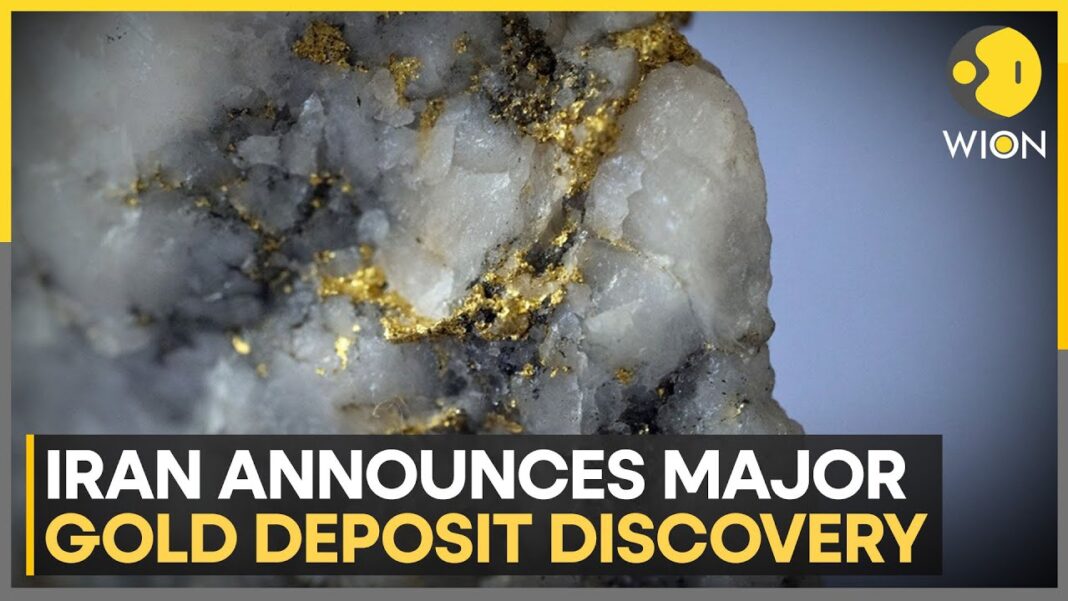
Iran has unveiled what state-linked media are calling one of the most significant mineral discoveries in years: a massive new gold-bearing vein at the Shadan gold mine in eastern South Khorasan province. The announcement, which was first reported by the government-affiliated Fars News Agency and echoed by Agence France-Presse (AFP) in a report on Monday, immediately drew attention due to the sheer scale of the deposit and the country’s increasing reliance on gold as a strategic economic buffer against international sanctions.
The new vein structure, located within one of Iran’s most prominent privately owned mining complexes, includes an estimated 7.95 million tons of oxide gold ore and an additional 53.1 million tons of sulphide gold ore, according to assessments validated by Iran’s Ministry of Industry, Mines and Trade and reported by the AFP. The oxide ore—significantly easier and more economical to extract—is particularly valuable for a nation urgently seeking to shore up its foreign exchange reserves and stabilize its deteriorating currency.
Iran has for years withheld official figures regarding its national gold reserves, but Iranian financial officials have repeatedly suggested that the Islamic Republic has substantially increased state purchases of the precious metal. In September, Central Bank governor Mohammadreza Farzin stated that Iran had become one of the top five gold-buying central banks globally in 2023–2024—a claim that AFP reported was sourced through the ISNA news agency.
The motive for the gold-buying spree is no mystery. Iranian officials, such as Central Bank strategist Yekta Ashrafi, have argued that amassing gold reserves can serve as a vital bulwark for the economy. As quoted by Iranian outlets and summarized in the AFP report, Ashrafi said that boosting Iran’s gold holdings could help “fortify national economic resilience” against the unrelenting pressure of Western sanctions.
Iran currently operates 15 active gold mines, with the largest being the Zarshouran mine in the country’s northwest, a facility frequently referenced by international economic observers and cited in multiple AFP reports as the backbone of Iran’s domestic gold production. The newly identified Shadan vein appears poised to join Zarshouran as a major node in Iran’s mining strategy.
The Shadan complex itself has long been regarded as one of the country’s most promising sites, but the new discovery—which Iranian authorities describe as “among the country’s most important”—could significantly expand the mine’s output at a moment when Iran’s leadership is emphasizing self-sufficiency and indigenous resource mobilization.
Experts believe that if the reserves are extracted efficiently, the Shadan discovery could meaningfully alter Iran’s commodity landscape, though it is too early to gauge how much will ultimately be recoverable. Nonetheless, the government’s swift confirmation of the vein’s validity demonstrates a clear desire to project strength amid ongoing economic volatility.
As the AFP has repeatedly documented, Iran’s economy remains profoundly crippled by sanctions imposed by the United States and its allies following allegations that Tehran sought to weaponize its nuclear program—accusations Iran aggressively denies. Banking restrictions, oil export limitations, and broad asset freezes have resulted in chronic inflation, widespread unemployment, and an almost perpetual devaluation of the rial, the national currency.
The economic pressure intensified in recent months following the 12-day conflict between Israel and Iran, during which the United States reportedly targeted Iranian nuclear infrastructure, according to intelligence and diplomatic assessments referenced by AFP.
This dual assault—sanctions on one side, military escalation on the other—has compounded Iran’s economic precarity. In such an environment, gold has emerged not only as a strategic reserve for policymakers but also as a lifeline for ordinary citizens.
With the rial’s purchasing power steadily evaporating, many Iranians have turned increasingly to gold as a safe haven, a trend widely documented by financial analysts and echoed across AFP reporting. In Iran’s hyperinflationary climate—where annual inflation rates routinely exceed 40 percent—gold jewelry, bullion, and coins have become essential tools for preserving wealth.
This public reliance mirrors state policy: both the Iranian people and their government appear convinced that gold offers a degree of stability even sanctions cannot corrode. The discovery at Shadan is therefore poised to resonate not only in elite political circles but also throughout Iran’s struggling middle class.
Iran’s announcement arrives at a sensitive geopolitical moment. The Middle East continues to experience volatility in the wake of the Israel–Iran conflict and broader regional tensions, while global commodity markets remain unstable. Because gold is not as easily restricted by sanctions as oil or energy exports—especially when processed domestically—Iran may see in this discovery a partial means of evading Western economic pressure.
Moreover, Tehran’s renewed focus on mining fits within a broader national strategy to diversify income sources and strengthen sectors less vulnerable to external interference. Should the Shadan reserves prove as rich as preliminary data indicates, the mine could become a central pillar in Iran’s plan to counter economic isolation.
Yet Iran did not disclose specific estimates of how much of the Shadan deposit is economically recoverable nor how soon extraction will meaningfully contribute to national reserves. Analysts note that the announcement, amplified across Iranian media and contextualized by the AFP, may serve political as well as economic purposes. Tehran’s leaders have increasingly sought to reassure the Iranian public that gains are being made domestically despite inflation, sanctions, and diplomatic isolation.
The Shadan discovery allows Iranian officials to project a measure of progress—something the government desperately needs as frustration over economic hardship deepens.
Even with the new deposit, Iran faces formidable obstacles. Extracting and refining gold requires substantial investment, much of which must be sourced domestically given the country’s limited access to foreign capital. Mining infrastructure is aging, and sanctions restrict the import of advanced extraction equipment. Environmental concerns also loom large, as intensified mining in fragile regions may spark local disputes.
And although gold is a relative safe haven, it cannot solve every structural problem facing Iran’s economy. Without relief from sanctions, the country will likely continue to struggle with inflation, capital flight, and stagnant growth.
For now, however, Tehran is celebrating. As AFP noted in its early reporting, the announcement was delivered with palpable enthusiasm, signaling Iran’s eagerness to showcase a rare economic victory. Whether the Shadan discovery becomes a transformative national asset or merely another symbol of unrealized potential remains to be seen.
What is clear is that in a nation battered by external pressure and internal economic decay, the discovery of millions of tons of gold-bearing ore offers a glimmer of optimism—a reminder that even under the weight of sanctions and conflict, Iran’s mineral wealth and resourcefulness still hold strategic significance.