



|
Getting your Trinity Audio player ready...
|
By: Fern Sidman
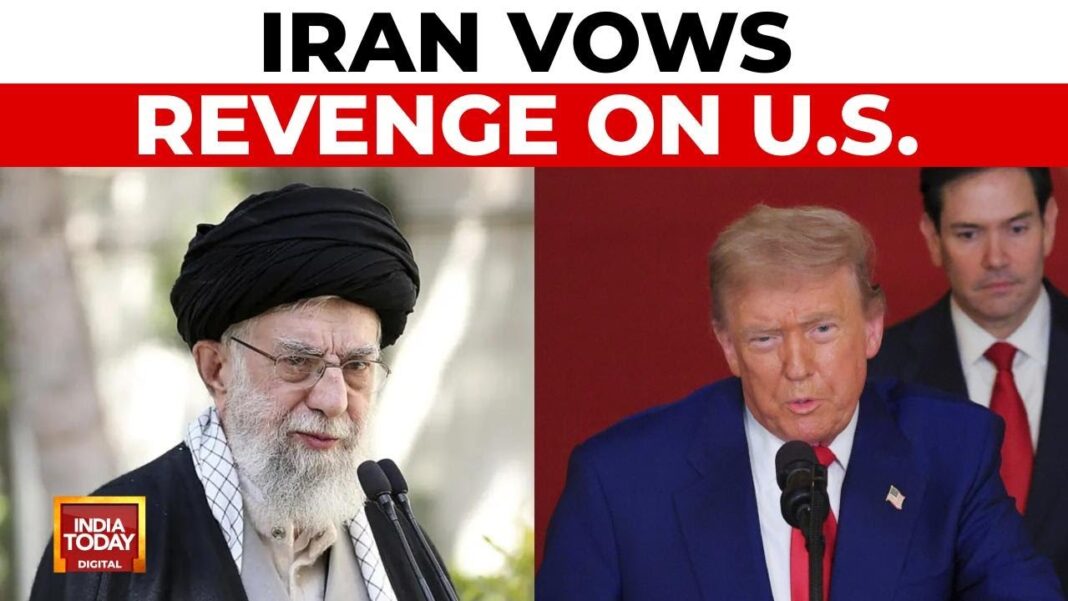
In the immediate aftermath of President Donald J. Trump’s confirmed military strikes on three of Iran’s most guarded nuclear facilities, the Islamic Republic has issued a chilling threat: retaliation not only through regional proxies, but directly within the borders of the United States.
According to a report published by NBC News and further analyzed by The Jerusalem Post, Iranian representatives allegedly warned President Trump at the recent G7 summit that any offensive action on its nuclear infrastructure would be met with asymmetric reprisals. The report, citing two high-level sources, claims Iran threatened to activate so-called “sleeper cells” embedded within the U.S.—a threat that has drastically elevated security alerts across multiple federal agencies.
The threat appears to have been delivered personally and deliberately, indicating a calculated escalation by Tehran in the face of what it now considers a broadening war. The Jerusalem Post, which has been closely tracking developments between the two adversaries, emphasized that this is among the most explicit warnings issued by Iran toward the U.S. homeland in recent years.
President Trump confirmed Saturday evening that the United States had carried out successful airstrikes on Iran’s nuclear installations at Fordow, Natanz, and Isfahan. These sites, long suspected by Western intelligence to be integral to Iran’s covert weapons program, were described by Trump as having been “completely and totally obliterated.”
The airstrikes, which were executed with the assistance of Israeli intelligence and coordinated regional surveillance assets, reportedly caused catastrophic damage to Iran’s nuclear enrichment capabilities. The Jerusalem Post quoted unnamed Israeli defense officials calling the mission “a historic blow to Tehran’s strategic depth.”
Speaking Sunday, Trump defended the action as a “decisive and necessary measure to protect American lives, Israeli sovereignty, and global security from the threat of a nuclear-armed Iran.” Yet the military success has done little to quell growing concerns about possible retaliatory measures.
The gravity of Iran’s threat has not gone unnoticed by U.S. officials. Homeland Security Secretary Kristi Noem issued a National Terrorism Advisory System (NTAS) Bulletin late Sunday evening, warning of a “heightened threat environment” in the wake of the strikes.
“There are currently no specific, credible threats,” Noem clarified during a national address, “but the seriousness of the warning delivered to President Trump at the G7 summit requires heightened vigilance across all levels of security.”
The Jerusalem Post cited senior counterterrorism sources who confirmed that federal law enforcement agencies, including the FBI and the Department of Homeland Security (DHS), are actively reviewing intelligence for signs of sleeper cell activation. “We are aware of chatter, but no operational plans have been detected,” one official told the Post, “Still, we’re treating this with the utmost seriousness.”
The NTAS bulletin urged vigilance not only regarding potential terror attacks, but also cyber intrusions and antisemitic hate crimes, which the DHS believes could escalate in response to the ongoing Israel-Iran conflict. “Cyberattacks on American infrastructure and online incitement are likely tools of retaliation,” Noem added.
In a televised address aired across Iranian state media and later re-broadcast by outlets including The Jerusalem Post, Brig. Gen. Ebrahim Zolfaqari, a spokesperson for Iran’s armed forces, promised sweeping retaliation.
“Mr. Trump, the gambler,” Zolfaqari declared in English, “you may start this war, but we will be the ones to end it.” He warned that American cities, military sites, and “even cultural symbols of the United States” could now be considered legitimate targets by Iran and its allies.
Zolfaqari’s language, reminiscent of past Revolutionary Guard threats, underscores the Islamic Republic’s pivot toward global asymmetrical warfare, especially if it feels cornered by superior conventional forces.
As The New York Times reported Sunday, U.S. bases in Iraq and Syria—home to several thousand American troops supporting regional stabilization efforts—could also be in the crosshairs. Iranian-backed militias, including Kata’ib Hezbollah and Harakat al-Nujaba, reportedly discussed retaliatory attacks but had not yet acted as of Monday morning.
The Jerusalem Post independently verified those claims through IDF and Western defense officials monitoring communications in the region. According to one source cited by the paper, Iran may be holding back temporarily in hopes of a coordinated response across multiple fronts, including Lebanon, Yemen, and cyberspace.
Iraqi government officials, meanwhile, are reportedly engaged in urgent efforts to prevent Iranian-linked militias from escalating hostilities. A U.S. defense official quoted by The New York Times stated that Baghdad has asked Washington for deconfliction protocols to avoid a broader regional war.
Though many in Washington have praised Trump’s decision as a strong show of leadership—particularly among GOP lawmakers who have roundly endorsed the strike as a reassertion of American deterrence—the possibility of attacks on U.S. soil has added a new layer of complexity.
The Jerusalem Post report noted that this is not the first time Tehran has hinted at the existence of operatives on American soil. In 2011, U.S. intelligence officials thwarted an Iranian plot to assassinate the Saudi ambassador in Washington. More recently, Iranian proxies have been linked to assassination attempts against former U.S. officials.
Security experts, including former DHS advisor Matthew Levitt, told the Post that sleeper cell activation would represent a “monumental escalation” and a shift from Iran’s typical proxy-based operations. “If confirmed, this would be the first time Iran openly threatens to deploy assets within the U.S. as a counter-strike strategy,” Levitt warned.
Meanwhile, the U.S. State Department has issued a global advisory urging American citizens overseas to exercise caution and avoid large public gatherings, especially near diplomatic missions and U.S.-branded locations.
As tensions mount and Iran weighs its next move, American officials are bracing for a wide spectrum of retaliatory behavior—from cyberwarfare and terror plots to regional assaults on allied assets. What remains uncertain is whether Tehran is truly prepared to ignite a direct conflict with the United States or if its threats are calibrated bluffs aimed at extracting political concessions.
Still, as The Jerusalem Post noted in its latest editorial, “The language coming out of Tehran is unusually sharp, the warnings uncommonly specific. In this precarious moment, vigilance is not just prudent—it is imperative.”
Whether this marks the next stage in a shadow war that has long defined U.S.-Iran relations or the beginning of open hostilities may depend less on the intentions of either capital—and more on the actions of individuals buried within operational cells or perched on digital networks, waiting for the signal to act.

Steven Miller is lying when he claims that Trump’s handling of this matter has been “flawless“. It in fact has been FLAWED since Trump got ahead of himself and failed to assure that Iran did not under everyone’s noses spirit away 650 kg of highly enriched uranium. Then, his behavior has been a temper tantrum, including against Israel, when Iran humiliated him.