



|
Getting your Trinity Audio player ready...
|
Edited by: TJVNews.com
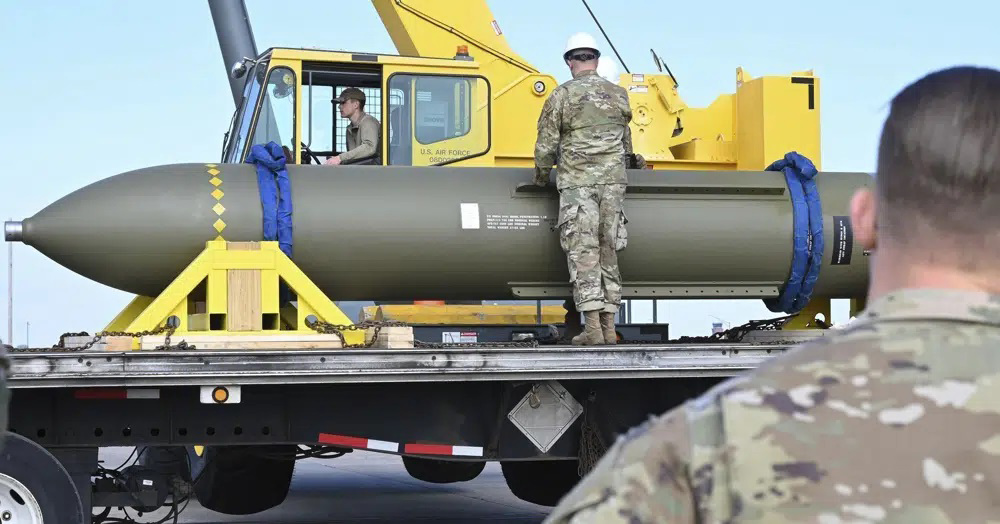
As tensions with Iran have escalated over its nuclear program, the US military this month posted pictures of a powerful bomb designed to penetrate deep into the earth and destroy underground facilities that could be used to enrich uranium, the Associated Press reported.
The US Air Force on May 2 released rare images of the weapon, the GBU-57, known as the “Massive Ordnance Penetrator.” Then it took the photos down, the AP reported, apparently because the photographs revealed sensitive details about the weapon’s composition and punch.
The publication of the photographs comes as The Associated Press reported that Iran is making steady progress in constructing a nuclear facility that is likely beyond the range of the GBU-57, which is considered the US military last-ditch weapon to take out underground bunkers.
The US developed the Massive Ordnance Penetrator in the 2000s as concerns grew over Iran hardening its nuclear sites by building them underground, the AP reported.

The Air Force posted images of the bombs on the Facebook page for Whiteman Air Force Base in Missouri. The AP reported that the base is home to the fleet of B-2 stealth bombers, the only aircraft that can deploy the bomb.
In a caption, the base said it had received two Massive Ordnance Penetrator bombs so a munitions squadron there could “test their performance.”
It is not the first time the Air Force has published photos and videos of the bomb that coincided with rising acrimony with Tehran over its nuclear program. The AP also reported that in 2019, the US military released a video of a B-2 bomber dropping two of the bombs. The Air Force did not respond to requests for comment on why it posted — and removed — the most recent set of photos, the AP said.
The latest photos revealed stenciling on the bombs that listed their weight as 12,300 kilograms (27,125 pounds). It also described the bomb as carrying a mix of AFX-757 — a standard explosive — and PBXN-114, a relatively new explosive compound, said Rahul Udoshi, a senior weapons analyst at Janes, an open-source intelligence firm, the AP reported.
The report also indicated that the weight of the bomb, judging from the stenciling, shows the majority of it comes from its thick steel frame, which allows it to chew through concrete and soil before exploding. However, it remains unclear what the exact effectiveness of the weapon would be.
The Warzone, an Internet news site, first reported on the publication of the photographs. The AP contacted Whiteman Air Force Base and the Air Force’s Global Strike Command with questions about the images. Within a day, the Facebook post vanished.
Udoshi said the Air Force likely took them down because they revealed too much data about the bombs. “Immediate removal from the internet without comment (or) justification means there is a potential lapse,” Udoshi said, according to the AP report.
The AP reported on Monday that satellite imagery from Planet Labs PBC reveals Tehran has been digging tunnels in the mountain near the Natanz nuclear site in central Iran. Excavation mounds at the site suggest the facility could be between 80 meters (260 feet) and 100 meters (328 feet) under the ground, according to the experts and AP’s analysis.
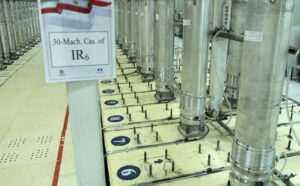
Experts say the size of the construction project indicates Iran likely would be able to use the underground facility to enrich uranium as well — not just to build centrifuges. The AP also reported that those tube-shaped centrifuges, arranged in large cascades of dozens of machines, rapidly spin uranium gas to enrich it. Additional machines would allow Iran to quickly enrich uranium under the mountain’s protection.
The publication of the photographs comes as Iran is making steady progress in constructing a nuclear facility that is likely beyond the range of the GBU-57, which is considered the US military last-ditch weapon to take out underground bunkers, the Mirror of the UK reported.
That could be a problem for the GBU-57. The AP reported that in previously describing the bomb’s capabilities, the Air Force has said it could tear through 60 meters (200 feet) of ground and cement before detonating.
US officials have discussed using two such bombs in succession to ensure a site is destroyed. But even then, the new depth of the Natanz tunnels likely presents a serious challenge.
Further complicating any possible US military strike is that the B-2 had been grounded for months since December when one caught fire after an emergency landing, as was reported by the AP. On Monday, Gen. Thomas A. Bussiere, the commander of the Air Force’s Global Strike Command, announced the B-2 grounding had been lifted.
“While the B-2 fleet safety pause is officially over, our ability to deliver nuclear deterrence and provide long-range strike was never in doubt,” an Air Force statement said.
On Monday, the AP reported that near a peak of the Zagros Mountains in central Iran, workers are building a nuclear facility so deep in the earth that it is likely beyond the range of a last-ditch U.S. weapon designed to destroy such sites, according to experts and satellite imagery analyzed by The Associated Press.
With Iran now producing uranium close to weapons-grade levels after the collapse of its nuclear deal with world powers, the installation complicates the West’s efforts to halt Tehran from potentially developing an atomic bomb as diplomacy over its nuclear program remains stalled, the AP report stated.
Kelsey Davenport, the director of nonproliferation policy at the Washington-based Arms Control Association warned that completion of such a facility “would be a nightmare scenario that risks igniting a new escalatory spiral,” the AP reported. “Given how close Iran is to a bomb, it has very little room to ratchet up its program without tripping U.S. and Israeli red lines. So at this point, any further escalation increases the risk of conflict.”
The construction at the Natanz site comes five years after then-President Donald Trump unilaterally withdrew America from the nuclear accord. The AP reported that Trump argued the deal did not address Tehran’s ballistic missile program, nor its support of militias across the wider Middle East. But what it did do was strictly limit Iran’s enrichment of uranium to 3.67% purity, powerful enough only to power civilian power stations, and keep its stockpile to just some 300 kilograms (660 pounds).
The AP also reported that since the demise of the nuclear accord, Iran has said it is enriching uranium up to 60%, though inspectors recently discovered the country had produced uranium particles that were 83.7% pure. That is just a short step from reaching the 90% threshold of weapons-grade uranium.
As of February, international inspectors estimated Iran’s stockpile was over 10 times what it was under the Obama-era deal, with enough enriched uranium to allow Tehran to make “several” nuclear bombs, according to the head of the International Atomic Energy Agency, as was reported by the AP.
President Joe Biden and Israeli Prime Minister Benjamin Netanyahu have said they won’t allow Iran to build a nuclear weapon, the AP reported. “We believe diplomacy is the best way to achieve that goal, but the president has also been clear that we have not removed any option from the table,” the White House said in a statement to the AP.
The Islamic Republic denies it is seeking nuclear weapons, though officials in Tehran now openly discuss their ability to pursue one, according to the report.
Iran’s mission to the United Nations, in response to questions from the AP regarding the construction, said that “Iran’s peaceful nuclear activities are transparent and under the International Atomic Energy Agency safeguards.” However, Iran has been limiting access for international inspectors for years.
Iran says the new construction will replace an above-ground centrifuge manufacturing center at Natanz struck by an explosion and fire in July 2020, the AP reported. Tehran blamed the incident on Israel, long suspected of running sabotage campaigns against its program, but never proven.
Tehran has not acknowledged any other plans for the facility, though it would have to declare the site to the IAEA if they planned to introduce uranium into it, the AP reported. The Vienna-based IAEA did not respond to questions from the AP about the new underground facility.
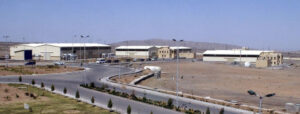
The new project is being constructed next to Natanz, about 225 kilometers (140 miles) south of Tehran. The AP report said that Natanz has been a point of international concern since its existence became known two decades ago.
Protected by anti-aircraft batteries, fencing and Iran’s paramilitary Revolutionary Guard, the facility sprawls across 2.7 square kilometers (1 square mile) in the country’s arid Central Plateau.
Satellite photos taken in April by Planet Labs PBC and analyzed by the AP show Iran burrowing into the Kūh-e Kolang Gaz Lā, or “Pickaxe Mountain,” which is just beyond Natanz’s southern fencing, the report stated.
A different set of images analyzed by the James Martin Center for Nonproliferation Studies reveals that four entrances have been dug into the mountainside, two to the east and another two to the west, the AP reported. Each is 6 meters (20 feet) wide and 8 meters (26 feet) tall.
The scale of the work can be measured in large dirt mounds, two to the west and one to the east. Based on the size of the spoil piles and other satellite data, experts at the center told AP that Iran is likely building a facility at a depth of between 80 meters (260 feet) and 100 meters (328 feet). The center’s analysis, which it provided exclusively to AP, is the first to estimate the tunnel system’s depth based on satellite imagery.
The Institute for Science and International Security, a Washington-based nonprofit long focused on Iran’s nuclear program, suggested last year the tunnels could go even deeper, the AP said.
Experts say the size of the construction project indicates Iran likely would be able to use the underground facility to enrich uranium as well — not just to build centrifuges. The AP reported that those tube-shaped centrifuges, arranged in large cascades of dozens of machines, rapidly spin uranium gas to enrich it. Additional cascades spinning would allow Iran to quickly enrich uranium under the mountain’s protection.
Steven De La Fuente, a research associate at the center who led the analysis of the tunnel work said, “So the depth of the facility is a concern because it would be much harder for us. It would be much harder to destroy using conventional weapons, such as like a typical bunker buster bomb.”
The new Natanz facility is likely to be even deeper underground than Iran’s Fordo facility, another enrichment site that was exposed in 2009 by U.S. and other world leaders, the AP reported. That facility sparked fears in the West that Iran was hardening its program from airstrikes.
Such underground facilities led the U.S. to create the GBU-57 bomb, which can plow through at least 60 meters (200 feet) of earth before detonating, according to the American military, the AP said. U.S. officials reportedly have discussed using two such bombs in succession to ensure a site is destroyed. It is not clear that such a one-two punch would damage a facility as deep as the one at Natanz.
With such bombs potentially off the table, the U.S. and its allies are left with fewer options to target the site. If diplomacy fails, sabotage attacks may resume.
The AP also reported that Natanz already has been targeted by the Stuxnet virus, believed to be an Israeli and American creation, which destroyed Iranian centrifuges. Israel also is believed to have killed scientists involved in the program, struck facilities with bomb-carrying drones and launched other attacks. Israel’s government declined to comment to the AP on this matter.
Experts say such disruptive actions may push Tehran even closer to the bomb and the AP reported that that would put its program even deeper into the mountain where airstrikes, further sabotage and spies may not be able to reach it.
“Sabotage may roll back Iran’s nuclear program in the short-term, but it is not a viable, long-term strategy for guarding against a nuclear-armed Iran,” said Davenport, the nonproliferation expert, as was reported by the AP. “Driving Iran’s nuclear program further underground increases the proliferation risk.”
On Tuesday, the Jewish News Syndicate (JNS.org) reported that, Israel Defense Forces Chief of Staff Lt. Gen. Herzi Halevi said that “negative developments” with Tehran’s nuclear program could prompt the Jewish state to act.
“Iran has advanced in the last few years by enriching uranium more than ever and we are examining very closely the other fields as well on the way to nuclear capabilities,” Halevi said at a conference hosted by the Institute for Policy and Strategy of Reichman University in Herzliya, as was reported by JNS.
“We see negative potential developments on the horizon that might bring action,” the general said.
National Security Adviser Tzachi Hanegbi also spoke at the conference about the Iranian threat on Tuesday, addressing a report that an Iranian nuclear facility under construction at Natanz is so deep underground that U.S. airstrikes likely couldn’t reach it.
“Of course, it limits the ability to attack, but there is no place that can’t be reached,” Hanegbi said, according to the JNS report.
On the Lebanon front, Halevi noted that Hezbollah is a constant challenge for Israel. JNS reported that he emphasized the importance of maintaining the IDF’s qualitative edge over the Iran-backed terrorist group.
“Hezbollah is very much deterred from an overall war with Israel. It understands how we think. This brings Hezbollah to dare to challenge us where it is sure that it will not lead to an overall war. I see that as a ‘good’ path to create surprises in times of need,” Halevi said, as was reported by the JNS web site.
The IDF chief said that Israel is well prepared on the northern borders while cautioning that a conflict in the north “would be difficult.” The citizens of Lebanon would find an Israel-Hezbollah clash “extremely difficult to come back from,” he warned.
Maj. Gen. Aharon Haliva, speaking at the conference on Monday, had a different take on the prospects of war with Hezbollah, according to the JNS report.
Hezbollah leader Hassan Nasrallah is “close to making a mistake that could lead this entire region into a war,” the IDF Military Intelligence Directorate head said.
Also on Tuesday, JNS reported that Israeli Prime Minister Benjamin Netanyahu visited an IDF Intelligence base together with the head of IDF Intelligence Maj.-Gen. Aharon Haliva and additional commanders.
The prime minister received an in-depth briefing on the efforts being made in various fields regarding the Iranian threat.