



Edited by: TJVNews.com
Israel on Monday hosted the foreign ministers of four Arab nations and the United States in a bid to strengthen its position in a rapidly shifting Middle East, according to an AP report.
At the top of the agenda is the pending nuclear deal with Iran, which Israel predicts could be signed this week. The deal currently being negotiated by world powers in Vienna would provide the Islamic Republic of Iran with billions of dollars in sanctions relief, according to a JNS report.
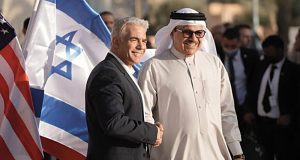
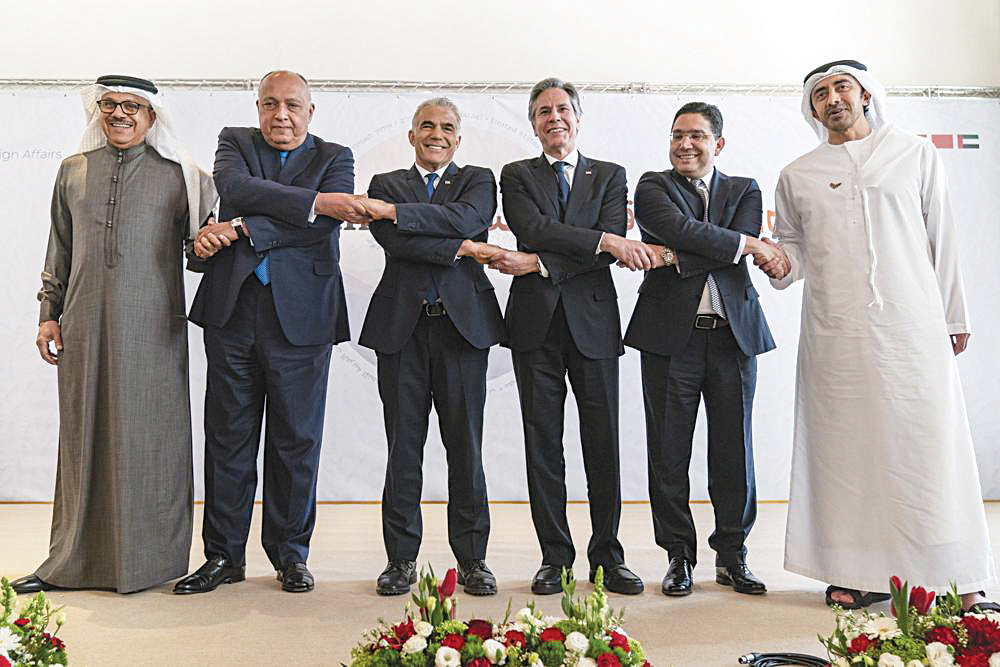
The gathering in the Negev was considered to be a historic summit as it brought together the top diplomats from Egypt and three Arab nations — the United Arab Emirates, Bahrain and Morocco — that signed the Abraham Accords to normalize relations with Israel under the Trump administration.
Underscoring regional anxieties, Israel’s government hastily arranged the meeting of top diplomats from Arab countries that have normalized relations with Israel, as was reported by the AP. Sudan, the fourth Arab country to normalize ties with Israel during the Trump administration, is mired in turmoil following a military coup in October and did not attend the meeting in Israel.
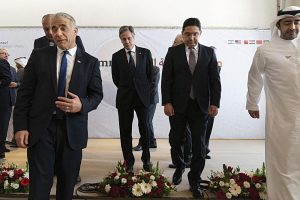
TPS reported that six foreign ministers participated in the historic Negev Summit which included Israeli Foreign Minister Yair Lapid, Secretary of State Antony Blinken, Minister of Foreign Affairs of the United Arab Emirates Sheikh Abdullah bin Zayed, Minister of Foreign Affairs of Bahrain Dr. Abdullatif bin Rashid Al Zayani, Minister of Foreign Affairs of Morocco Nasser Bourita, and Minister of Foreign Affairs of Egypt Sameh Shoukry, the direct outcome of the Abraham Accords.
No joint statement was made at the end of the two-day summit.
Jordan, a close U.S. ally that strongly supports Palestinian statehood, declined to attend the meeting. Instead, King Abdullah II visited Palestinians in a solidarity measure.
“The region cannot enjoy security and stability without a just and comprehensive solution to the Palestinian issue,” the king said as he met with Palestinian President Mahmoud Abbas, who welcomed the visit, as was reported by AP. Neither leader mentioned the meeting hosted by Israel.
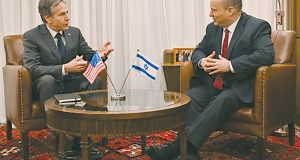
At the conclusion of the summit on Monday, Israeli Foreign Minister Yair Lapid stated as the US top diplomat and foreign ministers from four Arab countries looked on, “Hesitation or being conciliatory” will not stop Iran’s aggression, but “determination and strength” will, according to a TPS report.
Lapid also said that the countries at the summit were forming a partnership based on technology, religious tolerance, security and intelligence cooperation, according to the AP report.
“This new architecture, the shared capabilities we are building, intimidates and deters our common enemies, first and foremost Iran and its proxies,” he said. “They certainly have something to fear. What will stop them is not hesitation or being conciliatory but rather determination and strength.”
The cordial atmosphere at the summit was overshadowed by a deadly ISIS terror attack in the city of Hadera in central Israel, concern over the potential revival of the Iran nuclear deal and Israel’s conflict with the Palestinians, who publicly support terrorism directed at Israeli soldiers and civilians.
AP reported that as the ministers gathered late Sunday, a deadly shooting rampage claimed by the extremist group Islamic State killed two young police officers in central Israel. Participants also repeatedly expressed misgivings over Iranian military behavior across the region and the possible renewal of the international nuclear accord.
TPS reported that in his concluding remarks, Lapid began by relating to the shooting attack in Hadera that saw the murders of two Border Police troops and which wounded 10 Israelis.
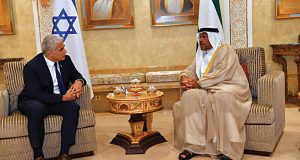
“Last night, for the second time in a week, terror struck at the heart of Israel. ‘At the heart of Israel’ in two senses: in the heart of the country, in a crowded city. And also, at the heart of every Israeli citizen. This was murder for the sake of murder, terror for the sake of terror,” he stated.
“Shortly after this attack, Islamic Jihad and Hamas praised it. They declared that it was a response to the Negev Summit that we are holding here. The terrorists’ goal is to intimidate us. To make us afraid to meet and build the relationships and agreements between us. They will not succeed. We will not let them,” he vowed.
“What we are doing here today is making history. Building a new regional architecture based on progress, technology, religious tolerance, security and intelligence cooperation. This new architecture, the shared capabilities we are building, intimidates and deters our common enemies – first and foremost Iran and its proxies – they certainly have something to fear. What will stop them is not hesitation or being conciliatory, but rather determination and strength,” he declared, according to the TPS report.
TPS reported that Lapid also said that the summit was “the first of its kind, but not the last. Last night we decided to make the Negev Summit into a permanent forum. Together with our closest friend, the United States, we are today opening a door before all the peoples of the region, including the Palestinians, and offering them to replace the way of terror and destruction with a shared future of progress and success.”
The main point of contention remains between the US and Israel and the Gulf states – the resigning of a nuclear agreement with Iran, as was reported by TPS. The top diplomats apparently hid the dispute between them and turned to the convenient common denominator – the Palestinians and peace.
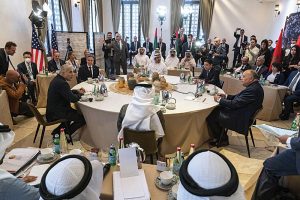
Bahraini Foreign Minister Al Zayani opened his remarks by condemning the terror attack, as was reported by TPS. UAE Foreign Minister bin Zayed said the summit was a blow against the terror attack in Hadera, while Morocco’s Foreign Minister Bourita said that the summit is the “best response to such attacks.”
“We did highlight the importance of the Israeli-Palestinian peace process, importance of maintaining the credibility and viability of the two-state solution,” said Egypt’s foreign minister, Sameh Shoukry, according to the AP report. “This an important issue.”
The ministers and Secretary of State Antony Blinken pledged to expand cooperation to include energy, environmental and security matters and try to bring others into the agreements, according to an AP report.
“Just a few years ago this gathering would have been impossible to imagine,” Blinken said. “The United States has and will continue to strongly support a process that is transforming the region and beyond.”
The Biden administration has urged Israel and the Palestinians to take steps to reduce tensions and create conditions for eventually renewing peace talks, as was reported by the AP. The report indicated that it has made clear that it has no immediate plans to press the sides to renew negotiations. The last serious and substantive talks broke down more than a decade ago.
Israeli Prime Minister Naftali Bennett has said he opposes a Palestinian state and has no intention of restarting peace talks. Instead, he has called for steps to improve economic conditions for the Palestinians to help reduce tensions, according to the AP report.
The Biden administration has meanwhile been working to renew the 2015 international nuclear deal with Iran. AP reported that the agreement placed curbs on Iran’s nuclear program in exchange for billions of dollars in sanctions relief.

With support from Israel, the Trump administration withdrew from the deal in 2018, causing it to unravel.
Although Iran has since raced ahead with its nuclear program, Israel and Gulf Arab countries are deeply concerned about restoring the original deal. AP reported that Israel fears it does not include enough safeguards to prevent Iran from developing nuclear weapons.
Both Israel and its Gulf allies also believe that relief from economic sanctions will allow Iran to step up its support for terrorism in the form of proxy groups in Iraq, Syria, Lebanon, Yemen and inside Israel.
The report indicated that Bahrain’s foreign minister, Abdullatif al-Zayani, said the need to cooperate was made “more urgent” by attacks by Iranian-backed terrorist groups and the unresolved nuclear issue.
“We need to put into practice the principles behind the accords, mainly those of dialogue, cooperation and mutual respect,” he said, according to the AP report. “By doing so, we will demonstrate to the whole region what can be achieved by working together.”
AP also reported that Blinken sought to address the concerns about Iran on Sunday, saying that the U.S. sees “eye to eye” with Israel on the goal of making sure Iran never builds a nuclear weapon.
“They (the nations represented at the summit) see the upcoming agreement with Iran doesn’t serve their interests. And they are worried,” Yoel Guzansky, a senior research fellow at the Institute for National Security Studies (INSS), told JNS.
“There is tension between some Arab capitals and the U.S. regarding all kinds of issues that they find irritating about U.S. Middle East policy. They see the U.S. as distancing itself from the region.”
Guzansky explained that in recent weeks, the Saudis and Emiratis reportedly declined to take calls from President Biden as he has attempted to build international support for Ukraine and lobby the Gulf states to produce more oil to contain surging prices, according to the JNS report. “They didn’t play along because the Saudis and Emiratis have had a full stomach with the Americans,” he said.
Prior to the summit, Guzansky predicted that the Arab states would likely come with a list of demands for Blinken, including security assurances and defense materials Guzansky noted that just last Friday, Riyadh was hit by a missile strike from Iranian-backed Houthi rebels in neighboring Yemen, as was reported by JNS.
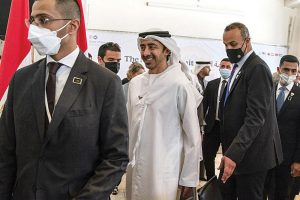
Before the commencement of the Negev summit, Hillel Frisch, an expert on the Arab world at the Jerusalem Institute for Strategy and Security (JISS), told JNS it is important not to let Iran and the looming security issues overwhelm the positive aspects of the summit.
The fact that Arab leaders are meeting at a kibbutz in the Negev is “an Israeli dream come true. Even 10 to 15 years ago, it would have been considered prophetic,” said Frisch.
“Most of the conference is a photo-op event, but a meaningful one,” he added, according to the JNS report. “It shows there’s an emerging alliance of strong states in the region that are going to try and cope with the Iranian problem.”
JNS reported that he noted that because Morocco is less concerned about Iran, given its geographical distance, its presence at the summit is important: “It means that Morocco is interested in cementing the regional relationship with Israel.”
Frisch pointed out that Egypt’s presence sends a message to Turkish President Recep Tayyip Erdoğan that while Israel views its improving relations with Turkey as important, they’re not as important as those of its immediate neighbor and first peace partner, Egypt, as was reported by JNS.
The summit also puts the end to the threat of the “Arab street,” he said, a term connoting the theory that Arab populations would rise up against any government that dared make peace with Israel. “We’re witnessing that the Arab street is a crumbling facade.”
In one of its first foreign-policy acts, the Biden administration removed the Houthis from the Foreign Terrorist Organization and Specially Designated Global Terrorist lists.
Placing the Houthis back on the U.S. terror list will be a key Arab demand, said Guzansky, along with keeping the terror designation on Iran’s Islamic Revolutionary Guard Corps (IRGC). The United States has suggested it may give into an Iranian demand to remove the IRGC from the designated terrorist list, as was reported by JNS.
Lapid on Monday visited Ben-Gurion’s grave with Blinken, as was reported by the AP. But the Arab ministers did not join them, citing scheduling issues.
Blinken on Sunday also traveled to Ramallah to meet with Palestinian Authority President Mahmoud Abbas. He stressed to him the U.S. commitment to help the Palestinian people and encourage a resumption in long-stalled peace talks with Israel.
(Sources: AP, TPS, JNS) – Additional reporting by Fern Sidman