



|
Getting your Trinity Audio player ready...
|
By: Fern Sidman
As Israeli Prime Minister Benjamin Netanyahu boarded his plane for Washington on Sunday to meet President Donald Trump, Tehran chose its moment with unmistakable theatricality. According to reports from Reuters and The Jerusalem Post, Iran on Sunday lofted three domestically developed satellites into space from a Russian launch facility, a maneuver that Israeli officials immediately interpreted as a calculated display of defiance toward Jerusalem and Washington alike.
The launches, which were announced well in advance by Iranian authorities, were not merely technical exercises. As The Jerusalem Post report emphasized, they were framed by Tehran as symbols of resilience following the bruising war between Israel and Iran in June — a conflict that left Iran’s nuclear ambitions in tatters and recalibrated the strategic chessboard of the Middle East.
Yet the true implications of these new satellites remain contested. Are they little more than technological bravado from a wounded regime, or do they herald a deeper, more insidious shift in Iran’s long-term capabilities? Both Reuters and The Jerusalem Post suggest the answer lies somewhere in between.
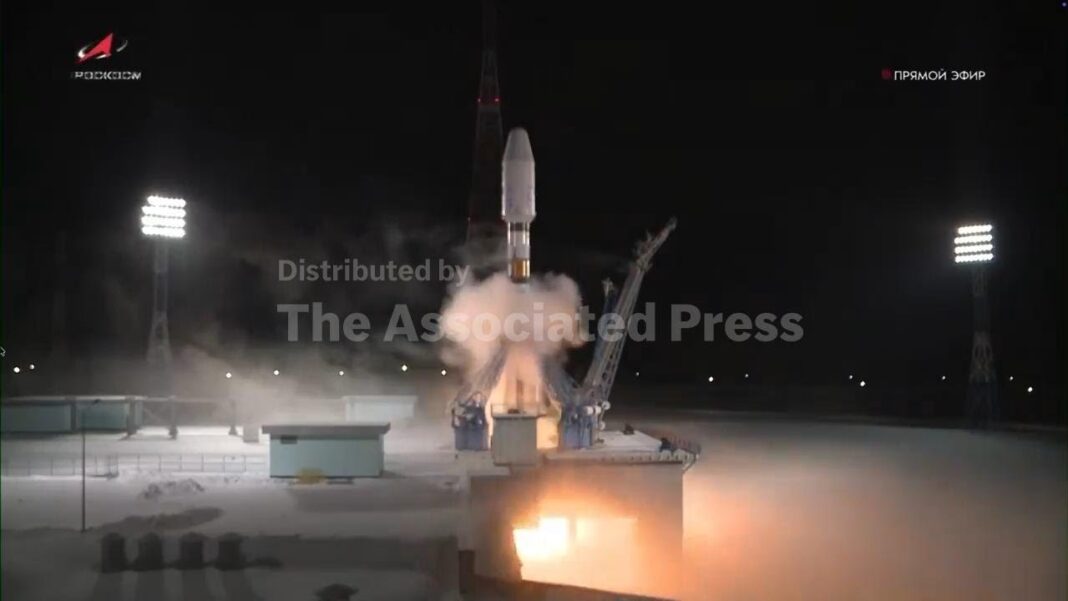
The timing was impossible to ignore. As Netanyahu prepared to press the Iranian file in Washington — discussing Tehran’s ballistic missile arsenal, its shattered nuclear program, and the prospects of renewed sanctions — Iran’s state media triumphantly broadcast footage of three satellites being carried aloft by a Russian Soyuz-2.1b rocket from the Vostochny Spaceport in Russia’s Far East.
According to the Reuters report, the satellites — named Paya (Tolu-3), Zafar-2, and a second prototype of Kowsar-1.5 — were developed by Iran’s private sector, a detail Iranian officials were keen to highlight as evidence of domestic technological maturity.
VAHID Yazdanian, head of the Iranian Space Research Institute and a deputy minister for communications and information technology, told state outlets that the mission marked the seventh time Tehran had relied on Russian rockets to place satellites in orbit. The Jerusalem Post notes that this deepening cooperation with Moscow has been a persistent concern for Israel, which sees the Russian-Iranian space partnership as more than a civilian enterprise.
For much of the last decade, every Iranian satellite launch was met with alarm in Jerusalem and Washington. Before the June war, Tehran’s steady cadence of orbital tests was widely regarded as a “dual-use” endeavor — ostensibly civilian, yet perilously close to advancing the technology needed for intercontinental ballistic missiles (ICBMs).
But the landscape today is radically different. As Reuters reported, Iran’s nuclear program has been effectively crippled over the past six months. Facilities were damaged or destroyed, enrichment cascades dismantled, and the scientific infrastructure that underpinned Tehran’s atomic ambitions left in disarray.
This raises a perplexing question: if Iran cannot currently enrich uranium or assemble nuclear warheads, what strategic purpose do these satellite launches serve?
Despite Iran’s weakened nuclear posture, Israeli intelligence officials, speaking through The Jerusalem Post, have identified three enduring ways in which these orbital advances could still pose a threat.
First, even in isolation, progress in satellite-launch vehicles sustains Iran’s knowledge base in long-range missile technology. Should Tehran manage to rehabilitate its nuclear program in the future, the ICBM component could already be advanced — shortening the timeline for a renewed existential threat.
Second, the launches underscore Iran’s formidable conventional missile capabilities. Between April 2024 and June of this year, Iran unleashed three massive barrages of ballistic missiles at Israel. As the Reuters report recounted, these salvos demonstrated that even without nuclear warheads, Tehran possesses the ability to saturate defenses across the region.
If Iran continues refining its ICBM-class rockets, Israeli analysts warn, this conventional threat could one day extend directly to Washington and Western Europe, mirroring the danger already felt in Jerusalem, Riyadh, and parts of Eastern Europe.
Third, the satellites themselves — particularly the observation platforms — represent a leap in Iran’s intelligence-gathering capacity. During the June war, Israel enjoyed a decisive advantage through its own constellation of surveillance satellites. As The Jerusalem Post report noted, this edge allowed the IDF to strike Iranian assets with unprecedented precision.
Should Iran begin closing that gap, future confrontations could become far more perilous for Israel.
Iranian officials were effusive about the capabilities of the new satellites. Yazdanian told state television that Tolu-3, weighing approximately 150 kilograms, is the most advanced observation satellite Tehran has ever launched. Reuters reported that it can provide black-and-white imagery at resolutions of around five meters and color imagery at roughly ten meters.
The trio was placed into low Earth orbit at an altitude of about 500 kilometers — a departure from earlier Iranian satellites that operated at higher, less efficient altitudes. The satellites are expected to transmit data with spatial resolutions ranging from 15 meters down to under five meters, a notable improvement over Iran’s earlier platforms.
This mission also follows a pattern. In July, Iran’s Nahid-2 satellite was launched by Russia to enhance Tehran’s navigation and telecommunications systems. In September 2024, the Islamic Revolutionary Guard Corps (IRGC) successfully deployed the Chamran-1 satellite using its own Qaem-100 rocket, a solid-fuel, three-stage vehicle that reached a 550-kilometer orbit.
As the Reuters report pointed out, the U.S. intelligence community’s 2024 worldwide threat assessment warned that Iran’s satellite-launch vehicles “would shorten the timeline” for developing an ICBM — a phrase that continues to reverberate through security circles.
The collaboration with Moscow is perhaps the most disquieting aspect of Tehran’s space ambitions. The Jerusalem Post recalls that in 2022, a Russian Soyuz rocket launched Iran’s Khayyam remote-sensing satellite from the Baikonur Cosmodrome in Kazakhstan, prompting acute concern among Israeli defense planners.
That satellite was believed capable of delivering imagery at resolutions as fine as 1.2 meters — a significant upgrade over Iran’s indigenous capabilities at the time. The Washington Post later reported that the platform could enable “continuous monitoring” of targets across the Middle East, from Israeli military bases to U.S. troop deployments in Iraq.
To Israeli officials, this partnership with Russia is not simply about access to rockets; it is about technological transfer, training, and the gradual erosion of Israel’s qualitative intelligence advantage.
Yet not all experts are convinced that Iran’s space program merits such alarm. In 2022, Israel Space Program chief and former major general Yitzhak Ben Israel sought to deflate the panic, arguing that even the most advanced Iranian satellite is strategically underwhelming.
As The Jerusalem Post reported at the time, Ben Israel noted that commercial satellite imagery — available to virtually anyone with $10,000 — often exceeds the quality of Iran’s military-grade platforms. “To the average reader,” he said, “a resolution of 1.2 meters sounds phenomenal. But it is already obsolete in the commercial market.”
This skepticism still resonates today. If Iran can already purchase high-resolution imagery on the open market, does launching its own satellites meaningfully change the strategic equation?
That question lies at the heart of the debate now unfolding in Jerusalem and Washington. Reuters characterizes the latest launches as a blend of symbolism and residual capability: a wounded power reminding the world that it is not finished.
For Netanyahu, arriving in the U.S. amid this orbital spectacle, the message is clear. Iran may be reeling, but it is not retreating. It is probing, adapting, and recalibrating — seeking new domains in which to assert relevance even as its nuclear ambitions lie in ruins.
As discussions begin between Netanyahu and Trump, Iran’s satellites will loom large over the agenda. According to The Jerusalem Post report, Israeli officials intend to press Trump not only on sanctions and enforcement but on the broader challenge of countering Tehran’s evolving missile and space programs.
The ultimate irony may be that, in the wake of its greatest military setback in decades, Iran has turned to the heavens to reclaim a measure of prestige. Whether these three satellites represent a genuine strategic breakthrough or merely a shimmering distraction, they have already achieved one undeniable objective: they have forced Israel, the United States, and the world to look up — and to wonder what, exactly, Tehran is preparing to launch next.