



|
Getting your Trinity Audio player ready...
|
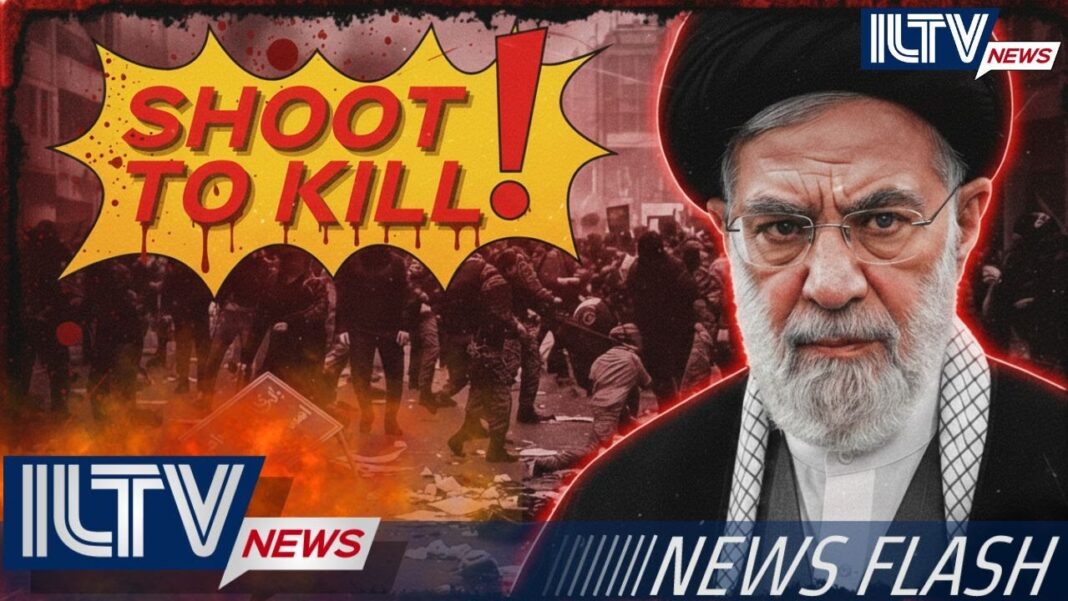
Intelligence Report: U.S. and Israel Amass Evidence Confirming Iranian Protester Executions
By: Fern Sidman
In a development that is rapidly reshaping the strategic landscape of the Middle East, the United States has obtained what officials now describe as conclusive intelligence evidence that Iran carried out executions of protesters despite explicit assurances from Tehran that such actions had been halted. The explosive revelations, reported on Saturday by Israel Hayom, are already reverberating through diplomatic, military, and intelligence circles in Washington, Jerusalem, and across the region, intensifying an already volatile confrontation between the Islamic Republic and the Western alliance.
According to the information provided in the Israel Hayom report, the intelligence assessment directly contradicts claims that were previously conveyed to President Donald Trump — claims that led him to delay military action after being told that more than 800 detainees arrested during mass protests would not be executed. At the time, Trump publicly stated that he had received assurances that the executions had been canceled, framing the decision as a humanitarian breakthrough achieved through pressure rather than force.
Now, however, U.S. intelligence agencies have reached a starkly different conclusion. As reported by Israel Hayom, the updated assessment indicates that executions did occur and that they were carried out through multiple methods. The report further states that live fire was used against protesters during demonstrations, and that additional killings took place after detainees were captured — a pattern suggesting systematic repression rather than isolated abuses.
Crucially, Israeli intelligence services played a central role in gathering, corroborating, and verifying the evidence. Officials familiar with the intelligence file described the material to Israel Hayom as a “smoking gun” — a definitive proof package establishing that Tehran violated its commitments and deliberately misled international interlocutors.
This revelation does not exist in a vacuum. It is unfolding against a backdrop of intense diplomatic maneuvering, internal divisions within the Trump administration, and unprecedented military coordination between the United States and Israel. As Israel Hayom reported, the issue has already been discussed in high-level meetings between representatives of Prime Minister Benjamin Netanyahu and senior American officials, including Steve Witkoff, the president’s Middle East envoy, and Jared Kushner, a senior adviser to Trump.
Witkoff and Kushner are widely regarded, according to Israel Hayom, as leading figures within a diplomatic faction of the administration — a camp that continues to prioritize de-escalation, negotiated frameworks, and the avoidance of a broader regional war. This faction is supported by regional actors such as Qatar, Saudi Arabia, and Turkey, all of whom have improved relations with Tehran in recent years. Saudi Arabia, once among Iran’s most vocal adversaries, has notably adopted a more restrained public posture, emphasizing regional stability over confrontation.
Yet the Israel Hayom report underscored that this diplomatic camp now faces mounting pressure from within the administration itself. Senior figures including Vice President JD Vance, Secretary of State Marco Rubio, and Defense Secretary Pete Hegseth are described as favoring a far more aggressive approach. For this faction, the intelligence revelations do not merely represent a moral outrage — they constitute a strategic opportunity.
According to the report in Israel Hayom, these officials view a decisive strike against Iran as both a moral necessity and a transformative geopolitical lever — one that could weaken the regime internally, dismantle its regional proxy networks, and fundamentally reshape the balance of power across the Middle East. In this view, Tehran’s internal repression and external aggression are inseparable, and any policy that fails to confront both is ultimately unsustainable.
The international alignment surrounding this debate is equally complex. Israel Hayom reports that supporters of military action include the United Arab Emirates and elements within Europe, particularly Britain. Several countries are reportedly prepared to provide intelligence, logistical support, and missile-defense assistance in the event of Iranian retaliation. Jordan and Gulf states could also play critical roles in intercepting drones or missiles targeting Israel, U.S. bases, or regional energy infrastructure.
This emerging coalition reflects a growing convergence of security interests, driven by shared concerns over Iran’s regional ambitions, missile capabilities, and proxy networks. What was once a fragmented set of bilateral anxieties is increasingly coalescing into a multilateral strategic alignment.
Meanwhile, military preparations are accelerating. As Israel Hayom reported, Gen. Bradley Cooper, commander of U.S. Central Command, has arrived in Israel for coordination meetings with senior Israeli defense officials. Central Command oversees all U.S. forces across the Middle East and would be responsible for managing any potential strike or escalation.
An Israeli security source cited in the Israel Hayom report described current U.S.–Israel cooperation as being at an unprecedented level, encompassing intelligence sharing, joint air-defense systems, and integrated operational planning. This is not symbolic coordination — it is structural integration, reflecting a depth of military interoperability rarely seen outside formal alliance frameworks.
U.S. naval and air assets, including aircraft carriers and missile-equipped ships, are already positioned in the region, pending a presidential decision. These deployments, reported by Israel Hayom, are not merely precautionary; they are strategically calibrated assets capable of immediate kinetic action, defensive interception, and sustained regional operations.
At the heart of the crisis lies a profound question of credibility. The intelligence findings reported by Israel Hayom strike at the core of diplomatic trust. If Iran provided assurances — whether directly or through indirect diplomatic channels — that executions would not occur, and if those assurances were demonstrably false, then the very foundation of negotiation is undermined.
The report notes that some of the messages were attributed to Iranian President Masoud Pezeshkian, conveyed through indirect diplomatic pathways. Tehran has publicly denied sending such a message and has rejected claims that mass executions occurred. But U.S. intelligence officials now assess, according to the Israel Hayom report, that these denials are inconsistent with verified evidence.
This contradiction places the Trump administration in a strategic bind. On one hand, diplomacy requires trust in communication channels; on the other, intelligence now suggests those channels were exploited for deception. The gap between diplomatic assurances and intelligence assessments has become dangerously wide.
For Israel, the implications are existential. As the Israel Hayom report emphasized, Israeli leadership views Iranian internal repression and external aggression as two sides of the same ideological project — one rooted in regime survival, regional dominance, and ideological exportation. From Jerusalem’s perspective, Iran’s treatment of its own citizens is not merely a human rights issue; it is a strategic indicator of regime behavior.
This perspective explains why Israeli intelligence invested heavily in verifying the executions and why Israeli officials have pressed Washington to treat the findings not as an isolated incident, but as part of a broader pattern of deception and coercion.
Within Washington, the intelligence revelations have injected new urgency into internal deliberations. Israel Hayom reported that uncertainty now dominates policy discussions — uncertainty over whether diplomacy can still restrain Tehran, and uncertainty over whether delay merely enables further bloodshed.
The debate is no longer theoretical. It is operational, strategic, and immediate. The presence of U.S. military assets, the arrival of CENTCOM leadership in Israel, and the intensity of intelligence coordination all point to a moment of decision approaching.
Yet even as preparations intensify, no final decision has been announced. President Trump has not formally authorized military action, and diplomatic channels remain technically open. But the intelligence described by Israel Hayom has fundamentally altered the calculus.
In strategic terms, the situation reflects a classic crisis of deterrence and credibility. If Iran can execute protesters after offering assurances not to, and face no consequences, then diplomatic pressure loses its coercive power. Conversely, if the intelligence is acted upon militarily, the risk of regional escalation becomes real.
This is the paradox now confronting policymakers: restraint risks emboldening Tehran, while action risks igniting a broader conflict.
What makes this moment particularly dangerous is the convergence of moral outrage and strategic opportunity. The executions are not merely atrocities; they are now framed, within parts of the administration, as evidence of regime illegitimacy. This framing transforms military action from deterrence into interventionist logic — a shift with profound implications.
As the Israel Hayom report makes clear, the intelligence findings have not closed the door to diplomacy, but they have narrowed it dramatically. Each day that passes without resolution increases pressure on decision-makers, amplifies internal divisions, and raises the stakes of every diplomatic exchange.
In Jerusalem, the mood is reportedly one of grim clarity rather than triumphalism. Israeli officials understand the risks of escalation, but they also view inaction as a strategic failure. The intelligence, in their view, removes ambiguity.
In Washington, the administration stands at a crossroads between two visions of power: one rooted in negotiation and managed containment, the other in decisive force and strategic disruption.
What is certain is that the illusion of stability has been shattered. The intelligence evidence has punctured the diplomatic narrative and exposed a regime willing to deceive while repressing its own population.
Whether this leads to renewed diplomacy, intensified sanctions, covert operations, or open military confrontation remains uncertain. But the trajectory is unmistakable: the space for compromise is shrinking, and the consequences of delay are growing heavier.
In the words of one senior official cited by Israel Hayom, this is no longer a question of if Iran violated its commitments — it is a question of how the world responds now that the violation is proven.
And in that response, the future of regional stability, international credibility, and the architecture of Middle Eastern security may well be decided.
