



|
Getting your Trinity Audio player ready...
|
By: Fern Sidman – Jewish Voice News
The Hasidic world awoke this week to a wave of anguish, disbelief, and renewed concern for the sanctity of Jewish heritage sites abroad after learning that the 180-year-old Kloyz Kadisha synagogue—one of the most treasured institutions of the storied Sadigura Chasidic dynasty—had been deliberately set on fire in the Sadgora district of Chernivtsi, Ukraine. As VIN News reported on Friday, the incident has shaken communities far beyond the region, touching a deep nerve at a time when Jewish heritage sites across Eastern Europe remain uniquely vulnerable to neglect, vandalism, and the unpredictable volatility of political and social conditions surrounding them.
The details, while disturbing, call attention to both the fragility of centuries-old Jewish landmarks and the urgency of ensuring that the legacy of Rabbi Yisroel of Ruzhin—the revered founder of the Ruzhiner dynasty, whose descendants built the Sadigura court—remains protected. According to the information provided in VIN News report, Ukrainian authorities say the arsonist, a 30-year-old local man whose name has not been released to the public, entered the historic synagogue late Monday evening. In a stroke of tragic circumstance, the synagogue’s security guard had stepped outside for only a brief moment—a gap the suspect exploited to slip inside.
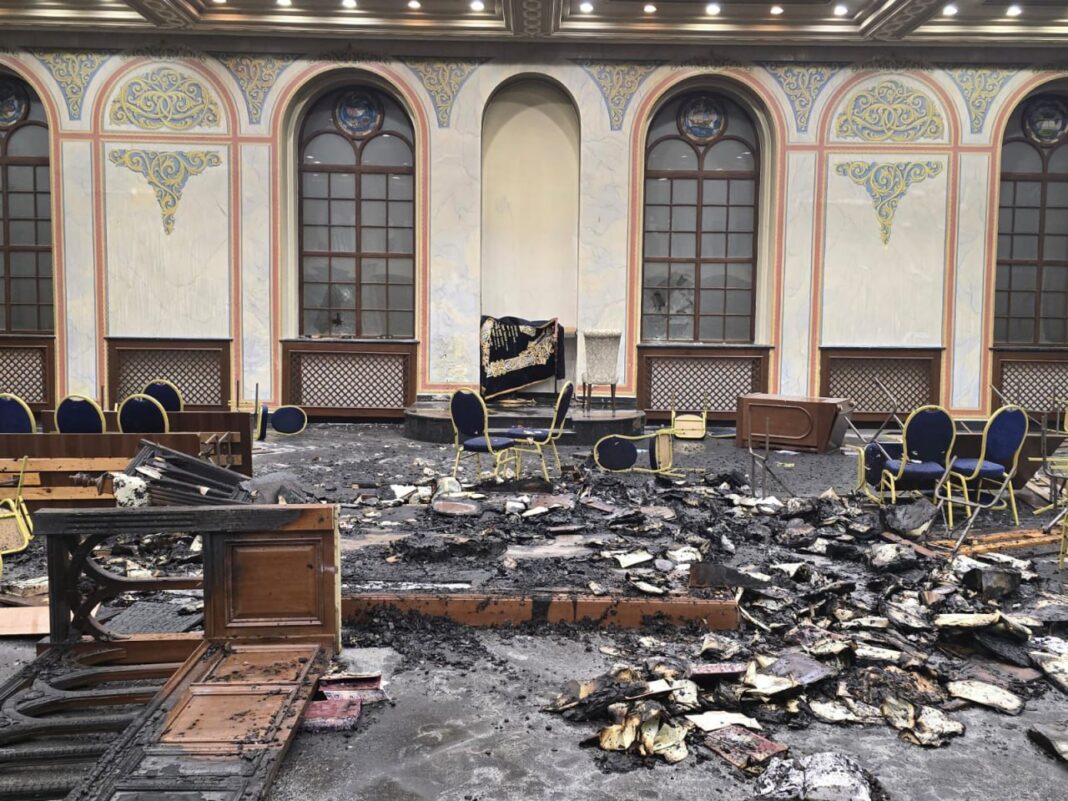
Once within the prayer hall, police report that the man gathered books, papers, and assorted household objects, piling them together before setting them alight. Flames quickly spread across the room, damaging sacred texts, furnishings, and structural elements of the hall. The symbolism of deliberately burning holy books inside one of the region’s most important Hasidic synagogues was not lost on the Jewish community. The act, as the VIN News report observed, evoked echoes of darker eras, when Jewish property was targeted precisely because of its spiritual significance.
When local police arrived, what they found stunned them. The suspect was still sitting inside the burning structure, calmly positioned near the smoldering debris he had ignited. Officers apprehended him at the scene, immediately transferring him into custody.
According to official statements cited in the VIN News report, the man was quickly identified as someone previously involved in an attempted arson attack on a Christian church just a month earlier. Ukrainian authorities also confirmed that he is registered at a psychiatric facility, a detail that immediately complicated public discussions about motive, hate crimes, and mental-health-related criminality. The suspect has been detained under Article 208 of the Ukrainian Criminal Procedure Code, which authorizes immediate preventive custody, and a criminal case has been opened under Part 2, Article 194 of Ukraine’s Criminal Code, which concerns intentional destruction or damage to property, particularly when it involves cultural or religious institutions.
While the fire was contained before it could engulf the entire building, the damage is far from negligible. Structural and interior assessments are ongoing, with city officials and synagogue staff working under significant pressure to determine the full extent of the losses. Yet the emotional wounds, as many in the Hasidic community expressed to VIN News, are already profound.
The Kloyz Kadisha synagogue is no ordinary house of prayer. Constructed 180 years ago, the building is intimately bound with the heritage and memory of the Ruzhin-Sadigura dynasty, which once flourished in the region before the devastation of the Holocaust. It was in these spaces that generations of Chasidim prayed, studied, received blessings, and maintained vibrant communal life under the leadership of one of the most illustrious Hasidic courts in Eastern Europe. After decades of Soviet repression, wartime destruction, and demographic upheaval, the synagogue’s restoration in 2017 was heralded as a landmark moment in the revival of Jewish cultural memory in Chernivtsi.
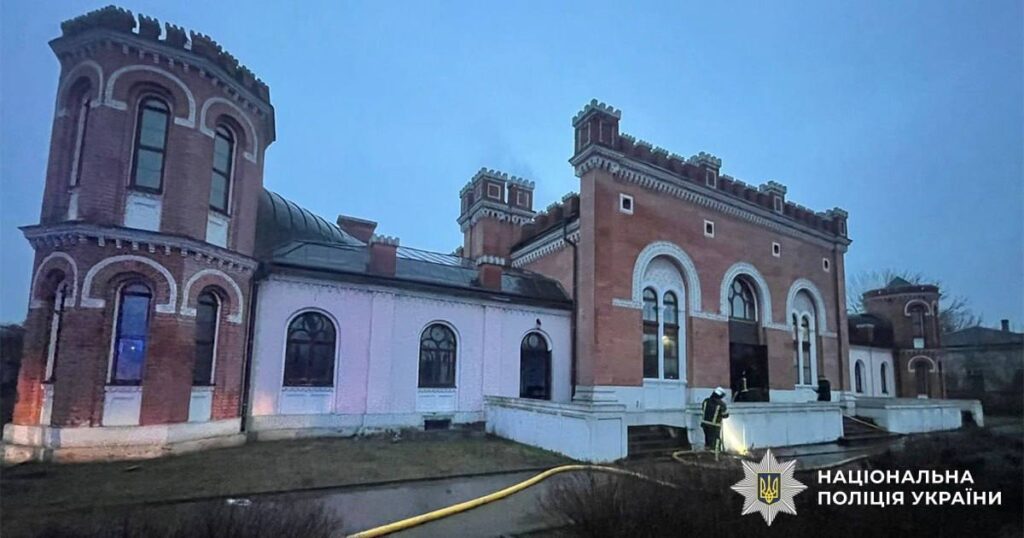
For this reason, the VIN News report emphasized that the arson attack was not only a criminal act but a symbolic blow to a living historical link cherished by Jews around the world. The Kloyz Kadisha stands as one of the few remaining structures that bear witness to the grandeur and depth of Jewish religious life that once thrived in the region. Its desecration feels, to many, like an assault on memory itself.
In the aftermath of the fire, Chernivtsi’s regional rabbi, Menachem Mendel Glitzenshtein, arrived at the scene early Thursday morning alongside Mayor Roman Klichuk. The two spent considerable time surveying the damage, speaking with synagogue staff, and meeting local officials tasked with analyzing the ruin. Sources say Rabbi Glitzenshtein was visibly moved as he walked through the smoke-scarred sanctuary, taking in the smell of charred wood and the heartbreaking sight of burned prayer books scattered across the floor.
The mayor, for his part, was adamant that Chernivtsi remained a city that prided itself on its multicultural legacy and its longstanding reputation for tolerance. “This city has always belonged to many religions, many peoples, many cultures,” he said, according to the report at VIN News, and he pledged that municipal authorities would assist the Jewish community in every way possible.
The attack, however, must be understood in broader context. While antisemitic incidents in Ukraine have historically been less frequent than in Western Europe—something Jewish leaders often point out—recent years have witnessed a troubling rise in acts of vandalism targeting Jewish cemeteries, Holocaust memorials, and synagogues. Although preliminary evidence suggests that this particular attack was likely tied to the suspect’s mental illness rather than ideological hatred, the VIN News report noted that the impact on the Jewish community is no less painful. Sacred spaces carry memories and meaning that transcend politics; when they are violated, the wound reverberates across continents.
The Kloyz Kadisha synagogue is one of those rare institutions that embodies an entire spiritual galaxy. For followers of the Sadigura dynasty, the synagogue is not merely a site of prayer but the architectural embodiment of the luminous mysticism and royalty associated with the House of Ruzhin. Rabbi Yisroel of Ruzhin—known as the “Ruzhiner Rebbe”—was famed for conducting his Hasidic court with regal majesty, emphasizing beauty and dignity as reflections of divine service. His descendants established the Sadigura court in this exact region, and the synagogue became a central locus of their spiritual leadership.
Many Hasidim expressed sorrow not only over the damage but over the symbolism: an attack on a sacred vessel of their dynasty’s memory, occurring in a place where that memory had already survived so much. One prominent Sadigura follower remarked that the fire “felt like a reopening of old wounds,” referencing the destruction of Jewish life in Bukovina during World War II, when synagogues were demolished and entire communities annihilated.
While Ukrainian officials have moved swiftly to condemn the attack and have emphasized the suspect’s psychiatric history, the incident raises questions about security protocols at religious sites, especially in regions where police resources are strained and where Jewish heritage preservation relies partly on private or communal funding. Synagogue representatives told VIN News that the guard’s brief departure had been entirely routine. No one could have anticipated that in the handful of minutes during which the entrance was momentarily unsupervised, a troubled individual would slip inside and ignite a blaze.
As city authorities and Jewish leaders begin to confront the next phase—restoration—the challenge will require not only financial investment but emotional resilience. The burnt pages that once held the prayers of generations will not be returned to their original form. The scorch marks on the walls will eventually be painted over, but the knowledge of what transpired will linger as part of the synagogue’s narrative.
Yet, there is also a remarkable determination among Chasidim to ensure that the Kloyz Kadisha rises again. Many have expressed hope that donors from around the world, including Sadigura communities in Israel, Europe, and the United States, will participate in restoring the building to its former dignity. Rabbi Glitzenshtein echoed this sentiment, emphasizing that while the fire was a blow, it was not a defeat. “We will rebuild,” he said. “We will restore what was damaged, and we will continue to honor the legacy of our ancestors.”
The fire in Chernivtsi also arrives at a time when Jewish communities globally are more attuned than ever to the vulnerability of cultural and religious heritage. From rising antisemitism in Western cities to political instability in Eastern Europe, the preservation of Jewish historical sites has become a collective responsibility, not a local one. The Kloyz Kadisha synagogue is a reminder that these structures are not merely relics; they are living connections to a world that once was, and whose echoes continue to guide the spiritual life of Jews today.
Ultimately, the deliberate arson of the Kloyz Kadisha synagogue is a tragedy—but not the final word. As VIN News conveyed in its coverage, the Jewish community of Chernivtsi, bolstered by a global network of Chasidim and heritage activists, is resolved to restore the damage and ensure the synagogue remains a beacon of memory, worship, and historical continuity.
The flames that scorched its walls were real and destructive, but the spiritual fire that built Sadigura is not so easily extinguished.