



|
Getting your Trinity Audio player ready...
|
By: Fern Sidman
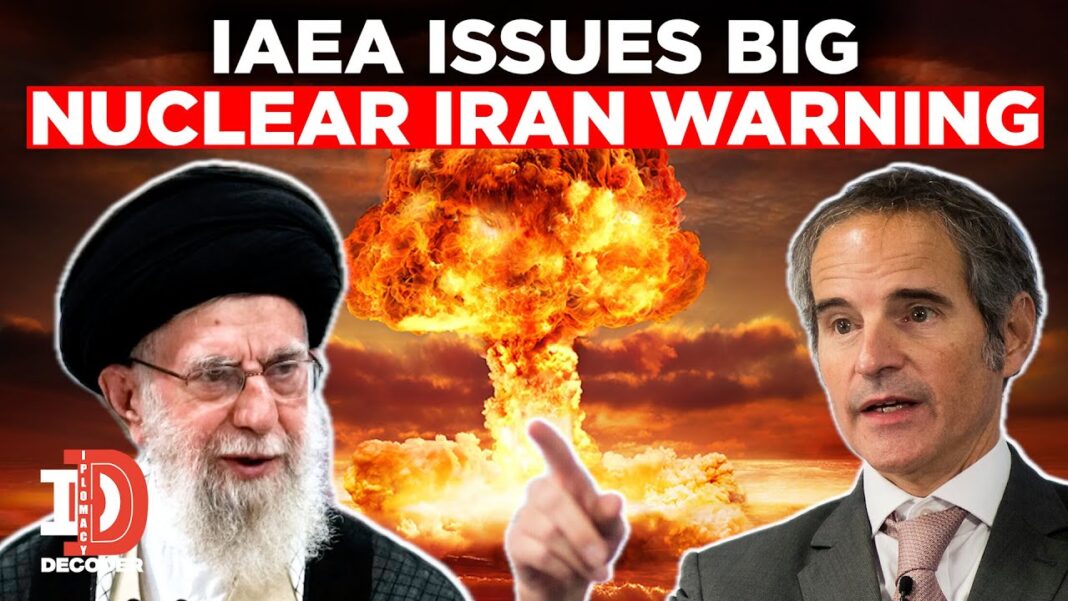
Iran now possesses enough highly enriched uranium to build ten nuclear weapons if it chose to take the final step toward weapons-grade enrichment, the head of the United Nations nuclear watchdog warned this week — a revelation that underscores the deepening international anxiety over Tehran’s nuclear ambitions and the fragile state of regional stability.
In a detailed interview with the Swiss daily Le Temps, Rafael Grossi, Director General of the International Atomic Energy Agency (IAEA), disclosed that Iran’s current stockpile includes approximately 400 kilograms of uranium enriched to 60 percent purity, an unprecedented level for a country officially committed to civilian nuclear purposes. While weapons-grade uranium requires enrichment of roughly 90 percent, Grossi cautioned that the remaining step is technically small — though politically monumental.
“If it went further,” he said, “Iran would have enough material for roughly ten nuclear bombs.” However, he emphasized that the IAEA “has no evidence that Tehran intends to build one.”
According to a report that appeared on Wednesday at Iran International (iranintl.com), Grossi’s remarks come amid a volatile backdrop: mounting tensions between Tehran, Jerusalem, and Washington following the June attacks on Iran’s nuclear facilities — strikes widely attributed to the United States and Israel during a twelve-day conflict that left several key enrichment sites in ruins.
The interview marks one of Grossi’s most candid assessments to date of Iran’s nuclear capabilities since the resumption of limited monitoring in late 2024. Analysts cited by Iran International described his comments as “a sober warning” that, while Iran may not be actively building nuclear weapons, it is now a de facto threshold state — capable of doing so swiftly should it choose.
Grossi revealed that the IAEA’s latest assessments, based on pre-strike inspections and subsequent satellite imagery, confirm that Iran’s stockpiles remain largely intact in Isfahan, Natanz, and Fordow — the three sites at the heart of its nuclear infrastructure.
“The technical know-how has not vanished,” Grossi told Le Temps, adding that while President Donald Trump and Israeli Prime Minister Benjamin Netanyahu have spoken of “obliteration,” the IAEA’s findings suggest Iran’s enrichment capacity remains formidable, though severely disrupted.
As Iran International reported, Grossi’s acknowledgment of “severe” damage to Iran’s key facilities sheds light on the impact of the joint Israeli-American airstrikes in June. Those operations, targeting uranium centrifuges and electrical systems at enrichment facilities, were intended to cripple Iran’s nuclear potential and delay its ability to produce fissile material. Yet, the IAEA chief’s statement implies that Iran’s scientific and technical capabilities — the human capital behind its nuclear enterprise — survived largely intact.
Following the 12-day confrontation, both Iran and the IAEA agreed in September to a framework for renewed cooperation, but as Iran International has reported, progress has been minimal. Tehran has allowed inspectors to re-enter certain bombed facilities “in dribs and drabs,” Grossi said, citing Iran’s security concerns as the rationale for its restricted access.
“For now, Tehran is only allowing inspectors in dribs and drabs,” Grossi explained. “It’s imposing limits out of security concerns — which I understand. But if diplomacy fails, I fear a renewed resort to force.”
The prospect of another military escalation looms large. Iranian officials continue to accuse Western nations of “instrumentalizing” the IAEA’s technical findings to justify sanctions and political pressure. Meanwhile, the U.S. and Israel have made clear that renewed uranium enrichment beyond current levels would trigger “immediate consequences.”
In its latest analysis, Iran International described the situation as a “deadly diplomatic paradox” — a tense equilibrium in which both sides are maneuvering to avoid war, yet each is preparing for its eventuality.
The most striking divergence from previous assessments came from President Donald Trump and Prime Minister Benjamin Netanyahu, both of whom claimed that Iran had resolved to “race toward a bomb” following the June strikes. Their statements — made in the aftermath of Israel’s targeted operations — appeared to contradict the conclusions of U.S. intelligence agencies, which have repeatedly maintained that Iran has not made the political decision to weaponize its nuclear program.
Tehran, for its part, vehemently denies seeking nuclear weapons, asserting that its nuclear activities are strictly for civilian and energy purposes under the Non-Proliferation Treaty (NPT) framework. Iranian officials have accused Washington and Jerusalem of waging an information campaign designed to justify future strikes and perpetuate economic sanctions.
Grossi, a veteran Argentine diplomat whose tenure at the IAEA has been marked by cautious diplomacy, tried to bridge the divide. He reiterated that while Iran’s nuclear trajectory is concerning, the IAEA has seen “no evidence” of weaponization. Yet, he warned that the current trajectory is “unsustainable without full transparency.”
Despite the mutual recriminations, Grossi expressed cautious optimism that Iran remains open to dialogue. “After the twelve-day war, Iran could have cut ties with the international community, withdrawn from the Non-Proliferation Treaty, and become a pariah state like North Korea. It didn’t,” he said.
This restraint, he suggested, demonstrates Tehran’s continued desire to maintain diplomatic channels, even as it faces crushing sanctions and internal political turmoil. According to Iran International, Grossi continues to maintain “direct, regular contact” with Iranian Foreign Minister Abbas Araghchi, describing their exchanges as “a fragile but necessary line of communication.”
“I’m maintaining diplomatic space by keeping regular contact with Foreign Minister Abbas Araghchi,” he said. “That space must be preserved, because the alternative is confrontation.”
The IAEA’s ability to resume unfettered inspections, Grossi emphasized, is central to avoiding that outcome. “Inspections must resume to be certain,” he said, noting that “countries tracking Iran’s program have reached the same conclusions as we have.”
In parallel with Grossi’s comments, Iran’s Foreign Ministry spokesman Esmail Baghaei reiterated Tehran’s doctrine of balancing deterrence with dialogue. “Iran must rely on both its missile capabilities and diplomacy to safeguard national interests,” Baghaei told reporters in Tehran.
This statement, reported extensively at Iran International, reflects Iran’s enduring belief in “strategic resilience” — maintaining its missile program as leverage while engaging in negotiations to relieve economic isolation. Analysts have described this dual-track approach as the cornerstone of Iran’s regional strategy, designed to project power while avoiding outright confrontation.
“Every time Iran comes under pressure, it accelerates enrichment to increase its bargaining power,” said a senior analyst quoted by Iran International. “But this time, the stakes are higher. With 400 kilograms of 60 percent uranium, Iran is much closer to a breakout capability than ever before.”
The IAEA’s findings arrive at a time when Middle East diplomacy is once again being redefined by shifting alliances. The Trump administration’s Gaza peace framework, coupled with its renewed defense pacts with the Gulf states, has intensified Iran’s sense of encirclement. Meanwhile, Israel’s government continues to lobby Washington for a more aggressive stance, arguing that the IAEA’s limited access proves Iran’s bad faith.
“Iran’s threshold capability is now a global concern,” Iran International observed in an editorial on Wednesday. “The country stands at a nuclear crossroads — one that could define the security architecture of the Middle East for decades to come.”
European governments, too, have expressed frustration with Tehran’s lack of transparency. France and Germany have called for the full restoration of the Joint Comprehensive Plan of Action (JCPOA), while Britain has floated the possibility of a new interim deal tied to limited sanctions relief.
Yet, as the Iran International report noted, the political landscape has changed dramatically since the original 2015 accord. Iran’s leadership is more hardline, its nuclear infrastructure more advanced, and its economic resilience — buoyed by clandestine oil sales to Asia and trade with Russia — stronger than at any point in the past decade.
For Rafael Grossi, the challenge now lies in re-establishing trust and verification before the nuclear threshold becomes irreversible. His appeal for renewed diplomacy echoes across a region exhausted by war and wary of escalation.
“The choice is between managed transparency and managed conflict,” Iran International quoted one European diplomat as saying. “If inspections do not resume soon, the temptation for pre-emptive strikes will grow.”
Grossi himself has warned that another breakdown in communication could lead to catastrophe. “If diplomacy fails,” he said, “I fear a renewed resort to force.”
As the IAEA chief navigates between technical rigor and geopolitical tension, his warning underscores a sobering truth: while Iran may not yet be building the bomb, it already possesses the means to do so — and the world, once again, is teetering on the edge of a nuclear crisis.