



|
Getting your Trinity Audio player ready...
|
By: Fern Sidman
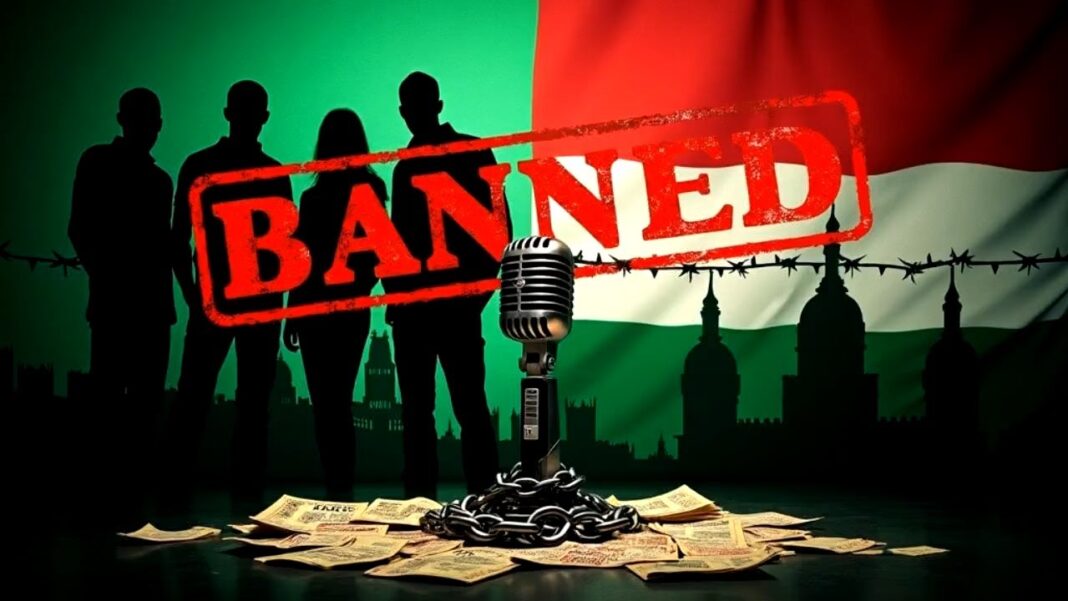
In a move that illustrates Hungary’s staunch policy against antisemitism and terror glorification, the Hungarian government has officially barred the controversial Northern Irish band Kneecap from entering the country, citing national security concerns. The decision, announced less than a month before the group was scheduled to perform at the renowned Sziget Festival in Budapest, has drawn both praise and criticism across cultural and political circles.
The three-member hip-hop group from Belfast was set to perform on August 11, the final day of the week-long Sziget Festival, widely regarded as one of Europe’s most prominent music gatherings. However, as reported on Thursday by The Jewish News Syndicate (JNS), Hungarian authorities intervened preemptively, invoking the government’s well-established “zero tolerance” policy toward antisemitism and extremism.
Hungarian government spokesman Zoltán Kovács took to social media to explain the rationale behind the ban, citing “antisemitic hate speech and open praise for Hamas and Hezbollah” as grounds for the action. Kovács emphasized that the decision was aligned with the country’s ongoing commitment to protecting Jewish communities and maintaining public security.
JNS reported that Hungary’s Minister for European Union Affairs, János Bóka, had previously issued a formal letter to Sziget Festival organizers on July 11, informing them of the state’s opposition to Kneecap’s scheduled appearance. The letter referred directly to the group’s past statements and behavior, stating that allowing Kneecap to perform would violate Hungary’s core principles and its public security policies.
“Hungary will not permit individuals or groups that glorify designated terrorist organizations to perform on its soil,” the letter read, according to the JNS report. “There is no place in Hungarian society for hate speech or incitement to violence, no matter how it is dressed up as political expression.”
Prime Minister Viktor Orbán’s administration has consistently promoted Hungary as one of Europe’s safest environments for Jewish life. As JNS has repeatedly noted, Orbán’s government has taken a clear and public stance against rising antisemitism in the continent, reinforcing protections for Jewish citizens even as antisemitic incidents surge elsewhere in Europe.
The government’s decision has received widespread backing from Hungary’s artistic and cultural sectors. According to the information provided in the JNS report, hundreds of Hungarian musicians, cultural leaders, and arts professionals signed a petition demanding that Sziget Festival drop Kneecap from its lineup, expressing concern over the band’s inflammatory messaging.
Their appeals appear to have played a role in prompting governmental review. “This is not about censorship—it’s about safeguarding the integrity of our society,” the petition stated, as quoted in the JNS report. “We refuse to normalize incitement, antisemitism, or the endorsement of terrorism under the guise of performance art.”
Kneecap’s troubles stem largely from its lead vocalist, Liam Óg Ó hAnnaidh (stage name: Mo Chara), who is currently facing legal proceedings in the United Kingdom. As the JNS report detailed, O’Hanna was charged under the UK’s Anti-Terrorism Act following a November 2024 performance in London where he was filmed displaying a Hezbollah flag while shouting, “Up Hamas, up Hezbollah.” Both organizations are classified as terrorist groups by the UK government.
The Metropolitan Police noted that the display was made “in such circumstances as to arouse reasonable suspicion that he is a supporter of a proscribed organization,” as reported by JNS. His first court appearance occurred on June 18, and he is expected to appear again on August 20. O’Hanna is currently out on bail.
Further controversies followed in June at the Glastonbury Festival, where O’Hanna declared on stage that “Israel are war criminals” and led the crowd in chanting “Free, free, Palestine.” These comments drew intense criticism, particularly given the mounting antisemitic incidents across the continent.
The group also made headlines in April when it used its set at the Coachella Valley Music and Arts Festival in California to display incendiary messages on stage screens, including “Israel is committing genocide against the Palestinian people” and “F*** Israel, free Palestine.” Following that performance, Kneecap was dropped by its U.S. booking agency and visa sponsor, according to the report at JNS.
The international repercussions for Kneecap have been swift and severe. In early July, the municipal council of Saint-Cloud, a suburb west of Paris, revoked a €40,000 grant designated for the Rock en Seine music festival over the inclusion of Kneecap in the event’s program. The council declared that public funds would not be used to support political incitement or hate speech, a decision applauded by French Jewish leaders.
In Canada, the backlash continued. A coalition of Indigenous leaders penned a formal request for the cancellation of Kneecap’s upcoming concert tour in the country, expected to take place in October. “Kneecap has outwardly supported antisemitism, genocide and the indiscriminate murder of civilians,” the letter stated. JNS reported that Canadian venues and concert promoters are now reviewing the group’s eligibility to perform.
Additionally, as The New York Times noted and the JNS report highlighted, Kneecap’s 21-date North American tour may now be imperiled by visa obstacles stemming from the group’s legal entanglements and rising international disapproval.
The ban placed by Hungary signals a broader shift in how European governments may respond to artists perceived as promoting extremism or disseminating hate speech. While some have raised concerns about potential encroachments on artistic freedom, JNS reported that the Hungarian government maintains that its actions are rooted in a principled stance against antisemitism and terrorism—values that it considers paramount in the wake of increasing radicalization across the cultural sphere.
Kneecap, for its part, continues to deny wrongdoing. “We deny this ‘offense’ and will vehemently defend ourselves,” the band said in a statement provided to festival organizers. Nevertheless, their efforts to distance themselves from the growing list of accusations have done little to reverse the momentum of institutional pushback.
Hungary’s decision to bar Kneecap from its borders—just days before their slated performance at one of Europe’s most celebrated music festivals—speaks volumes about the country’s unwavering commitment to combating antisemitism and terrorism, even when cloaked in the garb of popular culture. As the JNS report indicated, the controversy surrounding Kneecap has become a flashpoint in the global conversation about the limits of artistic expression, national security, and the defense of Jewish communities in the 21st century.
At a time when Europe faces a troubling surge in antisemitic incidents and pro-terror rhetoric, Hungary has made clear that it is prepared to draw a firm line. Whether other nations will follow suit remains to be seen.
Kneecap meet sledgehammer.