



|
Getting your Trinity Audio player ready...
|
By: Fern Sidman
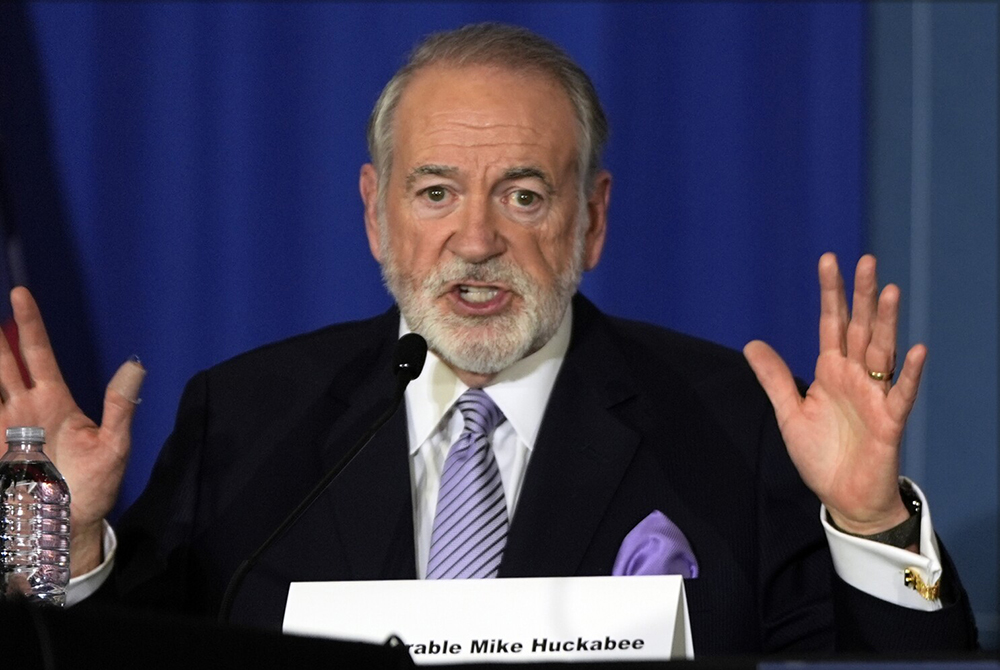
U.S. Ambassador to Israel Mike Huckabee has launched a blistering critique of Ireland’s proposed legislation that would criminalize the importation of goods produced in Israeli communities across Judea, Samaria, and East Jerusalem, according to a report that appeared on Wednesday at VIN News. The outspoken diplomat, known for his unwavering support of Israel, took to social media on Monday to deliver a sharply worded rebuke.
“Did the Irish fall into a vat of Guinness & propose something so stupid that it would be attributed to act of diplomatic intoxication?” Huckabee tweeted. “It will harm Arabs as much as Israelis. Sober up Ireland! Call Israel & say you’re sorry!”
As VIN News has reported, the bill in question—officially titled the Israeli Settlements (Prohibition of Importation of Goods) 2025—is now moving through the Irish legislative process and is expected to pass within weeks. Should it be enacted, Ireland would become the first European Union member state to impose a legal ban on imports originating from Jewish communities in territories broadly labeled by international entities as “occupied Palestinian land.”
The bill’s advancement has ignited fierce opposition from Jewish leaders within Ireland, as well as prominent voices from the international Jewish community. During a Tuesday session of the Irish Parliament’s Committee on Foreign Affairs, former Irish Justice Minister Alan Shatter, representing the Ireland Israel Alliance, delivered a scathing comparison. According to the report at VIN News, Shatter warned that the measure “echoes legislation drafted during the Nazis in the 1930s,” a historical parallel that has intensified the controversy surrounding the bill.
Maurice Cohen, Chair of the Jewish Representative Council of Ireland, also spoke before the committee, warning that the proposed legislation “sends an anti-Jewish message,” whether by design or default. “This is not diplomacy. This is not a strategy. It’s performance politics dressed as principle. And in that theatre, we’re not helping Palestinians — we’re just congratulating ourselves,” Cohen stated during his remarks, calling attention to concerns shared by Ireland’s Jewish community about the broader implications of the measure.
Further amplifying Jewish opposition, Irish Chief Rabbi Yoni Wieder addressed the committee, cautioning that the legislation “demonizes Israel” rather than targeting actual sponsors of terrorism such as Iran and Hamas. The VIN News report noted that Wieder later expanded on his remarks in a message to The Times of Israel, asserting, “If Ireland was genuinely motivated by humanitarian concerns as the committee said today, it would also be trying to put pressure on Hamas to release the hostages.”
VIN News reported that concern over the bill has extended far beyond Ireland’s borders. Major U.S.-based Jewish organizations have united in opposition, issuing a joint statement decrying the legislation’s potential impact. The American Jewish Committee, the Anti-Defamation League, B’nai B’rith International, and the Conference of Presidents of Major American Jewish Organizations jointly warned that the bill “could create significant risks for US companies doing business in Israel and would fuel rising antisemitic and anti-Zionist sentiment in Ireland and elsewhere.” The statement further argued that the legislation “undermines the prospect for a negotiated two-state solution by attempting to unilaterally predetermine the final status of disputed territories.”
The controversy surrounding the Irish bill reflects growing international tensions over trade policies linked to the Israeli-Palestinian conflict. According to the information provided in the VIN News report, the move by Irish lawmakers has drawn criticism for potentially disrupting diplomatic efforts, threatening business ties, and fostering an atmosphere that Jewish leaders fear may embolden antisemitic rhetoric.
Ambassador Huckabee’s comments have amplified U.S. diplomatic engagement in the matter. The ambassador’s direct rebuke of Ireland—a nation with historically strong ties to both the European Union and the Palestinian cause—signals that Washington may not remain silent if the legislation proceeds to final passage.
On July 3rd, it was reported that in a striking escalation of tensions between Washington and Dublin, Senate Foreign Relations Committee Chairman James Risch (R-ID) delivered a searing condemnation of Ireland’s recent policies targeting Israeli trade, accusing the Irish government of “embracing antisemitism” and warning of potential economic consequences should the legislation proceed.
Risch’s remarks, delivered via a post on X and reported by The Algemeiner, mark one of the most pointed warnings to a U.S. ally in recent memory over its stance toward the State of Israel. “Ireland, while often a valuable U.S. partner, is on a hateful, antisemitic path that will only lead to self-inflicted economic suffering,” Risch declared. “If this legislation is implemented, America will have to seriously reconsider its deep and ongoing economic ties. We will always stand up to blatant antisemitism.”
As The Algemeiner report indicated, Risch’s warning comes against the backdrop of intensifying diplomatic friction between Ireland and Israel—a rift that widened significantly following the Hamas-led terrorist assault on southern Israel on October 7, 2023. That attack, which claimed the lives of approximately 1,200 Israelis and resulted in 251 hostage abductions, prompted a forceful Israeli military response in Gaza. While the U.S. has largely supported Israel’s right to self-defense, Dublin has emerged as one of the most vociferous international critics of Israel’s conduct during the war.
Ireland’s criticism has been matched by tangible policy measures. In May 2024, the Irish government formally recognized a Palestinian state—making it one of the first EU countries to do so in the wake of the conflict. The move was met with outrage in Jerusalem. Israel’s foreign ministry condemned the recognition as “a gift to terror,” and Israel subsequently recalled its ambassador from Dublin. As The Algemeiner report noted, the diplomatic freeze has since deepened, with Irish lawmakers proposing a series of measures aimed at curbing trade with Israeli settlements in the West Bank—measures viewed by critics as thinly veiled support for the global Boycott, Divestment, and Sanctions (BDS) movement.
The latest legislative proposal, currently under consideration in the Irish parliament, would restrict imports of goods produced in Israeli settlements—an initiative Risch and others have described as discriminatory and economically provocative. “This isn’t principled diplomacy,” one Republican aide told The Algemeiner. “It’s punitive grandstanding.”
Risch’s threat to reassess economic ties between the U.S. and Ireland carries significant weight. The United States is one of Ireland’s largest foreign investors, with multinationals such as Apple, Google, Meta, and Pfizer operating large-scale European headquarters in Dublin and surrounding areas. According to the report in The Algemeiner, Ireland’s pro-business tax regime and EU access have long made it an attractive base for American capital—a foundation that could be shaken if bilateral relations deteriorate further.
While the Trump administration has not formally endorsed Risch’s warning, it has expressed growing concern over European efforts to isolate Israel diplomatically. The State Department has stopped short of criticizing Ireland directly but has issued general statements discouraging unilateral measures that could “undermine the pursuit of lasting peace.”
Nevertheless, Risch’s comments signal that bipartisan patience in Washington may be fraying. “This isn’t just about Israel,” said a senior Senate Republican aide to The Algemeiner. “It’s about whether key U.S. partners will continue to treat our shared democratic values—including opposition to antisemitism—as foundational or optional.”
Irish public opinion has long leaned heavily pro-Palestinian. Political discourse in Dublin routinely invokes historical parallels between Ireland’s colonial experience and the Palestinian cause. These sympathies have intensified in recent months amid graphic media reports of destruction in Gaza and rising civilian casualties.
Irish Prime Minister Simon Harris has defended his government’s positions as grounded in “humanitarian law and moral clarity.” However, critics in Israel and the U.S. argue that the Irish government’s approach lacks balance and betrays a pattern of hostility toward the Jewish state.
Risch’s message may resonate most with centrist voices in Irish politics, particularly given Ireland’s economic dependence on foreign direct investment. “No responsible government should sacrifice a strategic transatlantic relationship on the altar of performative diplomacy,” said a former U.S. ambassador to Ireland in remarks to The Algemeiner. “The costs will be real, and they won’t be borne by the political class—they’ll be borne by workers and families in Ireland.”
The growing chasm between Ireland and Israel—now threatening to draw in U.S. economic policy—raises broader questions about the future of Western alliances amid deepening divisions over the Gaza war. The alignment of traditionally liberal European democracies with anti-Israel positions reflects a shifting international landscape—one in which democratic solidarity is increasingly tested by populist pressure, social media activism, and moral absolutism.
For Risch, the line is clear. “We will always stand up to blatant antisemitism,” he concluded in his post. Whether Dublin sees its path as one of principled dissent or diplomatic isolation remains to be seen. But as The Algemeiner report observed, “Ireland may soon discover that moral symbolism carries a price—and Washington is no longer willing to subsidize both sides of that equation.”
Ireland has long been a Nazi state.
Simply put, Israel is committing genocide. Most Americans (Irish Americans & others) don’t want to support ethnic cleansing with our tax dollars.