



|
Getting your Trinity Audio player ready...
|
By: Abe Wertenheim
In a development that has drawn international attention, Henry Hamra, a Syrian-born Jew now living in the United States, has launched a campaign for a parliamentary seat in Damascus in what will be Syria’s first legislative elections since the ouster of longtime dictator Bashar al-Assad. The elections, set for Sunday, could mark a historic milestone: if elected, Hamra would become the first Jewish representative in the Syrian parliament since the 1940s. The media has followed his candidacy closely, noting its significance not only for Syria’s fractured political landscape but also for the visibility of its nearly vanished Jewish community.
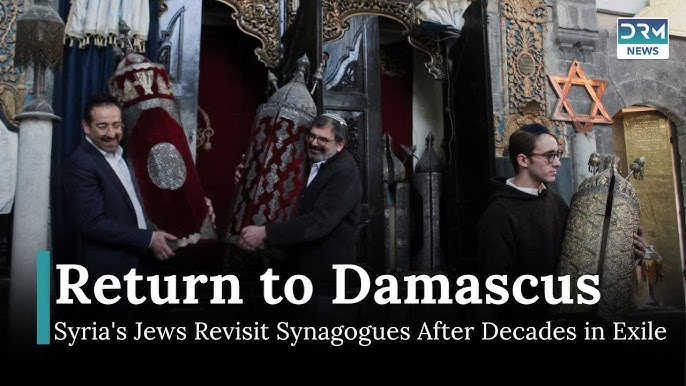
Hamra, who fled Damascus in 1992 at the age of 15, is no stranger to the hardships endured by Syrian Jews in the latter half of the 20th century. His father, Rabbi Yusuf Hamra, was widely recognized as the last chief rabbi of Syria before the community was all but extinguished. According to a report at VIN News, father and son returned to Damascus this past February, where they joined a group prayer at the historic Faranj synagogue — their first visit to the holy site in more than three decades.
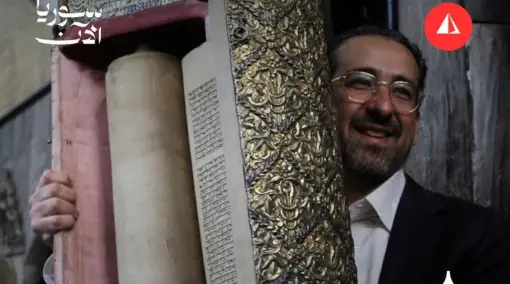
The symbolism of their return was not lost on observers. It represented both a personal pilgrimage and a political signal: that the small remnants of Syria’s Jewish population, once numbering around 100,000 and now reduced to only a handful, may be regaining a voice in national life.
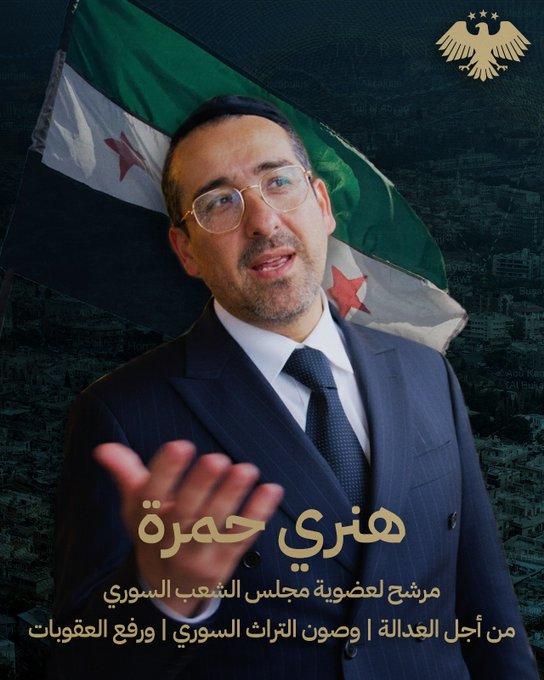
Posters for Hamra’s campaign have appeared throughout Damascus’ Old Jewish Quarter, emblazoned with his image next to the Syrian flag. The slogan reads simply: “Candidate for Damascus for the Syrian People’s Assembly.”
The campaign has already sparked widespread discussion across Arab media and social platforms. The image of a Jewish candidate in the heart of Damascus is striking in itself, especially after decades in which Jews were excluded from political life, and their cultural footprint was steadily erased or ignored.
Hamra has emphasized that his platform is not narrowly sectarian. Instead, he envisions himself as a candidate for all Syrians, with policies centered on preserving Syria’s rich cultural heritage, strengthening its national identity, and building bridges with the diaspora.
A central theme of Hamra’s campaign has been the need to repeal the U.S. Caesar Act sanctions, which have crippled Syria’s economy since 2019. The sanctions, imposed in response to Assad’s atrocities during the civil war, restrict Damascus’ ability to access global financial networks and have contributed to widespread shortages of food, medicine, and fuel.
Hamra has argued that the sanctions harm ordinary Syrians more than the political elites they were designed to punish. As VIN News highlighted in an exclusive report, he has pledged to work with the Syrian diaspora — including communities in the United States and Europe — to build a coalition for lifting sanctions and fostering reconstruction.
At the same time, Hamra’s platform stresses tolerance and inclusion. He has spoken of promoting “a flourishing, tolerant, and just Syria,” where Jews, Christians, Muslims, and other groups can coexist as they once did in the country’s golden eras of cultural pluralism.
Hamra’s bid carries deep historical resonance. Historian Sami Moubayed noted that the last Jewish member of Syria’s parliament was elected in 1947, just before the creation of the State of Israel and the subsequent Arab-Israeli wars that sparked waves of persecution and emigration for Jews across the Middle East.
The intervening decades saw Syria’s once-thriving Jewish community wither under government repression, travel restrictions, and rising hostility. Most of the community fled, often clandestinely, to Israel, the United States, or Europe. By the 1990s, only a few dozen Jews remained, scattered in Damascus and Aleppo.
For community leader Bakhour Chamntoub, Hamra’s candidacy represents a long-awaited reversal. He told VIN News that the bid was “a positive step” and pointed to the new government’s outreach efforts, including recent meetings with Syrian Jewish representatives in New York during the United Nations General Assembly.
Sunday’s vote will fill 210 seats in Syria’s parliament, though analysts stress that the process remains tightly controlled. According to the information provided in the VIN News report, two-thirds of the seats will be chosen by local committees with close ties to the regime, while the remainder will be appointed directly by President Ahmed al-Sharaa. Critics inside and outside Syria have derided the system as undemocratic and little more than a cosmetic exercise.
Nevertheless, Hamra’s participation is significant. Even if the election does not represent genuine democratic choice, the visibility of a Jewish candidate could signal a tentative opening under the new government, which has sought to project a more inclusive image following Assad’s ouster.
A striking feature of Hamra’s platform is his insistence on reconnecting the global Syrian Jewish diaspora with its ancestral homeland. Tens of thousands of Jews of Syrian origin live today in New York, Miami, Panama, Mexico City, and Jerusalem. Many of them maintain strong cultural ties to Syria, speaking Arabic at home and preserving Syrian liturgical traditions.
Hamra believes these communities could play a role in Syria’s reconstruction, both by investing in the economy and by restoring historic Jewish sites. The preservation of synagogues, cemeteries, and cultural institutions, he says, should be part of a broader campaign to celebrate Syria’s multi-religious past and move beyond the exclusivist nationalism that marked the Assad era.
Arab media coverage of Hamra’s campaign has been intense, ranging from cautious optimism to outright skepticism. Some commentators see his candidacy as symbolic, designed by the government to demonstrate inclusivity without real power-sharing. Others, however, point to the very act of allowing a Jewish candidate to run as a meaningful gesture.
Among Jewish communities abroad, the reaction has been equally mixed. For many Syrian Jews in the diaspora, Hamra’s run stirs deep nostalgia and pride. For others, memories of persecution remain too raw, and they question whether the new government can truly guarantee the safety of Jews in Syria.
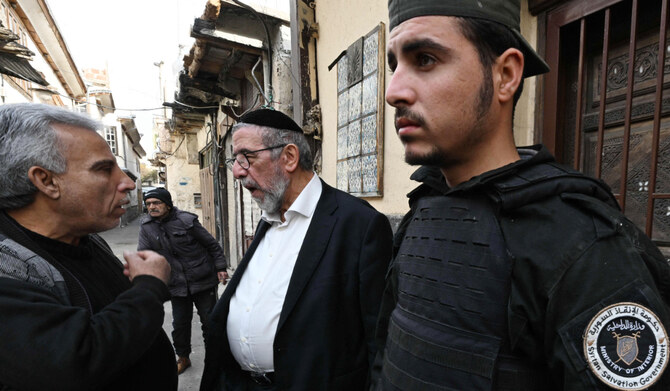
Hamra’s path is not without obstacles. Running as a Jewish candidate in Damascus carries inherent risks, given the prevalence of anti-Israel sentiment and the enduring scars of decades of state-sponsored antisemitism.
Moreover, his advocacy for repealing U.S. sanctions may expose him to criticism from Syrian opposition figures who argue that the Caesar Act is one of the few tools available to pressure the regime.
Nonetheless, VIN News reported that Hamra has thus far navigated these challenges with careful messaging, framing his campaign not as an ethnic or religious cause, but as part of a larger vision for national unity and recovery.
Whether or not Hamra wins a parliamentary seat, his candidacy has already achieved a symbolic breakthrough. This is the first time in nearly 80 years that a Jew has stood for office in Syria’s legislature.
For a community that has dwindled to the brink of extinction, the sight of campaign posters in Damascus’ Jewish Quarter featuring a Jewish candidate is profoundly moving. It suggests that even in a country scarred by war, dictatorship, and sectarian strife, there remains the possibility of renewal and reconciliation.
As Syria heads to the polls on Sunday, Henry Hamra’s candidacy will be closely watched not only in Damascus but across the world. For the Jewish diaspora, it represents a flicker of recognition in a homeland long lost. For Syria, it is a test of whether the new political order is prepared to move beyond the exclusionary practices of the past.
Hamra’s story is larger than one campaign. It is the story of a people nearly erased from Syrian life, now reasserting their presence in the country’s political and cultural fabric. Whether symbolic or substantive, this moment carries weight.
As Hamra himself put it in one of his campaign addresses: “Syria’s future must be for all Syrians — Muslims, Christians, Jews, Druze, and others. Only together can we build a flourishing, tolerant, and just Syria.”
Rabbi Yusuf Hamra — The Last Chief Rabbi of Syria
For decades, Rabbi Yusuf Hamra carried the weight of an entire community on his shoulders. Known as the last chief rabbi of Syria, his life’s work was to preserve the dignity, traditions, and survival of a once-vibrant Jewish population that had been reduced to only a handful of families.
Born in Damascus in the mid-20th century, Rabbi Hamra came of age at a time when Syria’s Jewish community still numbered in the tens of thousands. By the time he assumed religious leadership in the 1970s, however, their situation had become dire. The Arab-Israeli wars of 1948 and 1967, along with the rise of Arab nationalism, left Syria’s Jews increasingly vulnerable. Many were forbidden from emigrating, their property was confiscated, and synagogues were placed under heavy surveillance.
Rabbi Hamra became both a spiritual leader and a negotiator, maintaining delicate relations with the Syrian authorities while advocating discreetly for the rights and safety of his flock. His leadership extended far beyond Damascus’ synagogues. He became the central point of contact between the Jewish community and the Syrian state, mediating disputes, securing access to kosher food, and ensuring that Jewish traditions could be observed under the watchful eye of government officials.
During Rabbi Hamra’s tenure, Syrian Jews lived under constant suspicion, often accused of disloyalty or of secretly aiding Israel. Travel restrictions were severe. Families who tried to flee risked imprisonment or worse. Yet Rabbi Hamra remained steadfast, navigating between the regime’s demands and the community’s desperate desire to survive.
International Jewish organizations frequently described him as a man of quiet courage. He could not openly confront the authorities, but he worked tirelessly behind the scenes to alleviate pressure on his community. At times, his role required delicate compromises; at other times, it demanded extraordinary personal risk.
By the early 1990s, under growing international pressure, the Syrian government began to allow Jews to emigrate. Rabbi Hamra himself left Damascus in 1994, relocating first to the United States and later spending time in Israel. Even in exile, he continued to be recognized as the symbolic leader of Syrian Jewry, maintaining connections with the diaspora communities in Brooklyn, Deal, Miami, and beyond.
His departure marked the end of an era. For centuries, Syrian Jewry had played a vital role in the religious, cultural, and commercial life of the Middle East. With Rabbi Hamra’s exit, that chapter effectively closed, leaving behind only remnants of a once-flourishing community.
The candidacy of his son, Henry Hamra, in Damascus’ upcoming parliamentary elections, has brought renewed attention to Rabbi Hamra’s legacy. As VIN News has noted in its coverage, the elder Hamra represents the last bridge between Syria’s Jewish past and its uncertain future. His life encapsulates both the hardships and the resilience of a community that refused to be extinguished, even in the face of systemic discrimination and exile.
Community leaders in the Syrian Jewish diaspora often recall Rabbi Hamra’s role as a guardian of heritage. He ensured that sacred sites like the Faranj synagogue in Damascus and the Jobar synagogue outside the city were not forgotten, even as they fell into disrepair. His emphasis on education, tradition, and unity laid the groundwork for Syrian Jews to flourish abroad, even as their presence in their homeland dwindled.
Today, Rabbi Yusuf Hamra’s name is invoked with reverence among Syrian Jews worldwide. His passing in 2021 was marked with memorial services across multiple continents, a testament to the far-flung yet interconnected nature of the diaspora he shepherded into survival.
For many, Henry Hamra’s bid for parliament is not just a political candidacy but a continuation of his father’s legacy: a reclamation of visibility, a demand that Jewish voices still be heard in Syria.
As one community leader told VIN News: “Rabbi Hamra kept the candle burning when it seemed all was lost. His son now carries that flame back to Damascus. Whatever the outcome, the Hamra family will always symbolize the endurance of Syrian Jewry.”
That vision, however fragile, is a reminder that even in the most unlikely places, the possibility of coexistence can still flicker to life.
