



|
Getting your Trinity Audio player ready...
|
By: Fern Sidman – Jewish Voice News
On the eve of Pope Leo XIV’s highly anticipated arrival in Beirut, Hezbollah issued a statement that was ostensibly a gesture of welcome but functioned, in reality, as a sweeping and choreographed denunciation of Israel. The messaging, released ahead of the pontiff’s landing following his diplomatic visit to Turkey, has already come under scrutiny from regional observers, faith leaders, and security analysts. As World Israel News reported on Saturday, the carefully constructed document signals Hezbollah’s intent to harness the political theater of the papal visit to advance its long-standing ideological campaign against the Jewish state.
In its opening paragraphs, Hezbollah attempted to cast Lebanon in a romanticized light—a crossroads of civilizations, a space where religious identities intermingle, and a beacon of pluralism in the Middle East. Its declaration that “Lebanon, with its diverse composition, represents a civilizational link between the followers of the two Abrahamic faiths, Christianity and Islam” was, as the World Israel News report noted, an unsurprising rhetorical flourish for a group seeking to legitimize itself before an international religious audience. The statement further claimed that Lebanon stands at the intersection of “religious, cultural, and secular trends in every country and continent of the world,” a depiction that glosses over the profound fractures, demographic shifts, and sectarian power struggles that have transformed Lebanon in recent decades.
Yet the group’s selective invocation of Lebanon’s supposed pluralism was particularly striking for what it omitted. As the World Israel News report emphasized, Hezbollah made no reference to the near-erasure of Lebanon’s Jewish community—a once-vibrant population now reduced to roughly one hundred individuals who, for safety, practice their traditions in almost complete secrecy in Beirut. In a country that once hosted thriving synagogues and Jewish schools, the absence of even a perfunctory acknowledgment revealed the hollowness of Hezbollah’s claims of inclusivity. A statement that prided itself on Lebanon’s “civilizational link” deliberately sidestepped the story of the very Abrahamic community that has been pushed to the brink of disappearance—an omission with unmistakably political implications.
As the statement progressed, Hezbollah shifted tone, broadening its commentary to global tensions and claiming that the world’s conflicts arise from the refusal of certain actors to respect the rights of others. This moralizing rhetoric—asserting conflicts stem from differences in race, religion, color, or language—stood in stark contradiction to Hezbollah’s own record of violence against Lebanese civilians, particularly Lebanese Christians. As the World Israel News report recalled, the assassination of Elias Hasrouni in 2023 and the abduction and killing of Pascal Sleiman the following year remain searing reminders of Hezbollah’s willingness to use intimidation and brute force to shape Lebanon’s political landscape. These acts have left profound scars on Christian communities, revealing the group’s selective application of the principles it so confidently lectures the world about.
Nevertheless, Hezbollah’s statement attempted to position the group as a defender of humanity and a guardian of rights. It framed Israel at the epicenter of global instability, claiming that the ongoing war in Gaza reflects nothing less than a worldwide crisis in basic human rights protections. As World Israel News reported, Hezbollah characterized the conflict as “a tragedy resulting from the Zionist occupiers’ persistence in usurping the rights of the Palestinian people to their land, their homeland, and their right to self-determination.” This framing, predictably, made no mention of Hamas’ October 7 atrocities, the deliberate targeting of civilians, or the role of Hezbollah itself in prolonging regional hostilities.
The statement’s language—asserting that the international community consistently sides against “the rightful owners of the land and homeland”—reflects the group’s longstanding rhetorical playbook, one that merges maximalist political claims with accusatory moral positioning. Hezbollah’s narrative attempts to strip Israel of legitimacy while simultaneously presenting the group as an aggrieved defender of justice. As the World Israel News report highlighted, such narratives often fall apart upon closer scrutiny, particularly when weighed against Hezbollah’s own track record of internal repression, extrajudicial killings, and deeply destabilizing entanglements in Syria’s civil war.
The organization then escalated its rhetoric further by portraying Lebanon itself as a victim of alleged Israeli aggression. It claimed that Israel’s actions have harmed Lebanon’s “security and stability,” driven by a desire to control Lebanese “water, land, and gas wealth.” These accusations—standard components of Hezbollah’s ideological lexicon—were presented as though they were uncontested facts rather than allegations steeped in political opportunism. Hezbollah consistently uses such narratives to justify its military buildup in southern Lebanon and to portray itself as Lebanon’s indispensable resistance force, even as many Lebanese citizens view the group’s militarization as the primary source of their precarious national security environment.
In an especially incendiary passage, Hezbollah declared that Israel is committing “a clear act of genocide” in Gaza and engaging in “blatant and unacceptable aggression” in Lebanon. These accusations, which rely heavily on politicized terminology, underscore the group’s effort to cast Israel as an existential threat extending beyond Palestinian territories. The adoption of the term “genocide” mirrors language increasingly circulated by anti-Israel activists on social media, but, it is a definition that bears little resemblance to the legal criteria established by international courts. For Hezbollah, however, the point is not legal precision. The point is propaganda impact.
Hezbollah’s messaging strategy, particularly in the context of the pope’s visit, appears calibrated to achieve several objectives simultaneously. First, to assert moral authority in front of an international audience that includes Christian observers who view the papal visit as a moment of dialogue and hope. Second, to reframe the Lebanese state as perpetually besieged by Israel, thereby justifying the group’s continued military presence and its refusal to disarm. And third, to tether the group’s identity—and Lebanon’s future—to the Palestinian cause, ensuring that internal Lebanese criticism of Hezbollah is framed as opposition to this broader narrative of resistance.
As the World Israel News report noted, Hezbollah’s final message in the statement sought to position the group as a champion of internal coexistence, asserting what it termed a “legitimate right to reject foreign interference.” Hezbollah claimed it remains committed to rejecting any form of occupation or external control within Lebanon. Yet this declaration sits uneasily alongside the realities of Lebanon’s political paralysis, in which Hezbollah maintains an outsized role, not only through its military capabilities but through its deep entanglement with Iran—a foreign power whose influence over Lebanese political dynamics is self-evident.
To characterize Hezbollah as a guardian of coexistence requires a selective memory and a willingness to ignore a decade and a half of political intimidation, targeted killings, and sectarian pressure. The group’s power is buttressed by an arsenal that dwarfs that of the Lebanese Army and by a political apparatus that systematically marginalizes opponents. In this context, Hezbollah’s plea for “rejecting foreign interference” reads as an inversion of reality: a group dependent on Iranian support accusing its enemies of the very actions it engages in daily.
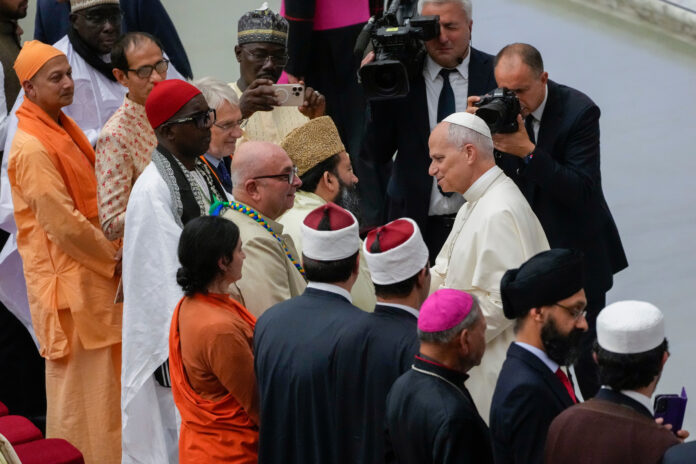
The juxtaposition between the tone of the papal visit and the tone of Hezbollah’s statement is stark. Pope Leo XIV’s arrival represents, for many Lebanese citizens, an opportunity to spotlight unity, interfaith cooperation, and a renewed plea for national stability. Hezbollah’s message, by contrast, was crafted as a political intervention—one that attempts to steer the narrative away from domestic reconciliation and toward an externalized struggle against Israel.
Political analysts interviewed by World Israel News have underscored the irony of this timing. Pope Leo XIV, known for his emphasis on peace, humanitarianism, and dialogue, arrives in a country fractured by economic collapse, political gridlock, and the lingering aftermath of the Beirut port explosion. Rather than treat the visit as an impetus for social healing, Hezbollah has chosen to weaponize it, injecting its well-rehearsed allegations against Israel into what could have been a rare moment of national unity.
This strategy carries risks. Many Lebanese—including many Shiites—have grown increasingly weary of Hezbollah’s insistence on defining the national agenda around perpetual resistance. As World Israel News reported, criticism of Hezbollah’s dominance has intensified across sectarian lines, fueled by economic desperation and a growing recognition that the group’s military posture has made Lebanon more vulnerable, not less.
Yet Hezbollah’s choice to overshadow the pope’s visit with a polemic against Israel demonstrates its confidence in its own political position. It reveals the group’s belief that maintaining its narrative supremacy remains essential to assuring its long-term relevance in Lebanese society. It also signals that the group is willing to reshape even religious and diplomatic milestones into vehicles for ideological messaging.
The pontiff’s arrival may bring moments of solace, prayer, and reflection to a country in need of all three. But Hezbollah’s intervention, documented by World Israel News, calls attention to the persistent challenge Lebanon faces: a non-state actor that seeks to define national identity not through coexistence or pluralism, but through conflict narratives and external antagonism.
As Pope Leo XIV steps onto Lebanese soil, he enters a nation at a crossroads—one where competing visions of the country’s future are locked in profound tension. And Hezbollah, through its latest statement, has made clear which vision it intends to champion: a Lebanon tethered to perpetual confrontation, draped in the mantle of resistance, and unable to disentangle its destiny from the ideological wars of the region.
Whether the pope’s presence can soften or counterbalance that narrative remains to be seen. But as the World Israel News report made evident, Hezbollah has already begun shaping the message it hopes will dominate the international stage during this pivotal visit.