



|
Getting your Trinity Audio player ready...
|
By: Fern Sidman
In a forceful appeal delivered during his state visit to Latvia, Israeli President Isaac Herzog urged the international community on Tuesday to take a united stance against Hamas by refusing all dialogue with the terror group until it releases the Israeli hostages it continues to hold in Gaza.
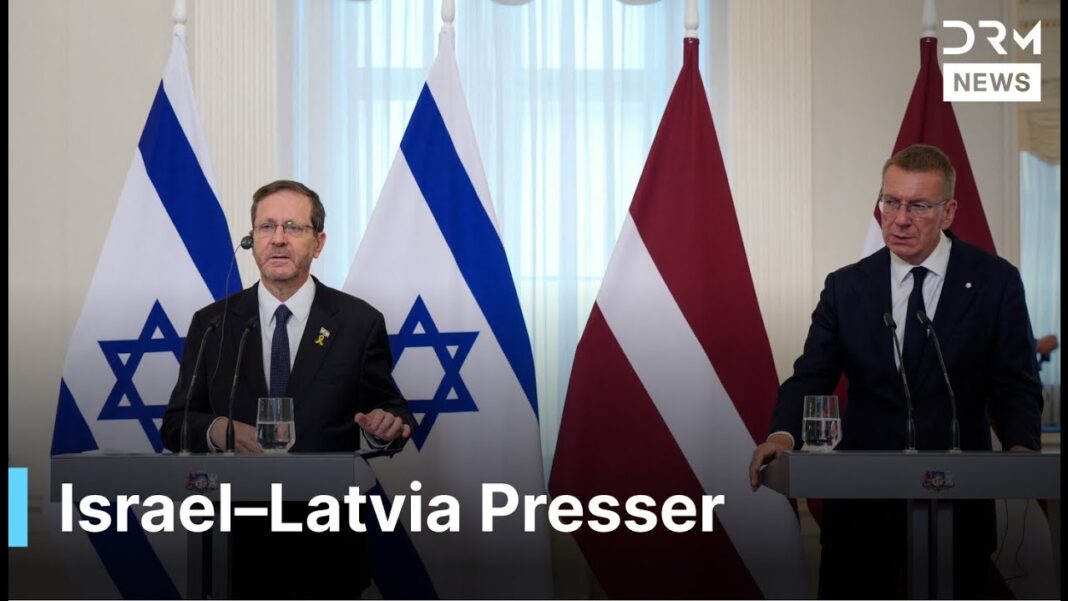
Speaking alongside Latvian President Edgars Rinkēvičs at the Presidential Palace in Riga, Herzog emphasized that the fate of the captives remains at the very heart of Israel’s military campaign and its diplomatic outreach. His comments, reported by The Jewish News Syndicate (JNS), highlighted Israel’s deep frustration at what it sees as a failure of international institutions to fully grasp the centrality of the hostage crisis to the war that erupted following Hamas’s unprecedented assault on October 7, 2023.
“In order to get to the day after, in order to finish the tragedy in Gaza, the terrible tragedy in Gaza, which was imposed only by Hamas, one has to get the hostages back home,” Herzog told reporters during his joint press conference with President Rinkēvičs.
He continued: “Because we are dealing with a jihadist terror regime in Gaza, which we are trying to remove in order to release our hostages and make sure that our citizens on the border live in peace, we have to get the hostages back.”
The Jewish News Syndicate report noted that Herzog’s remarks represented one of his strongest calls yet for international solidarity on the issue. He demanded that governments, especially in Europe, draw a clear moral line: there can be no engagement with Hamas, no political dialogue, and no legitimacy until the hostages are returned.
Herzog underscored his message by holding up photos of two young Israeli captives: 24-year-old Evyatar David and 21-year-old Rom Braslavski. Their images, released separately by Hamas and Palestinian Islamic Jihad in early August, showed both men emaciated to the point of resembling “living skeletons.”
“These horrifying images are further evidence of the cruel torture inflicted on innocent Israelis held by Hamas,” Herzog said, echoing a statement he made earlier in Lithuania, another stop on his Baltic tour.
JNS reported that Herzog pointed out David’s Lithuanian heritage in Vilnius, making a personal connection to his host country. In Riga, he again pressed the case that the visible suffering of these young men symbolized the larger evil of Hamas: a terrorist organization deliberately starving hostages while simultaneously stealing humanitarian aid intended for civilians.
The October 7 massacre left Israel reeling. More than 1,200 people were brutally and sadistically massacred in the Hamas-led assault, and 251 were kidnapped into Gaza. Since then, Israeli military operations and partial hostage deals have secured the release of some captives, but around 20 are still believed to be alive in Hamas tunnels.
The Jewish News Syndicate report highlighted that Herzog reminded his Latvian hosts that while Israel has facilitated vast deliveries of aid—more than 23,000 tons in just the past ten days—the fundamental humanitarian issue is the hostages’ plight.
“Humanitarian aid is important,” Herzog said, “but the real humanitarian breakthrough begins when our sons and daughters are freed from those dungeons.”
Herzog pointed to Israel’s unprecedented measures to ensure aid reached Gaza’s civilians despite the ongoing conflict. The JNS report detailed his figures: tens of thousands of tons of food and supplies delivered, increased airdrops in coordination with allies, and new logistical arrangements designed to bypass Hamas’s stranglehold on aid distribution.
Yet Herzog argued that these efforts are overshadowed by Hamas’s propaganda campaign. By publicizing the starvation of hostages while withholding Red Cross access and medicine, Hamas seeks to invert reality, portraying Israel as the oppressor even as it enables aid on an unprecedented scale during wartime.
From Riga, Herzog demanded clarity from the international community: “I call upon the international community from here in Riga to present a unanimous, tough position, including Europe, and saying to Hamas and its allies: we’re not talking to you until you release the hostages.”
The setting of Herzog’s appeal added layers of symbolism. Latvia, like Lithuania and Estonia, has a painful history of occupation and foreign domination, including the Nazi genocide of its Jewish population during World War II and decades of Soviet control.
According to the information provided in the JNS report, Herzog and Rinkēvičs held an extended bilateral meeting before their public remarks, discussing not only the hostage crisis but also broader regional security issues, from Russian aggression in Ukraine to shared concerns about disinformation and extremism.
For Herzog, Riga provided a powerful stage: a capital city where the memory of oppression remains vivid, and where the parallels with Israel’s own fight for survival would resonate deeply.
Herzog’s appeal arrives at a time when European governments are divided in their approaches to the Israel–Gaza war. While many EU states remain firm supporters of Israel’s right to defend itself, others have grown increasingly vocal in their criticism of Israeli operations and have signaled willingness to recognize a Palestinian state without a negotiated agreement.
The Jewish News Syndicate has reported extensively on the shifting European discourse, with some leaders calling for an immediate ceasefire without directly addressing Hamas’s refusal to release hostages. Herzog’s message in Riga was intended as a corrective: no ceasefire, no “day after,” can be legitimate until the hostages are freed.
Herzog’s insistence on prioritizing hostage release above all else reflects both Israel’s contemporary reality and its historical experience.
Analysts have drawn parallels to past hostage crises. In 1976, Israeli commandos carried out the famous Entebbe raid to rescue hostages held in Uganda by Palestinian and German terrorists. In 1985, TWA Flight 847 was hijacked by Hezbollah, resulting in the murder of a U.S. Navy diver and protracted negotiations.
What distinguishes October 7 is its scale: never before has a terror organization abducted so many civilians at once, holding them in underground tunnels and using their suffering as a bargaining chip.
Herzog’s Baltic speeches thus serve as a warning: unless the world unites to declare hostage-taking unacceptable and unprofitable, other terror groups could emulate Hamas’s strategy elsewhere. “Today it’s Israel,” Herzog said. “Tomorrow it’s you.”
A recurring theme in Herzog’s statements has been the silence—or perceived bias—of international organizations. He has criticized the United Nations, particularly Secretary-General António Guterres, for failing to condemn Hamas’s treatment of hostages with the same intensity reserved for Israel’s military operations.
JNS has reported that Herzog is also pressing the International Committee of the Red Cross, which has yet to secure access to the hostages despite an agreement in November 2023 that explicitly guaranteed such visits.
From Riga, Herzog again demanded that international agencies break their silence. “The medicine they desperately need to survive has not reached them,” he said, contrasting Hamas’s treatment of hostages with the medical care Israel provides to terrorists imprisoned in Israeli jails.
Herzog’s Baltic tour, including stops in Lithuania and Latvia, forms part of a broader Israeli strategy to shore up European support at a critical juncture. As JNS reported, the visits are meant not only to rally sympathy for the hostages but also to highlight Israel’s role as a partner in defending democratic values against terrorism and authoritarianism.
Herzog’s message dovetails with Prime Minister Benjamin Netanyahu’s repeated assertions that the war’s goals are indivisible: Hamas must be defeated militarily, Gaza must never again threaten Israel, and every hostage must be returned.
From Vilnius to Riga, Herzog has been consistent in his plea: the hostages are not only an Israeli concern but a global one. Their suffering, broadcast in shocking images of starvation and abuse, represents a moral test for the international community.
Herzog’s words left little room for ambiguity: “We’re not talking to you until you release the hostages.”
Whether Europe and other international actors heed that call will shape not only the outcome of the Gaza conflict but also the broader struggle against terrorism worldwide.
For Herzog, speaking from the heart of the Baltic region, the issue is clear: the hostages must come home first. Only then can the “day after” in Gaza begin.
