



|
Getting your Trinity Audio player ready...
|
Edited by: Fern Sidman
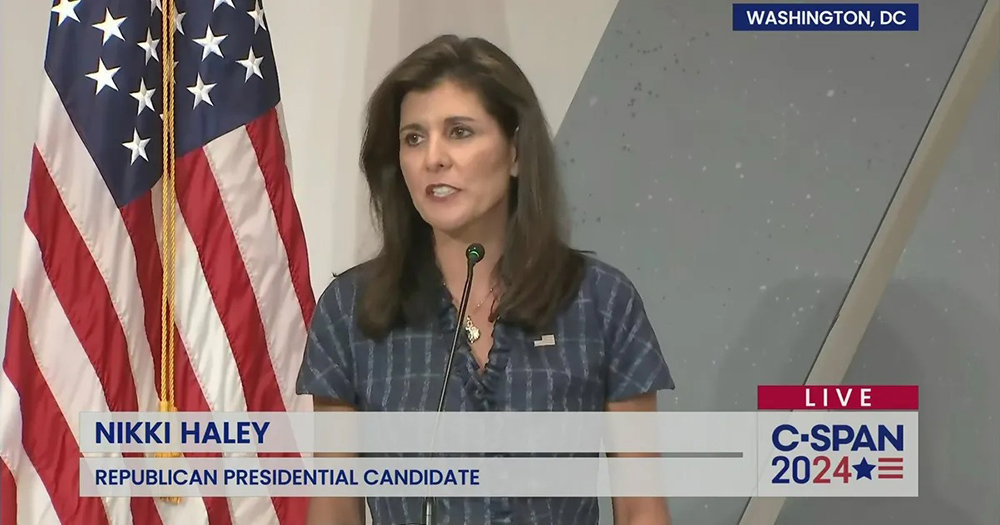
Former United Nations Ambassador Nikki Haley on Tuesday criticized former President Donald Trump for being too friendly to China during his time in office, while also warning that weak support for Ukraine would “only encourage” China to invade Taiwan, as was reported by the Associated Press.
Haley, a Republican presidential candidate running against Trump, said in a speech at the American Enterprise Institute that Trump was “almost singularly focused” on the U.S.-China trade relationship but ultimately did “too little about the rest of the Chinese threat.”
Amb. Haley spoke on a range of issues facing the United States in the Indo-Pacific region. She discussed the important role that allies and partners play in blunting Chinese aggression and how the United States can build more robust relationships with them. Additionally, she elaborated on how the United States can use diplomatic tools that promote American interests and confront the growing China challenge. She also emphasized the link between the fate of Ukraine and that of the Indo-Pacific and argued that US power in Asia would diminish if the United States failed to support Ukraine.
Specifically, Haley noted that Trump failed to rally U.S. allies “against the Chinese threat” and that he had congratulated Chinese President Xi Jinping on the 70th anniversary of Communist Party rule in China.
“He (Trump) did not put us on a stronger military foothold in Asia. He did not stop the flow of American technology and investment into the Chinese military. He did not effectively rally our allies against the Chinese threat. Even the trade deal he signed came up short when China predictively failed to live up to its commitments,” Haley said, according to a CNN report.
She added that, “Trump congratulated the Communist Party on its 70th anniversary of conquering China. That sends a wrong message to the world. Chinese communism must be condemned, never congratulated.”
Haley has started to take more direct aim at the Republican primary’s leading candidates in recent weeks, CNN reported. Tuesday marked her strongest public objections to Trump’s record with China so far.
Haley’s comments, promoted by her presidential campaign as “a major foreign policy speech,” came a week and a half after Secretary of State Antony Blinken held talks with Xi in Beijing. The AP reported that Blinken said they had agreed to “stabilize” badly deteriorated U.S.-China ties, but there was little indication that either country was prepared to bend from positions on issues including trade, Taiwan, human rights conditions in China and Hong Kong, Chinese military assertiveness in the South China Sea, and Russia’s war in Ukraine.
She called Secretary of Blinken’s recent trip to China a “gold plated-invitation for more Chinese aggression, not less,” CNN reported.
“Just look at what happened. China’s scolded us then President Xi pronounced it was a good meeting. He only says that when he gets a lot more than he gives. In fact, he gave us nothing,” Haley said, as was noted in the CNN report.
Haley did note that Trump imposed tariffs and other trade restrictions on the superpower, saying he “deserves credit for upending this bipartisan consensus.” But she added, “Being clear-eyed is just not enough,” as was reported by the AP.
CNN reported that in her speech laying out what her policy toward China would look like as president, Haley declared the Chinese Communist Party an “enemy” and deemed it the “most dangerous foreign threat we face since the second world war.”
“The Communist Party’s endgame is clear. China is preparing its people for war. President Xi has openly said it. We should take him at his word and act accordingly,” she said.
Haley added that the question of China is a question for presidential leadership, saying there must be a “series of fundamental shifts” in US policy, according to the CNN report. She said that her administration would respond domestically, economy and militarily.
She also proposed specific moves, including pushing Congress to put an end to permanent trade relations with China until the flow of fentanyl into the US ends, and eliminating federal funding for all universities that take Chinese money, CNN reported.
“Universities must choose, you either take Chinese money or you take American money, but the days of taking both are over. It shouldn’t be a hard decision,” Haley said during her address at the AEI.
She added that the US should ban all lobbying from the CCP and stop allowing licenses for exporting sensitive technology to China, as was reported by CNN.
On Taiwan, she said that the US should make clear that if China invades Taiwan “it would mean a full-blown economic decoupling and it would massively damage China.” CNN reported that Haley did not explicitly commit to keeping or getting rid of the US policy of strategic ambiguity when it comes to Taiwan.
Haley also said that a Russian defeat in the Ukraine war “would be an enormous loss for China” and – as she has done before – made the case for continued support to Ukraine so that it can reclaim its territory.
“Now is the time to seize the moment and help Ukraine bring this war to a decisive end. Make no mistakes China is watching the war in Ukraine with great interest,” Haley said, as was reported by CNN. “China is seeing what most fears if it invades Taiwan, but that could change in short order. If America and the West abandon Ukraine and Russia succeeds in taking its territory and freedom, China will hear an unmistakable message. That message can only encourage China to invade Taiwan as soon as possible. The warning signs are already flashing.”
Haley, who served for two years as Trump’s ambassador to the United Nations, said President Joe Biden has been “much worse” when it comes to dealing with threats. As was reported by the AP, she said China poses to America’s economic, domestic and military security. She also said that China’s military buildup and aggression toward Taiwan shows that the nation is “preparing its people for war,” a conflict she said would draw in the U.S. and other global partners if left unchecked.
“We must act now to keep the peace and prevent war,” she said, as indicated in the AP report. “And we need a leader that will rally our people to meet this threat on every single front. … Communist China is an enemy. It is the most dangerous foreign threat we’ve faced since the Second World War,” she added. Haley also called Biden “far too slow and weak in helping Ukraine,” warning that a failure to send enough military equipment to help stem Russia’s invasion there could “only encourage China to invade Taiwan as soon as possible,” leading to further international conflict.
“The events of this past weekend show how weak and shaky the Russian leadership is,” Haley said, referencing the short-lived weekend revolt by mercenary soldiers who briefly took over a Russian military headquarters, as was reported by the AP. “Make no mistake: China is watching the war with Ukraine with great interest.”
Some of Haley’s Republican rivals, including Trump and Florida Gov. Ron DeSantis, have faced criticism over their own comments toward Ukraine. The AP also reported that both Trump and DeSantis have said that defending Ukraine is not a national security priority for the United States. DeSantis also had to walk back his characterization of Russia’s war in Ukraine as a “territorial dispute.”
Last month, Biden approved a new package of military aid for Ukraine that totals up to $300 million and includes additional munitions for drones and an array of other weapons, as was indicated in the AP report. In all, the US has committed more than $37.6 billion in weapons and other equipment to Ukraine since Russia attacked on Feb. 24, 2022.
Also on Tuesday, the AP reported that China’s muted reaction to the Wagner mercenary group uprising against Russia’s military belies Beijing’s growing anxieties over the war in Ukraine and how this affects the global balance of power.
China’s ruling Communist Party called the swift end of the 22-hour revolt Moscow’s “internal affair,” with state media affirming China’s support for Russia, as was reported by the AP.
Chinese observers said the incident showed how overblown Western rhetoric was regarding the “Russian internal conflict” and that President Vladimir Putin’s hold on power remains secure.
But the uprising also threatens to deepen growing anxieties in Beijing over Russia’s war in Ukraine, given China’s limited ability to influence the situation, the AP report observed.
China has maintained a consistent position on the war: neutral on paper, but favoring Russia in practice, with frequent state visits and joint military drills between the two nations, according to the AP report. It’s a delicate balance, calibrated carefully to avoid damaging relations with Russia or Europe, both of which Beijing sees as critical to countering American power.
That stance continues. But in recent months, government advisors have expressed increasing frustration with Russia behind closed doors, feeling Beijing is increasingly being “dragged around” by Moscow’s risk-taking behavior, according to interviews with Chinese and foreign academics and diplomats.
The AP reported that some draw comparisons with China’s relationship with North Korea, whose leadership exasperates Beijing at times with erratic behavior but nonetheless benefits from Chinese economic aid and diplomatic support.
Speaking to the AP, Patricia M. Kim, an expert on Chinese politics and foreign policy at the Brookings Institution think tank in Washington, D.C. said that the Wagner rebellion has “likely raised doubts about whether Beijing made the right bet in designating the Kremlin, and Putin specifically, as a close ally and partner.”
“Chinese leaders must be concerned that China’s strategic alignment with a weakened Russia may turn out to be a net burden rather than a plus to China’s strategic interests,” Kim said.
Chinese state military academics worry about Russia’s underwhelming performance in the war.The AP also reported that it raises questions over China’s military structures, which were heavily influenced by the former Soviet Union.
China is also seen as closely watching the conflict in Ukraine for indications of possible ramifications to its threat to enforce a blockade, invade or coerce the self-governing island of Taiwan, a close U.S. ally, into accepting Communist Party control, as was noted in the AP report.
Also speaking to the Associated Press was Alexander Gabuev, director of the Carnegie Russia Eurasia Center. He addressed recent developments in Russia by saying, “China realizes that the system is more brittle than they thought, that Putin is more incompetent than they would love to see.” He added that, “What leads to this frustration to an extent is that China cannot do anything about it.”
China has embarked on a flurry of diplomacy in recent months, positioning itself as a neutral mediator in the conflict, according to the AP report. Chinese leader Xi Jinping met Putin in Moscow and called Ukrainian President Volodymyr Zelenskyy earlier this year. He also published a 12-point proposal urging the two sides to come to the negotiating table.
The prospects for a peace deal are slim at the moment, and even Chinese experts acknowledge behind closed doors that Beijing’s proposal is unrealistic, the AP observed.
China’s real goal in calling for negotiations, analysts say, is to convince Europe that it is acting in good faith and prevent relations from deteriorating. The AP also reported that Chinese officials bristle at U.S. attempts to portray Beijing as a backer of Moscow, seeing it as an attempt to alienate Europe from China.
Wang Huiyao, a Chinese foreign policy advisor and president of the Center for China and Globalization, a Beijing-based think tank, told the AP, “It’s not that China wants to be closer to Russia. It’s that the U.S. is forcing that.”
Still, the two countries share common grievances against Washington. Chinese and Russian officials have both had travel and financial sanctions imposed against them by the U.S., and watch U.S.-led military alliances warily, as was indicated in the AP report.
Chinese foreign policy experts are worried that the war has revitalized NATO and the U.S. alliance with Europe, and fret that this could prompt a renewal of American alliances in East Asia.
The AP report also noted that Chinese military experts grilled Western diplomats in private about reports that NATO might open a liaison office in Japan, worried that it might represent the expansion of the organization’s interests in East Asia, three people with knowledge of the matter told The Associated Press.
A civil war or major political conflict in Russia would have a definite impact on relations between Beijing and Moscow, particularly with the Chinese president seeing the two aligning to challenge the U.S.-led liberal world order, according to the report.
Li Xin, director of the Institute of European and Asian Studies of Shanghai University of Political Science and Law told that AP that, “Historically, the U.S. never trusted Russia and has always attempted to dismember it into smaller countries. To the United States, Russia and China are their major threats.”
In other China related news, last Tuesday the AP reported that three men were convicted of various charges in a trial showcasing U.S. claims that China has engineered pressure campaigns on American soil to bully expatriates into returning home, as part of an effort called “Operation Fox Hunt.”