



|
Getting your Trinity Audio player ready...
|
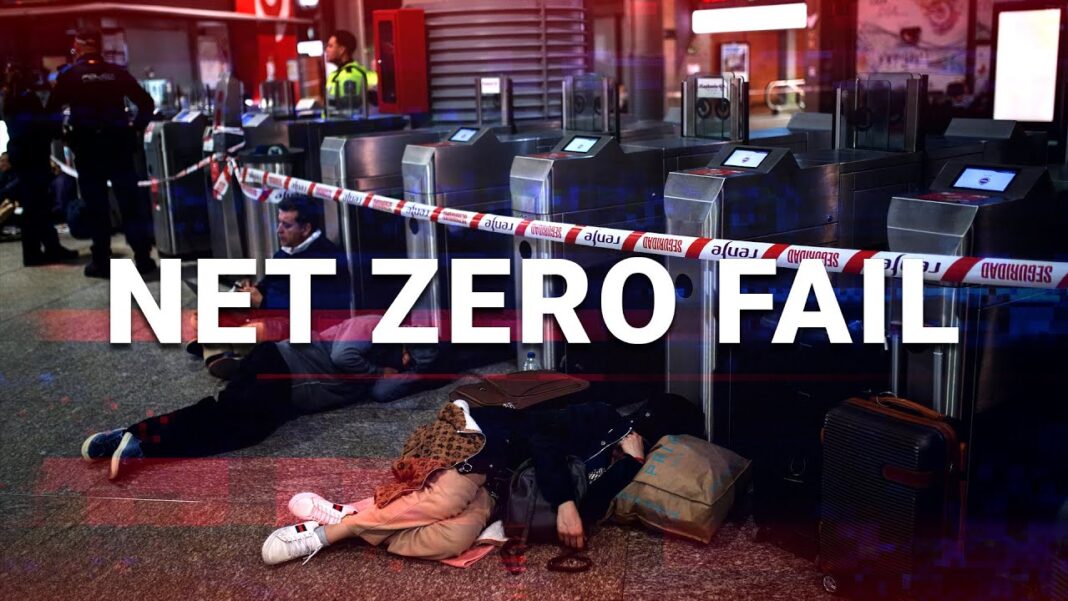
(TJV NEWS)Just days after Spain celebrated a historic renewable energy milestone, the fragility of its “green” power system was exposed in devastating fashion. On Monday, April 28, a massive power grid collapse triggered widespread blackouts across Spain, Portugal, and parts of France, throwing tens of millions into chaos and forcing emergency declarations across the region.
The catastrophe came on the heels of Spain’s April 16 achievement, when for the first time in history, the country claimed to meet 100% of its national energy demand using only renewable sources—wind, solar, and hydroelectric. According to PV-Magazine.com, Spain’s grid operator Red Eléctrica had proudly confirmed that at 11:15 a.m. on April 16, “wind and PV combined to generate 100.63% of total demand – a first in Spain’s energy history.”
Renewables don’t risk blackouts, said the media. But they did and they do. The physics are simple. And now, as blackouts in Spain strand people in elevators, jam traffic, and ground flights, it’s clear that too little “inertia” due to excess solar resulted in system collapse. pic.twitter.com/FbuX1oSVcs
— Michael Shellenberger (@shellenberger) April 28, 2025
The celebration, however, was short-lived.
On Monday, at precisely 12:33 p.m. local time, the power went out across vast areas. The Guardian described scenes of panic: People trapped in elevators and stalled on trains, commuters stumbling through darkened subway tunnels by the light of their cellphones, supermarkets reduced to cash-only operations, and hospitals scrambling to keep life-saving equipment running on emergency generators.
Mobile networks collapsed, internet services were severed, and many ATM machines went dark. Though critical hospital services remained operational thanks to backup systems, the blackout upended daily life and crippled businesses across three nations.
While officials have not yet released a full report on the cause, widespread commentary on social media and among energy experts quickly pointed to an uncomfortable truth: an overreliance on unstable renewable energy sources. In particular, many noted that an overwhelming surplus of solar energy had destabilized grid balances, a risk that critics of green energy transitions have long warned about.
Tell me again about how successful Spain’s experiment with wind and solar power has been. https://t.co/CSfnh86E5L pic.twitter.com/vA8q8n5mUv
— David Turver (@7Kiwi) April 28, 2025
The blackout serves as a stark reminder that while renewable energy holds promise, hasty transitions without sufficient infrastructure, energy storage, and grid stability measures can lead to national emergencies.
Spain’s rapid push toward renewables had been hailed as a model for the world. Instead, it has become a cautionary tale.
The incident has already sparked fierce debates across Europe about the future of energy policy, with growing calls for a more balanced and resilient energy mix—including nuclear and reliable fossil fuel backup—to avoid future disasters.