



|
Getting your Trinity Audio player ready...
|
Global Leaders Voice Hesitation Over Trump’s Expansive ‘Board of Peace’ as Concerns Grow for UN’s Role
By: Fern Sidman
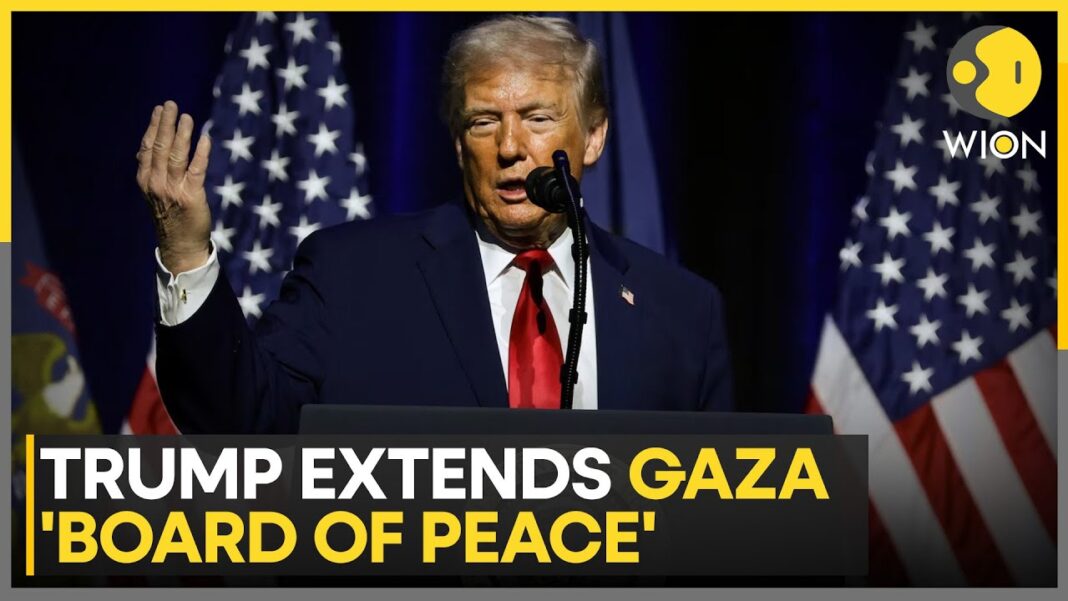
The unveiling of President Donald Trump’s proposed “Board of Peace” initiative has triggered a cautious, at times uneasy, reaction across world capitals, with diplomats and analysts warning that the ambitious plan—billed by the White House as a bold new architecture for global conflict resolution—could undermine established international institutions while profoundly reshaping the future of Gaza.
According to a report on Sunday by Reuters, invitations to join the proposed body were dispatched over the weekend to approximately 60 nations. The response, thus far, has been marked by hesitation and diplomatic restraint. Hungary, whose prime minister Viktor Orbán is one of Trump’s most loyal European allies, offered an immediate and enthusiastic acceptance. Most other governments, however, have refrained from public commitments, leaving officials to express their misgivings behind the cloak of anonymity.
At the heart of the proposal is an audacious idea: a new, Trump-chaired international board that would initially oversee the postwar reconstruction and governance of Gaza, and then expand to mediate other global conflicts. A draft charter of the plan, obtained and reviewed by Reuters, indicates that Trump himself would serve as chair “for life,” a formulation that has startled many diplomats accustomed to multilateral norms and rotating leadership.
The Board of Peace, the document reveals, would be financed in part by participating states, with an unusual twist. Member nations would be granted three-year terms, unless they contribute $1 billion each—an amount that would secure them permanent membership. The White House defended the provision in a social media post, stating, “This simply offers permanent membership to partner countries who demonstrate deep commitment to peace, security, and prosperity.”
To supporters of the initiative, the plan represents a fresh and muscular alternative to what Trump has long derided as the ineffectual bureaucracy of the United Nations. To skeptics, it looks dangerously like a parallel international system designed to sideline existing institutions and place unprecedented authority in the hands of one man.
The Algemeiner, which has closely tracked Israeli reactions to the plan, reported that Jerusalem’s response has been cautious but pointed. Israeli officials are particularly alarmed by the proposed inclusion of Turkey and Qatar in the Gaza oversight mechanism—two states that Israel views with deep suspicion due to their longstanding political and financial ties to Hamas.
The emerging controversy highlights the delicate balancing act at the core of Trump’s proposal. While the initiative purports to offer a comprehensive framework for stabilizing Gaza after years of war and chaos, it risks empowering actors that Israel believes helped create the crisis in the first place.
The draft charter reviewed by Reuters suggests that the Board of Peace would initially operate under a mandate authorized by the United Nations Security Council through 2027, focused exclusively on Gaza. Beyond that date, however, the body could expand its remit to other conflicts that Trump claims to have resolved or intends to tackle.
European diplomats, speaking anonymously to Reuters, warned that the plan’s structure and language appear designed to bypass the United Nations altogether. One diplomat described the initiative bluntly as “a Trump United Nations that ignores the fundamentals of the U.N. charter.”
Three other Western diplomats echoed the concern, telling Reuters that the board, if implemented as currently envisioned, could seriously erode the legitimacy and centrality of the U.N. system. The draft document’s call for “a more nimble and effective international peace-building body” was widely interpreted as a direct rebuke to existing global institutions.
The skepticism is not confined to Europe. In remarks carried by Reuters, Annalena Baerbock, president of the United Nations General Assembly, warned that sidelining the U.N. could lead the world into “very, very dark times.” Without addressing Trump’s plan directly, she emphasized that the United Nations remains the only institution with the legal and moral authority to unite nations of all sizes.
Yet for Israel and its supporters, the frustrations with the U.N. are longstanding and deeply felt. The world body has frequently been accused of bias against the Jewish state, particularly in its handling of the Israeli-Palestinian conflict. From Jerusalem’s perspective, a new mechanism not dominated by traditional U.N. politics could offer a rare opportunity to craft a more pragmatic and security-focused postwar order in Gaza.
🚨 BREAKING: TRUMP UNVEILS THE BOARD OF PEACE FOR GAZA — THE MOST POWERFUL COALITION EVER ASSEMBLED FOR THE STRIP 🚨
The White House has just revealed the Board of Peace for Gaza — a powerhouse governing body that will oversee security, reconstruction, investment, and diplomacy… pic.twitter.com/JQxmTeWJWK
— Richard Miriti (@miriti55453) January 17, 2026
As The Algemeiner noted in its analysis, the inclusion of figures such as former British Prime Minister Tony Blair, World Bank President Ajay Banga, and prominent American Jewish businessman Marc Rowan on the executive board has been welcomed by many pro-Israel observers as a sign that serious, competent hands will be guiding Gaza’s reconstruction.
At the same time, the proposed participation of Turkish Foreign Minister Hakan Fidan and Qatari negotiator Ali Al-Thawadi has generated consternation. Turkey under President Recep Tayyip Erdoğan has become one of the most strident critics of Israel, while Qatar has long served as a financial lifeline for Hamas. Their presence on a board tasked with shaping Gaza’s future strikes many in Israel as paradoxical at best.
The Algemeiner reported that Prime Minister Benjamin Netanyahu’s office issued a pointed statement saying that the composition of the Gaza Executive Board “had not been coordinated with Israel and contradicted its policy.” Israeli officials declined to elaborate publicly, but the message was unmistakable: Jerusalem does not intend to surrender its vital interests to a panel that includes adversarial actors.
Trump, for his part, appears undeterred. In an interview earlier this week, he told Reuters, “It’s going to, in my opinion, start with Gaza and then do conflicts as they arise.” The president has made no secret of his desire to claim a Nobel Peace Prize and to cement his legacy as a global dealmaker capable of succeeding where others have failed.
The board’s roster, at least on paper, is undeniably impressive. The White House announced that Secretary of State Marco Rubio, special envoy Steve Witkoff, Jared Kushner, Tony Blair, and several prominent international figures would serve as members. A separate “Gaza Executive Board,” designed to support the technocratic Palestinian administration envisioned under Trump’s ceasefire plan, would include representatives from the United Arab Emirates, Qatar, Turkey, and the United Nations.
Notably absent from the list, as both Reuters and The Algemeiner have observed, are any Palestinian representatives. The omission has drawn criticism from human rights advocates and analysts who argue that a board determining Gaza’s fate without Palestinian participation risks resembling a colonial-era trusteeship rather than a genuine partnership.
Supporters of Israel counter that the Palestinian Authority and other Palestinian factions have repeatedly failed to provide responsible governance, making international oversight not only justified but essential. After the horrors unleashed by Hamas on October 7 and the subsequent war, they argue, Gaza requires firm and credible stewardship to ensure that terror infrastructure is dismantled and that reconstruction does not become a prelude to renewed violence.
From this vantage point, Trump’s proposal—however unconventional—offers a chance to break the destructive cycle that has defined Gaza for nearly two decades. A board anchored in American leadership, backed by substantial financial resources, and focused on tangible results could, in theory, create conditions for stability that the U.N. has never managed to achieve.
Yet the plan’s critics remain unconvinced. Several diplomats told Reuters that the $1 billion price tag for permanent membership effectively turns global peacebuilding into a pay-to-play enterprise, favoring wealthy states over broader international consensus.
Italian Prime Minister Giorgia Meloni signaled a willingness to engage, telling reporters that her country was “ready to do our part,” though she stopped short of formally endorsing the Gaza-focused initiative. Canadian Prime Minister Mark Carney said he had agreed “in principle” to participate, pending further details. French, German, and Australian officials have so far maintained a studied silence.
The reaction across the Arab world has been equally cautious. While Egypt and the United Arab Emirates are listed among prospective participants, their leaders have yet to commit publicly. The prospect of Trump himself chairing a board that would oversee Gaza’s future has stirred unease in capitals long wary of American unilateralism.
Ultimately, the success or failure of the Board of Peace will hinge on whether it can reconcile two competing imperatives: the need for decisive, effective governance in Gaza, and the equally vital need to maintain legitimacy in the eyes of the international community.
For Israel, the stakes could not be higher. The Jewish state has endured years of rocket fire, tunnel warfare, and diplomatic isolation emanating from Gaza. A credible, security-oriented reconstruction framework—one that prevents Hamas from rearming and empowers responsible local administration—would represent a strategic breakthrough of historic proportions.
As The Algemeiner report emphasized, Israeli officials are likely to judge the initiative less by its grand rhetoric than by its concrete composition and policies. If the board evolves into a mechanism that safeguards Israel’s core security concerns, Jerusalem may ultimately embrace it despite initial reservations.
For now, however, the world waits to see whether Trump’s latest gambit will emerge as a transformative engine of peace—or as another source of geopolitical friction in an already volatile region.
As the Reuters report observed, the coming weeks will determine whether governments rally behind the proposal or quietly allow it to wither. In the words of one European diplomat, “This could either change everything—or collapse under its own contradictions.”
In Gaza, and in Israel, the consequences of that decision will be felt for generations
