



|
Getting your Trinity Audio player ready...
|
By: Fern Sidman
The world’s foremost Jewish communal leaders concluded a historic summit in Sydney this week with an urgent message: the dramatic spike in antisemitic incidents across Australia is not an isolated national crisis, but part of a dangerous global pattern threatening Jewish safety and democratic stability.
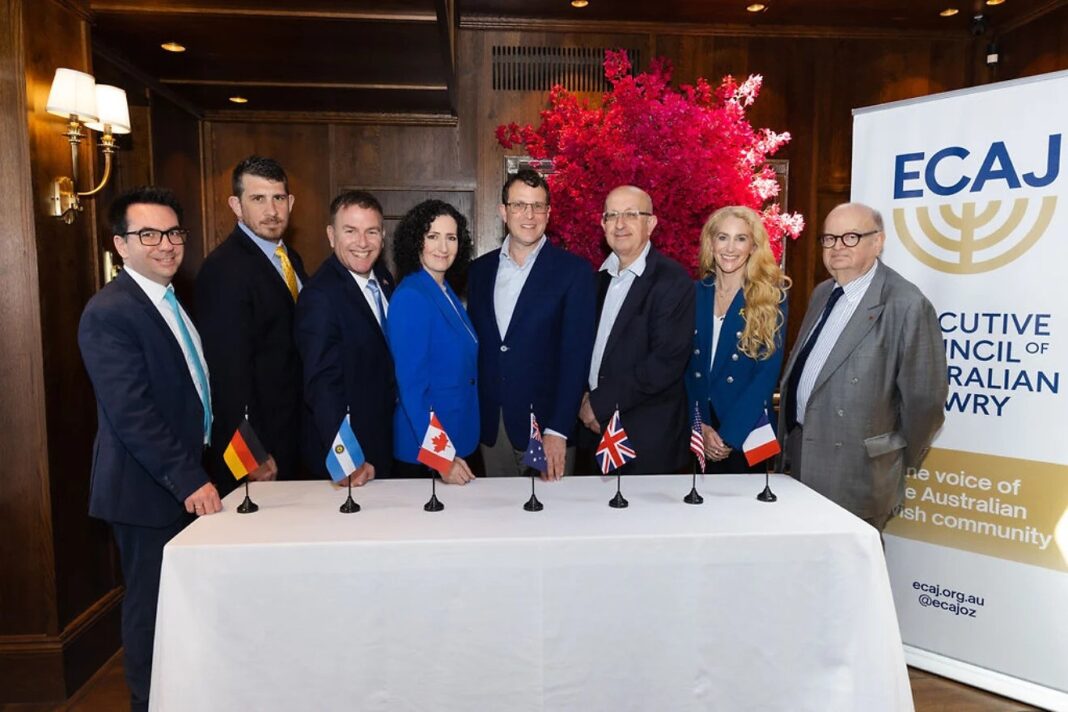
According to a report that appeared on Tuesday at The Jewish News Syndicate (JNS), which closely covered the proceedings of the inaugural J7 Task Force summit ever held in Australia, representatives from the seven largest Jewish diaspora communities—Argentina, Australia, Canada, France, Germany, the United Kingdom and the United States—arrived with a unified purpose: to confront the metastasizing threat of antisemitism that has accelerated dramatically since Hamas’ Oct. 7, 2023 massacre in Israel.
“We came from around the world to show our solidarity with the Australian Jewish community and make clear that we are one Jewish family,” the J7 leadership said in a joint statement issued at the summit’s conclusion on Monday. As the JNS report noted, the message was unequivocal: global Jewish communities now face a synchronized menace, with developments in one nation often echoing overnight across others.
Data unveiled ahead of the summit underscored Australia’s startling trajectory. The Executive Council of Australian Jewry (ECAJ) documented 1,654 antisemitic incidents nationwide between Oct. 1, 2024, and Sept. 30, 2025. Although this represented a 20% reduction from the prior year’s unprecedented 2,062 incidents, ECAJ leaders emphasized that the new figure remains the second-highest ever recorded in the nation’s history.
JNS reported that despite the slight decline, Australia experienced the steepest increase in antisemitic incidents among all J7 member countries between 2021 and 2024—nearly five times pre–Oct. 7 levels. Most concerning were the categories involving violence, threats to life, and attacks on Jewish communal infrastructure.
Jewish community leaders from around the globe joined ECAJ for a visit to the Adass Israel Synagogue this morning. This weekend marks the first anniversary of the arson attack that gutted the shule. The leaders are in Australia for the 2025 J7 Task Force Against Antisemitism. pic.twitter.com/y2lAzsimks
— Executive Council of Australian Jewry (@ECAJewry) December 4, 2025
The Dec. 3 ECAJ report described a spate of antisemitic arson attacks on synagogues, preschools, kosher businesses, and communal centers—acts that Australian intelligence agencies have directly linked to Iran’s Islamic Revolutionary Guard Corps (IRGC). The report highlighted two particularly chilling incidents that became focal points of discussion at the J7 summit: the 2024 firebombing of Sydney’s Lewis’ Continental Kitchen and the December 2024 arson attack on Melbourne’s Adass Israel Synagogue.
According to the information provided in the JNS report, Australian authorities assessed both attacks as part of a coordinated attempt by the IRGC to intimidate and destabilize Jewish communities abroad, ultimately prompting the federal government to designate the IRGC as a state sponsor of terrorism.
“This is not simply a problem of prejudice or street-level hatred,” one J7 delegate told JNS. “This is foreign-sponsored, ideologically driven extremism, operating inside a democratic nation.”
The J7 summit’s closing communiqué made explicit the global implications of Australia’s experience. “The antisemitism that targeted a synagogue in a devastating arson attack in Melbourne—and has led to record levels of incidents in Australia—has had a deadly impact in Manchester, Boulder, Washington, and beyond,” the statement read.
As JNS emphasized in its analysis, the leaders were referring to a disturbing international pattern: attacks on synagogues in Europe and North America, spikes in antisemitic assaults on university campuses, and the normalization of anti-Jewish rhetoric throughout political and media ecosystems.
The lethal attack on a Jewish grocery store in Boulder, Colorado; violent harassment outside synagogues in London and Manchester; and an armed intrusion at a Washington, D.C., day school were cited repeatedly during the sessions as symptoms of a transnational phenomenon—a phenomenon that Jewish leaders argue has been accelerated by coordinated propaganda campaigns from Iran-linked networks and extremist political groups.
One delegate from France, where antisemitic violence has surged following the 2023 Israel–Hamas war, told JNS: “We are watching the same playbook unfold. What happens in Melbourne later happens in Paris, New York, Berlin, or Montreal. The threat matrix is now global.”
Throughout the summit, speakers called attention to the fact that combating antisemitism requires not only local responses but national strategies grounded in law enforcement coordination, educational reform, and accountability for political rhetoric that inflames hatred.
The J7 delegation joined Australia’s ECAJ in urging the government to adopt the comprehensive national plan to counter antisemitism drafted by the Australian government’s Special Envoy to Combat Antisemitism, Jillian Segal, AO (Officer of the Order of Australia). Segal’s plan outlines a multi-pronged approach including enhanced security funding for Jewish institutions, federal oversight of antisemitic content on digital platforms,
national standards for reporting hate crimes, and mandatory educational initiatives about Jewish history and the dangers of contemporary antisemitism.
As JNS reported, the J7 leaders stressed that such measures are not optional but essential for safeguarding not only Jewish citizens but the democratic system itself.
“When arsonists burn down a synagogue in Melbourne, it’s not only an attack on Australia’s Jews—it is an attack on Australia’s democracy,” noted one U.S. representative, echoing sentiments long expressed in JNS reporting.
During the week-long gathering, J7 leaders held a series of high-level meetings with Australian parliamentarians, state officials, security experts, educators, and community members. Their itinerary, as detailed in the JNS report included a visit to The Great Synagogue in Sydney, Australia’s oldest functioning synagogue, a dialogue session at Moriah College with students who described harassment, online abuse, and threats of violence, a commemorative ceremony marking the first anniversary of the Iranian-linked arson attack on Melbourne’s Adass Israel Synagogue, and closed-door discussions with intelligence agencies about emerging threat patterns.
Students’ testimonies were particularly sobering. According to the information contained in the JNS report, multiple Australian Jewish students described no longer wearing Star of David jewelry in public, concealing Hebrew books on campuses, or avoiding transit routes near pro-Hamas demonstrations.
One university student, speaking to JNS on condition of anonymity for safety reasons, said: “If I’m walking near campus and I hear someone chanting ‘Globalize the Intifada,’ I immediately cross the street. I don’t know if they mean it metaphorically or literally. And neither do the police.”
Formed in response to the unprecedented global surge in antisemitism, the J7 is composed of experts and leaders from seven major Jewish diaspora communities. It includes working groups dedicated to security and intelligence coordination, government policy and legislative advocacy, combating extremism and radicalization, technology policy and online hate, campus antisemitism and youth protection, and education and public awareness campaigns.
As the JNS report noted, the J7’s strategic advantage lies in its ability to integrate intelligence, advocacy, and communal experience across continents. Antisemitic threats that once traveled slowly—through extremist literature or isolated activist networks—now proliferate instantly through digital platforms, necessitating similarly rapid coordination.
The J7 summit concluded with a poignant reminder that the rising tide of antisemitism is not a crisis confined to Jewish communities. It is, as one German delegate told JNS, “a barometer of democratic health.”
“When societies tolerate unchecked hatred against Jews,” he argued, “it is the first indicator that democratic norms are eroding. What begins with Jews never ends with Jews.”
The group’s closing statement distilled the summit’s somber consensus: “We reiterate our call on our governments to take all necessary steps to fight antisemitism and ensure the security of the Jewish community. This is a moment of global decision. We either confront this hatred now, or we face consequences later that none of our democracies are prepared to bear.”
Australia, according to the JNS report, may now stand at the epicenter of this global struggle—not because its challenge is unique, but because its recent experiences illuminate the worldwide convergence of antisemitic ideologies, foreign interference, and violent extremism.
“It is both a warning and an opportunity,” said one J7 official. “If Australia responds with clarity, commitment, and courage, it can model for the world how a democracy defends its Jewish citizens—and, in doing so, defends itself.”