



|
Getting your Trinity Audio player ready...
|
By: Fern Sidman
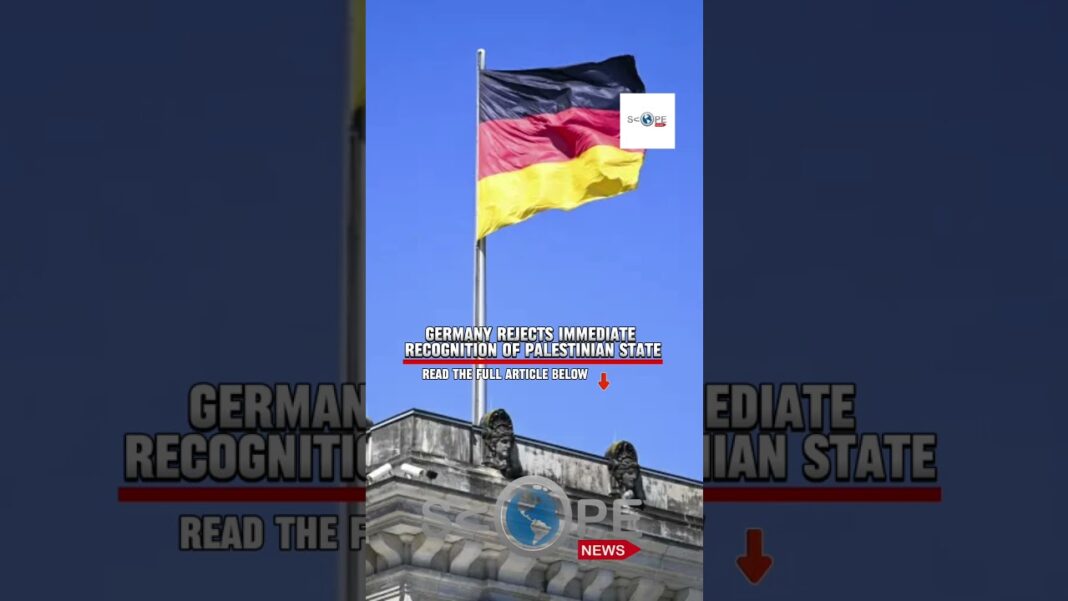
In a move that underscores Europe’s deep divisions on the Israeli-Palestinian conflict, the German government announced on Friday that it has no current plans to recognize a Palestinian state, warning that such a step would undermine prospects for a negotiated two-state solution.
Speaking at a press conference in Berlin, a government spokesman stressed that recognition cannot come as a unilateral gesture but must be the outcome of a peace process acceptable to both sides. “A negotiated two-state solution remains our goal, even if it seems a long way off today,” he said. “The recognition of Palestine is more likely to come at the end of such a process, and such decisions would now be rather counterproductive.”
As The Algemeiner reported, Germany’s caution contrasts sharply with the growing chorus of Western nations — including France, the United Kingdom, Australia, and Canada — that have in recent months floated the possibility of recognizing Palestinian statehood under certain conditions. Berlin’s resistance reflects both its historical relationship with Israel and its belief that premature recognition risks emboldening extremist actors rather than advancing peace.
Germany’s position, laid out by the government spokesman, places clear emphasis on sequencing: recognition must come at the conclusion of a peace process, not as a precursor to it. By framing unilateral recognition as “counterproductive,” Berlin is sending a signal to both its European partners and the broader international community that symbolism divorced from negotiation risks destabilizing the fragile regional balance.
According to the information provided in The Algemeiner report, Berlin’s stance aligns with Israel’s view that recognizing Palestinian statehood without direct talks effectively rewards violence. For German policymakers, there is also concern that such recognition would diminish incentives for Palestinian leadership to return to the negotiating table, especially at a moment when Hamas, rather than the Palestinian Authority, dominates global headlines.
Any discussion of Palestinian statehood is now viewed through the prism of Hamas’s unprecedented assault on Israel on October 7, 2023. That day, Palestinian terrorists launched a devastating invasion across Israel’s southern border, massacring civilians, abducting more than 250 hostages, and triggering a war that has since engulfed Gaza.
As The Algemeiner report has detailed, Hamas has embedded its military infrastructure within densely populated civilian areas — schools, hospitals, and residential buildings — a tactic widely condemned as the use of human shields. Israel argues that rewarding Palestinians with statehood recognition in the wake of such atrocities would signal to Hamas and its supporters that terrorism yields political dividends.
Germany’s spokesman alluded to this logic indirectly, emphasizing that recognition at this juncture would “weaken rather than strengthen the basis for a negotiated two-state solution.”
While Berlin has opted for caution, other Western capitals have begun charting a different course. France, for example, has openly discussed recognition at the United Nations General Assembly in September, with President Emmanuel Macron framing it as a way to “reignite momentum toward peace.” The United Kingdom and Australia have voiced similar sentiments, though both nations have indicated recognition would be conditional on reforms within Palestinian governance structures.
The Algemeiner report observed that Germany’s resistance highlights a fault line in Europe: between states like France and Spain, which see recognition as an instrument of leverage, and Germany, which views it as a premature gesture that risks undermining negotiations. Canada, too, has flirted with conditional recognition, though its stance remains largely symbolic given Ottawa’s historically close ties to Israel.
For Berlin, the stakes are particularly high. With its long-standing role as Israel’s most steadfast ally within the European Union — rooted in Germany’s historical responsibility for the Holocaust — any step toward recognition would carry disproportionate symbolic weight.
Israeli officials have wasted no time in framing unilateral recognition as an abdication of moral clarity. Prime Minister Benjamin Netanyahu, Foreign Minister Israel Katz, and other senior figures have described such moves as nothing less than a “reward for terrorism.”
The Algemeiner has reported extensively on Israel’s efforts to persuade allies that premature recognition hands Hamas a political victory. By elevating Palestinian statehood in the aftermath of mass killings, Israel argues, the international community risks validating Hamas’s strategy of violence.
In recent speeches, Netanyahu has stressed that “a Palestinian state today would be a terrorist state tomorrow” given Hamas’s control of Gaza and its influence over Palestinian politics. The concern is that recognition would not strengthen moderate actors like the Palestinian Authority but would instead embolden extremists who reject coexistence altogether.
Germany’s refusal to join the recognition camp reflects a careful balancing act. On one hand, Berlin reiterates its long-standing support for a two-state solution — the vision of Israel and Palestine living side by side in peace and security. On the other, it is acutely aware of Israel’s security concerns, especially in the aftermath of October 7.
The Algemeiner report noted that Berlin’s statement came just days after Israeli officials directly urged European partners not to succumb to what they view as political theater. Germany appears to have heeded those concerns, reinforcing its image as Israel’s most dependable ally on the continent.
Yet, the government’s spokesperson was also careful to stress that the two-state solution remains Germany’s ultimate objective, even if “a long way off today.” This rhetorical commitment to Palestinian aspirations reflects Germany’s effort to maintain credibility with Arab states and international institutions, while simultaneously upholding Israel’s security imperatives.
The debate over recognition is not only about Palestine; it is also about the role of international law, the United Nations, and the credibility of Western diplomacy in a fractured Middle East.
For the Biden administration, recognition is not currently on the table, though U.S. officials have expressed openness to new frameworks for eventual Palestinian statehood. Washington continues to prioritize Israeli security guarantees and the normalization process with Saudi Arabia as more immediate objectives.
As The Algemeiner report has argued, unilateral recognition by European nations risks splintering Western unity at a moment when cohesion is most needed — both to deter Iran’s regional ambitions and to manage the war in Gaza.
For Germany, the stakes are heightened by history. Since World War II, German leaders have emphasized an unbreakable bond with Israel, often declaring Israel’s security as part of Germany’s raison d’état. Against this backdrop, recognizing a Palestinian state prematurely could be perceived as a betrayal of that historical pledge.
By resisting recognition now, Berlin reinforces its commitment to the principle that peace cannot be imposed, but must be negotiated.
Germany’s decision not to recognize a Palestinian state at this juncture sends a clear signal of restraint amid a global climate of escalating impatience with the stagnation of the peace process. While other Western capitals pursue symbolic gestures, Berlin has anchored itself firmly in the belief that recognition must crown a genuine agreement, not substitute for one.
The refusal to recognize Palestine now highlights both Germany’s loyalty to Israel and its conviction that international law and diplomacy must prioritize negotiated outcomes. At a time when Israel continues to battle Hamas in Gaza and antisemitism rises across Europe, Berlin’s caution serves as a reminder that the path to peace lies not through unilateral decrees but through painstaking, mutual compromise.
For now, Germany stands apart from some of its allies, betting that long-term credibility outweighs short-term symbolism — and signaling that its historic commitment to Israel remains undiminished, even amid the pressures of shifting global diplomacy.

“Recognition (of a “palestinian” state) must come at the conclusion of a peace process, not as a precursor to it.” Entirely wrong. That is a distinction without a difference. Their plan for a “palestinian state” is permanently dead. Germany has no say in Israel’s future, and must educate its future generations on its Holocaust.
“Peace” comes only from total victory and the enemies’ complete surrender and
capitulation. The Arabs must permanently leave Gaza and be absorbed by their Arab neighbors outside of Israel. They must raise their children for the next three generations to recognize Israel as a Jewish state “from the river to the sea”.
This decision is on its face a positive sign. But, in actuality is isn’t and it’s just nonsense. It’s the product of incoherent ideology that clashes with itself to make no contribution at all to resolving the Hamas problem. Like all of the Globalist regimes in western Europe, Germany wants desperately to recognize a “Palestinian State”. But, for significant reasons, most of which arise out of Germany’s unique Holocaust-legacy, it is hesitant to do that. So, instead of being honest in the first place, it instead comes up with this “two-state solution” gibberish as a reason for not going along with Britain, France, Australia and others. Every one of them, including Germany, knows that the notion of a “Palestinian State” was from the beginning highly unlikely, but with Oct.7th, it is a now at last a literal dead-letter. Germany, were it interested in doing the right thing, would simply never have even addressed this “Palestinian State” nonsense and instead, declared support for all of Israel’s efforts to eradicate Hamas and any threat from the “palestinian” barbarians.