



|
Getting your Trinity Audio player ready...
|
Germany Honors Holocaust Survivor Margot Friedländer With State Funeral
By: Fern Sidman
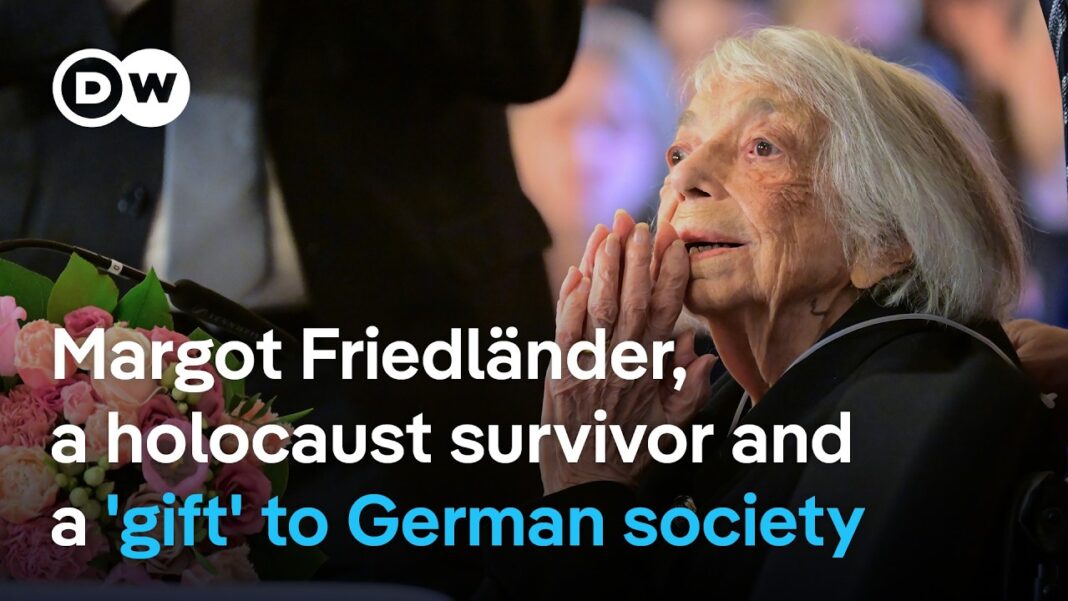
In a solemn ceremony that brought together some of Germany’s highest-ranking political leaders and cultural figures, Holocaust survivor Margot Friedländer was laid to rest on Thursday at the historic Weissensee Jewish Cemetery in Berlin. As The Jewish News Syndicate (JNS) reported, the funeral marked not only the passing of a beloved centenarian but also a powerful reaffirmation of Germany’s collective commitment to Holocaust remembrance and the fight against antisemitism.
Friedländer, who died on May 9 at the age of 103, was among the last living witnesses to the horrors of Nazi persecution and genocide. Her funeral drew a significant national response, with German flags flown at half-staff across Berlin and a public condolence book made available at Berlin’s city hall through Friday, according to the report at JNS.
Among those paying their final respects were former German Chancellor Angela Merkel, newly installed Chancellor Friedrich Merz, former Chancellor Olaf Scholz, President Frank-Walter Steinmeier, Bundestag President Julia Klöckner, and Berlin Mayor Kai Wegner. Their presence drew attention to Friedländer’s unique stature as a moral compass in German society and a tireless voice against antisemitism until her final days.
Also in attendance was Georg Friedrich, Prince of Prussia, a descendant of the last German emperor Wilhelm II, and a board member of the Margot Friedländer Foundation, which was established to carry on her legacy of Holocaust education and democratic engagement.
As the JNS report noted, Friedländer’s life was a story of extraordinary survival and profound purpose. Born in Berlin in 1921, she was raised in a Jewish family that would be torn apart by the Nazi regime. After going into hiding during the Holocaust, she was eventually captured and deported to the Theresienstadt concentration camp. Remarkably, she survived.
After the war, Friedländer emigrated to the United States, seeking refuge from the trauma that haunted postwar Germany. For decades, she lived quietly in New York, avoiding the country of her birth. But in 2010, at the age of 88, she made a decision that would redefine her life—and impact the lives of thousands of young Germans. She returned to Berlin and dedicated herself full-time to Holocaust education and the defense of democratic values.
Friedländer traveled extensively across Germany, speaking at schools, universities, and community forums. According to the information provided in the JNS report, she captivated students with her firsthand accounts of survival and her unwavering message: “There is no such thing as guilt for what your ancestors did—but there is responsibility.”
She often recited this message to young audiences, many of whom were meeting a Holocaust survivor for the first time. Her emphasis on reconciliation, remembrance, and civic responsibility earned her national honors, including the Order of Merit of the Federal Republic of Germany.
In recent years, Friedländer became an increasingly urgent voice against the resurgence of antisemitism in Europe, particularly in Germany. As the JNS report highlighted, her speeches served as a bulwark against rising extremism, and she often called on young people to be vigilant against hate and historical distortion.
Despite her age, Friedländer remained active until just two days before her passing, continuing to advocate for a Germany grounded in democratic values, memory, and justice. Her dedication served as a powerful rebuke to neo-Nazi sympathizers and Holocaust deniers, some of whom have grown more vocal in the digital age.
“She was not just a witness of history,” said a eulogist at her funeral, as reported by JNS. “She was a builder of Germany’s moral conscience.”
The funeral at the Weissensee Jewish Cemetery—Europe’s largest surviving Jewish cemetery—was itself deeply symbolic. Once desecrated by the Nazis and neglected during the postwar years, the cemetery now serves as a space of reverence and historical restoration, JNS reported. That Friedländer chose to be buried there is a testament to her belief in Germany’s potential to face its past honestly and compassionately.
The ceremony included prayers, readings from Psalms, and tributes from German leaders. President Frank-Walter Steinmeier praised Friedländer as “a beacon of reconciliation whose words carried the weight of history and the light of hope.” The JNS report said that Chancellor Merz echoed this sentiment, calling her “a national treasure and a European voice of conscience.”
Angela Merkel, who has long championed Holocaust remembrance during her tenure as chancellor, appeared visibly moved throughout the proceedings. According to the JNS report, she had maintained a personal relationship with Friedländer and often credited her for helping younger generations grasp the moral weight of Germany’s past.
With her passing, Margot Friedländer leaves behind a legacy that will continue through the work of the Margot Friedländer Foundation. Established in her honor, the foundation supports initiatives focused on Holocaust education, civic responsibility, and the fight against antisemitism.
As JNS reported, the foundation has already launched a number of programs in German schools and universities, including essay competitions, youth fellowships, and public exhibits. A new documentary about her life, commissioned before her death, is expected to premiere later this year.
In a time when historical memory is under pressure and antisemitic incidents are on the rise across Europe, Friedländer’s life and message serve as both warning and inspiration. Her voice may have been silenced, but her legacy remains loud and clear.
As the mourners departed the cemetery, the enduring impact of Margot Friedländer’s life was impossible to ignore. Her journey—from Holocaust survivor to beloved moral educator—epitomized the very best of postwar reconciliation and human resilience.
“The future of our democracy depends on remembering what happened,” she once said, a quote often cited by JNS in its coverage of her public appearance
