



|
Getting your Trinity Audio player ready...
|
By: Fern Sidman
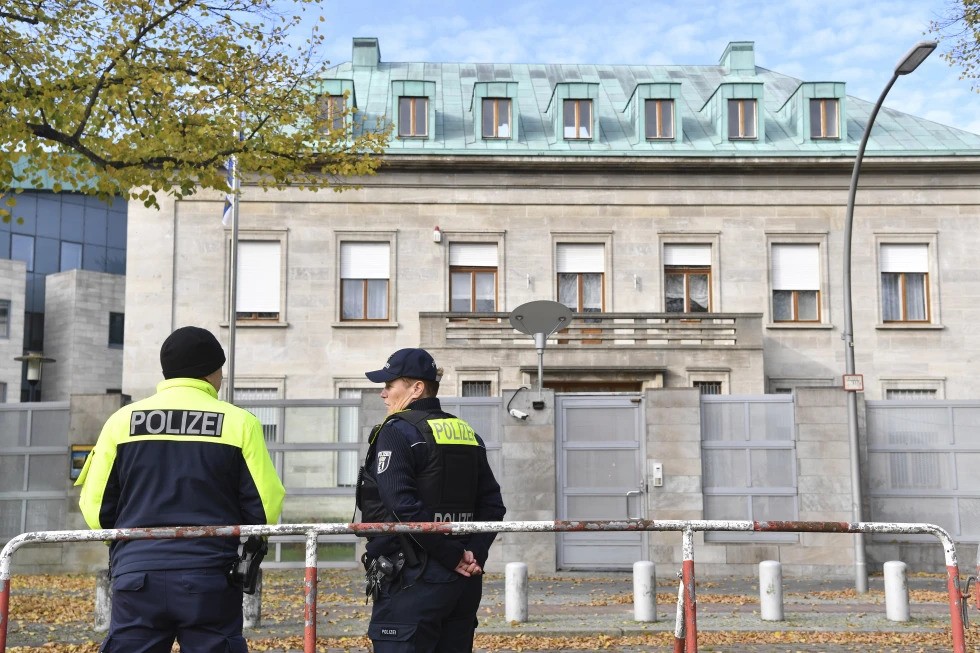
German federal prosecutors have formally charged a Russian teenager with plotting an attack on the Israeli embassy in Berlin and attempting to join the Islamic State terrorist group, according to a report from Reuters on Wednesday. The case has reignited concerns in Germany over extremist recruitment among minors and the enduring threat posed by Islamist terrorism across Europe.
As was detailed in a report on Wednesday at The Jewish News Syndicate (JNS), the accused—identified only as Akhmad E. under Germany’s strict privacy protections—was indicted on August 7. Prosecutors allege that the teenager meticulously planned an act of violence targeting Israeli diplomatic facilities and simultaneously sought pathways to embed himself with ISIS abroad. The charges against him include preparing and inciting a serious act of violence endangering the state and attempting to join a terrorist organization while still a minor.
According to federal investigators, the young suspect began pursuing his plans as early as February. He is alleged to have researched online instructions for constructing improvised explosive devices, though he ultimately failed to secure the necessary components. This lack of access to materials did not diminish the seriousness of the case, prosecutors stressed, as his intent remained explicit and his efforts concerted.
“From the beginning of February, he planned to carry out an attack in Germany, for example on the Israeli embassy in Berlin,” German prosecutors stated in a written declaration. The inclusion of Israel’s diplomatic presence as a prospective target is being treated with heightened sensitivity, given Berlin’s historic responsibility toward Israel and the global rise in antisemitic incidents since the Hamas-led assault of October 7, 2023.
As JNS has reported, Israeli diplomatic facilities worldwide have faced intensified security threats in recent years, with Germany no exception. Officials in Berlin have repeatedly warned of the potential convergence of Islamist extremism and antisemitic violence, a nexus that appears to be central to this latest case.
Beyond the foiled attack in Berlin, prosecutors allege that the teenager was actively pursuing ways to join the Islamic State abroad. Their investigation suggests that he had planned to travel to Pakistan for military training under ISIS guidance, seeking to immerse himself in terrorist instruction and combat preparation.
The financial mechanics of his plan underscore both its resourcefulness and its criminality. Prosecutors believe he funded his intended travel by selling smartphones, which he obtained through fraudulent mobile phone contracts. This blend of low-level financial crime and terrorist ambition has been observed before in European counterterrorism cases, where individuals exploit everyday fraud schemes to bankroll extremist activity.
As the JNS report highlighted, ISIS, though territorially diminished in the Middle East, continues to maintain international networks of sympathizers and recruiters. Its appeal to vulnerable or radicalized youth—particularly through encrypted online platforms—remains a persistent concern for European intelligence agencies.
One of the most unsettling elements of the case is the suspect’s age. Prosecutors revealed that Akhmad E. was still a minor at the time of his attempted recruitment and initial plotting. That detail adds a troubling dimension to an already serious case: the targeting and manipulation of teenagers by extremist organizations.
JNS has reported on the phenomenon of radicalization among minors, noting how jihadist groups increasingly tailor their propaganda to younger audiences. By exploiting online gaming communities, social media channels, and encrypted apps, these groups create pathways that lure adolescents into networks of indoctrination.
The German case calls attention to this challenge vividly. The transition from online radicalization to attempted real-world violence, combined with efforts to join ISIS abroad, reflects the dangerous speed with which extremist ideology can metastasize among vulnerable youth.
Germany has remained on high alert for terrorist threats since a string of attacks in the mid-2010s, including the 2016 Christmas market attack in Berlin that killed 12 people and injured dozens more. While the scale of ISIS-directed plots has diminished in recent years, the persistence of self-radicalized individuals—often acting in isolation—remains a pressing concern for German intelligence and law enforcement agencies.
Germany has faced a particularly difficult balancing act in combating radical Islamism while simultaneously addressing rising far-right extremism. Both trends have presented significant dangers to public safety and democratic stability. The attempted targeting of the Israeli embassy adds another layer, implicating not only Germany’s domestic security but also its international relations and moral commitments.
The federal prosecutor’s office in Karlsruhe, which specializes in national security cases, emphasized that even failed attempts at acquiring weapons or explosives must be treated with the utmost seriousness when embassies and foreign missions are identified as targets.
The implications of this case reverberate beyond Berlin. Attacks on Israeli diplomatic missions are widely seen as assaults not only on the State of Israel but also on global Jewish communities. As the JNS report highlighted, threats of this nature must be understood within the wider context of escalating antisemitism in Europe.
Since October 2023, when Hamas’s terror attack on Israel left more than 1,200 Israelis dead and hundreds kidnapped, Germany and other European states have reported surges in antisemitic rhetoric, protests, and acts of violence. The presence of an alleged ISIS sympathizer plotting against the Israeli embassy deepens the climate of unease for Jewish communities, who already feel increasingly targeted.
Security at Israeli and Jewish institutions across Europe has been visibly reinforced in recent months, but this latest case will likely intensify calls for even stronger protective measures.
The fact that the accused is a teenager also raises complex questions about justice and rehabilitation. German courts will need to weigh the severity of the charges against his youth, and whether imprisonment, deradicalization programs, or a combination of both represent the appropriate course of action.
As JNS noted in its analysis of similar cases, European governments remain deeply divided over how best to respond to radicalized minors. Some argue that severe punishment is necessary to deter future acts, while others advocate for comprehensive psychological and social interventions aimed at rehabilitation. In Germany, the debate is particularly acute, given the country’s legal framework that emphasizes both accountability and juvenile protection.
The indictment of Akhmad E. is a sobering reminder that the threat of jihadist terrorism has not disappeared, even as the Islamic State’s territorial “caliphate” has long been dismantled. For Germany, the case is an alarm bell—signaling both the continued reach of extremist ideology into European societies and the enduring vulnerability of Israeli and Jewish institutions abroad.
The attempted attack against Israel’s embassy in Berlin represents not merely a failed plot but a clear illustration of how antisemitism and Islamist extremism converge in dangerous ways. The story also underscores the critical importance of vigilance, international cooperation, and proactive measures to protect both diplomatic missions and the communities they represent.
The forthcoming trial of the teenager will not only determine his fate but will also test Germany’s broader approach to combating extremism among its youth. For Israel and Jewish communities worldwide, the case reinforces an all-too-familiar reality: that embassies, synagogues, and schools remain on the frontline of a struggle against hatred and terror that continues to adapt and
