



|
Getting your Trinity Audio player ready...
|
By: Andrew Carlson
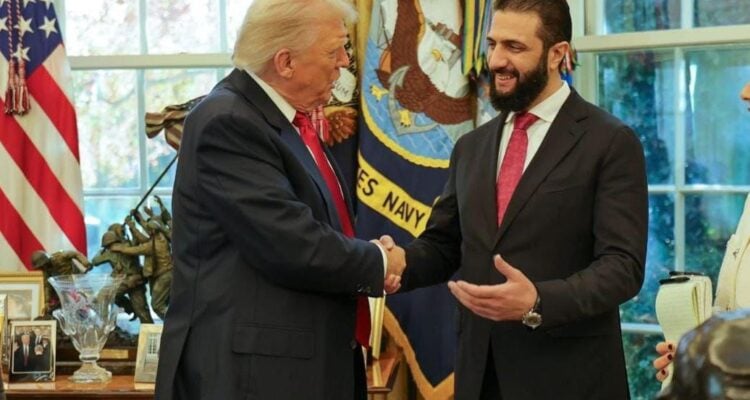
(JEWISH VOICE NEWS) In what Israel National News described as a “watershed moment in modern Middle Eastern diplomacy,” Syrian President Ahmed al-Sharaa’s visit to the White House earlier this week has been hailed as a transformative milestone in regional politics — and as a striking testament to the Trump administration’s doctrine of reconciliation through strength.
The visit, unprecedented in Syria’s history since its independence in 1946, marked the first time a Syrian head of state has ever set foot inside the Oval Office. For a nation long defined by its pariah status, international isolation, and devastating civil conflict, the symbolism was profound: Syria, once the world’s most sanctioned state, is now repositioning itself as a partner in regional stability and, potentially, in counterterrorism cooperation with Israel and the United States.
The initiative, which Israel National News has followed closely, was led by U.S. Ambassador to Turkey and Special Envoy to Syria Tom Barrack, who characterized the summit as “a decisive turning point in the modern history of the Middle East.”
“This week marks a decisive turning point in the modern history of the Middle East — and in the remarkable transformation of Syria from isolation to partnership,” Barrack wrote in his formal statement following the meeting, excerpts of which were published by Israel National News.
Barrack, a key architect of President Donald Trump’s Middle East policy framework, noted that the two leaders’ discussions reflected a shared conviction that “the time has come to replace estrangement with engagement and to give Syria — and its people — a genuine chance at renewal.”
The meeting brought together a formidable assembly of Trump’s foreign policy team: Vice President J.D. Vance, Secretary of State Marco Rubio, Defense Secretary Pete Hegseth, White House Chief of Staff Susie Wiles, Special Envoy Steve Witkoff, and Syrian Foreign Minister Asaad al-Shaibani.
In a symbolic act of geopolitical reconciliation, President al-Sharaa committed Syria to join the U.S.-led D-ISIS coalition, transforming what was once a battlefield adversary into an ally in the fight against global terrorism. “Damascus will now actively assist us in confronting and dismantling the remnants of ISIS, the IRGC, Hamas, Hezbollah, and other terrorist networks,” Barrack said, in remarks carried by Israel National News.
For Israel, the implications of such a shift are profound. A Syrian government aligning itself against Iran’s Revolutionary Guard Corps (IRGC) and Hezbollah — two of Israel’s most entrenched regional adversaries — could significantly alter the security calculus along the northern frontier.
According to the information provided in the Israel National News report, the historic meeting followed Trump’s May decision to lift all U.S. sanctions on Syria, a move that shocked Washington’s foreign policy establishment but was justified, as Trump put it, “to give Syria a chance.”
The most significant next step, Barrack noted, would be the full repeal of the Caesar Act, a 2019 U.S. law imposing severe economic penalties on the Syrian regime for war crimes committed during the civil war — legislation ironically signed by Trump himself during his first term.
Barrack’s statement, as reported by Israel National News, framed the repeal as the necessary final step toward stabilizing the nation: “We call upon and urge Congress to take this historic step. We have come far but now need one strong final push to empower the new Syrian government to restart its economic engine and allow the Syrian people and their regional neighbors to not only survive but to thrive.”
The message was clear: the rehabilitation of Syria, under the leadership of al-Sharaa and with American support, would not only mark the end of a brutal era of sanctions and war, but also anchor the nation firmly within a pro-Western, anti-terror alignment.
In what the Israel National News report called “the quiet diplomatic masterpiece of the Trump era,” the meeting also featured a trilateral dialogue between Secretary of State Rubio, Turkish Foreign Minister Hakan Fidan, and Syrian Foreign Minister Asaad al-Shaibani. The discussion produced an ambitious new U.S.–Turkish–Syrian framework aimed at reconciling years of hostility and fragmentation.
The agenda, as described by Barrack, was sweeping in scope. It included plans to:
Integrate the Syrian Democratic Forces (SDF) — long a contentious point between Washington and Ankara — into the new Syrian political, economic, and defense structures.
Redefine Turkish-Syrian-Israeli relations, setting the stage for long-term security coordination and normalization mechanisms.
Advance the fragile Israel-Hamas ceasefire, linking it to broader regional stabilization efforts involving Lebanon’s southern border and the Golan Heights.
“Türkiye’s tireless role deserves special acknowledgment,” Barrack said, citing Ankara’s “quiet, steadfast diplomacy” as instrumental in building bridges where “walls once stood.” He praised the expanded Arab coalition of Qatar, Saudi Arabia, and Türkiye, whose support for the reintegration of Syria into the Arab fold he described as “a magic elixir.”
According to the information contained in the Israel National News report, this new alignment marks an extraordinary reversal of a decade-long regional dynamic. Just years ago, Syria was seen as the epicenter of Iranian influence and the primary conduit for arms to Hezbollah. Now, with the encouragement of Trump’s envoys and Arab moderates, Damascus is being recast as a pillar of regional security, potentially undermining Tehran’s regional ambitions.
In his remarks, Barrack also reflected on the deeper cultural and historical resonance of the moment. “The Middle East is, by its very nature, a living mosaic,” he wrote — words that Israel National News called “both poetic and prescient.”
“Within it, Syria stands as a mosaic within that mosaic — a land where diverse peoples and religions have for centuries shared the same soil, suffered the same storms, and now seek the same peace. In the delicate interplay of these layers lies both the challenge and the promise of the region’s renewal.”
This theme of unity through diversity has been central to the Trump administration’s evolving Middle East strategy. Under what Israel National News has described as the “Abraham Doctrine,” Trump’s approach prioritizes security first, prosperity next, seeking to replace ideological confrontation with pragmatic cooperation.
Barrack echoed this philosophy in his statement: “President Trump’s leadership is forging a realignment built on ‘security first, prosperity next’ — a future defined not by the shadows and horrors of the past, but by the promise and hopes of a new and redefined future.”
For observers of Middle Eastern diplomacy, the image of a Syrian president walking through the colonnades of the White House carries extraordinary weight. Since the founding of modern Syria in 1946, no leader from Damascus had ever been received in Washington.
As the Israel National News report noted, the visit represents “the end of an era of estrangement and the beginning of an unprecedented chapter of engagement.” In a region long defined by mistrust, proxy wars, and sectarian divisions, the meeting stands as tangible evidence that former adversaries can become allies through mutual recognition of shared interests.
Ambassador Barrack described the scene inside the Oval Office with vivid reverence: “We witnessed President al-Sharaa’s commitment to President Trump to join the D-ISIS coalition — a framework marking Syria’s transition from a source of terrorism to a counterterrorism partner.”
He added that the moment was a “historic transformation” — Syria moving from a state once synonymous with conflict to a potential stabilizing force within the very coalition that once sought to contain it.
As Israel National News has frequently emphasized, this diplomatic achievement is emblematic of the Trump Doctrine’s broader redefinition of U.S. engagement in the Middle East — one grounded in direct negotiation, bilateral respect, and the empowerment of regional actors rather than foreign intervention.
“What is new — and extraordinary — is that it is being achieved by the regional nations themselves rather than Western mandates and dictates,” Barrack wrote. “The path will not be smooth. Integration is a process, not an event. But the vision of one man is now shared by many and can become a reality.”
The principle of “regional self-determination” — encouraging Arab and Muslim nations to take ownership of their collective security — has guided Trump’s policy initiatives from the Abraham Accords to the ongoing normalization efforts involving Saudi Arabia and Israel. Syria’s inclusion in this framework signals the most dramatic expansion of that doctrine yet.
As the dust settles on this extraordinary week of diplomacy, the implications are still being parsed by analysts. For the Syrian people, exhausted by decades of war, sanctions, and isolation, the promise of renewed economic and diplomatic engagement offers a glimmer of hope. For the region, it represents a potential shift in the balance of power — one that could redefine alliances and redraw the contours of postwar Middle East order.
According to the report at Israel National News, the visit also draws attention to the widening rift between Washington’s new Middle East strategy and the policies of previous administrations that prioritized punitive isolation over conditional engagement.
The message emerging from Washington, Ankara, and Damascus is clear: the era of endless wars and Western-imposed models is fading. In its place is emerging a regional compact of mutual interest, guided by the pragmatic recognition that economic recovery and security cooperation are the twin pillars of lasting peace.
“This was a week to remember,” Barrack concluded, in words quoted by Israel National News. “The next step in truly giving Syria a chance is the full repeal of the Caesar Act. We have come far, but now need one strong final push to empower the new Syrian government to restart its economic engine and allow the Syrian people and their regional neighbors to not only survive but to thrive.”
What unfolded in Washington this week, as the Israel National News report observed, was not simply a diplomatic engagement but a reimagining of the Middle East itself — one no longer divided by rigid alliances and ideological boundaries, but united by shared security and common prosperity.
If this vision holds, President Trump and President Ahmed al-Sharaa will have inaugurated more than a bilateral rapprochement — they will have lit the path toward a new regional order, in which Syria, once a symbol of destruction, becomes a cornerstone of renewal.