



|
Getting your Trinity Audio player ready...
|
By: Chaya Abecassis
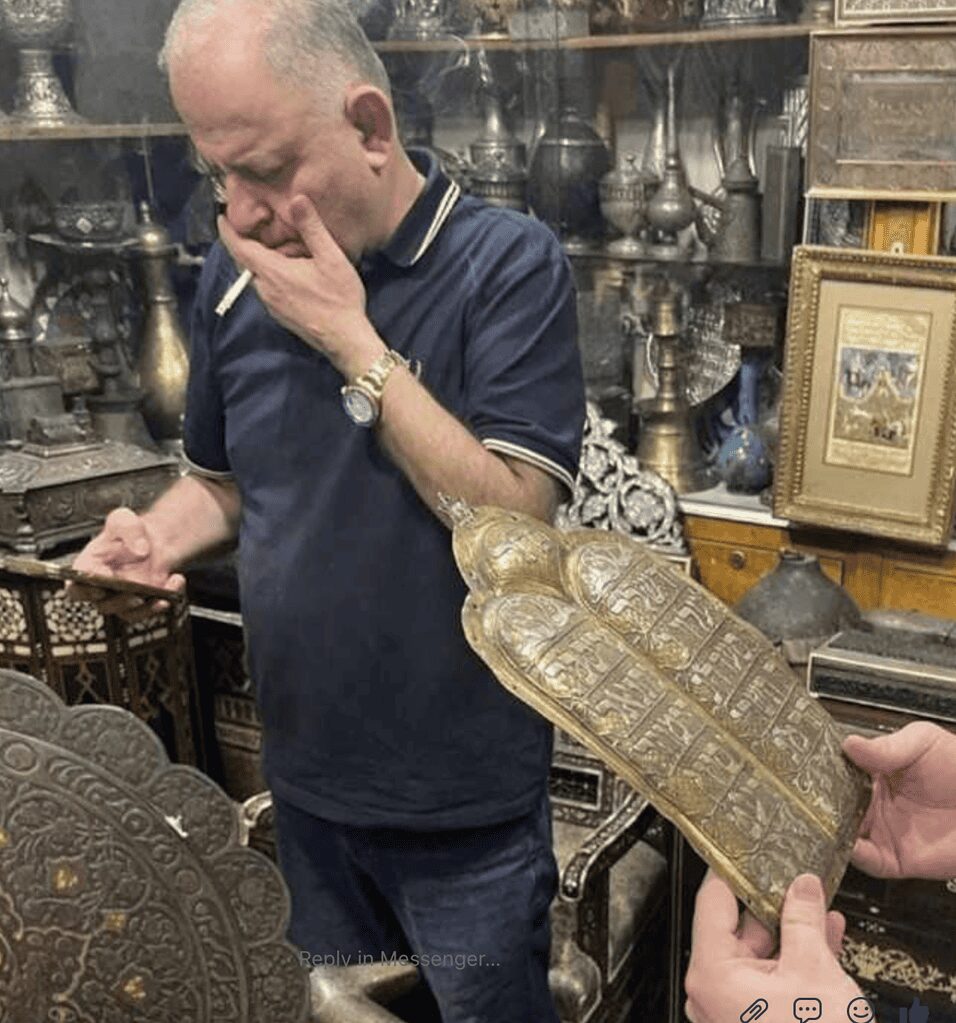
In a development that has reverberated quietly through Middle Eastern diplomatic circles, Syrian authorities have released Salim Hamadani, one of the last remaining Jews living openly in Damascus, after weeks in detention over allegations of illegal antiquities trading. The episode, reported on Sunday by VIN News, has taken on a symbolic weight far beyond the personal ordeal of a single man, coming as Syria’s new leadership seeks to reposition the country on the global stage and to recast its approach toward long-marginalized minority communities.
According to the information provided in the VIN News report, Hamadani, a well-known antiquities dealer in the Syrian capital, was taken into custody earlier this month amid a probe into alleged smuggling of historical artifacts — a crime that has plagued the war-scarred nation as looting and illicit trade flourished during more than a decade of civil conflict. For nearly three weeks, little was known about Hamadani’s fate, prompting concern among the already tiny Syrian Jewish diaspora scattered across the world.
The news of his release emerged through Joe Jajati, a Syrian-born Jewish activist now living in New York who has become an informal conduit between Syrian officials and Jewish expatriates. In a statement cited by VIN News, Jajati said Hamadani had been freed after approximately 20 days in detention and that authorities had cleared him of all charges.
But it was not only the outcome of the case that caught attention; it was the manner in which it was handled.
Jajati, whose communications with Syrian officials have intensified in recent months, emphasized that Hamadani’s arrest was not motivated by religious bias — a point he stressed repeatedly in remarks quoted by VIN News. Instead, he said, the investigation was conducted within the framework of Syria’s antiquities laws and that Hamadani was treated with “dignity and professionalism” while in custody.
In a post on X, Jajati wrote that the Syrian authorities had demonstrated a commitment to due process and fairness, a sentiment echoed by VIN News, which reported that officials took pains to separate the criminal inquiry from any questions of Hamadani’s Jewish identity.
For a country whose record on minority rights has long been the subject of international censure, such assurances — even if limited to a single case — represent a noteworthy shift in tone.
Hamadani’s story is inseparable from the broader narrative of Syria’s Jewish community, once one of the most vibrant in the Arab world. At its height in the early 20th century, tens of thousands of Jews lived in cities such as Damascus and Aleppo, their synagogues and markets woven into the cultural fabric of the Levant.
Today, however, only a handful remain, most of them elderly and reluctant to leave the homes where their families have lived for generations. VIN News reported that Hamadani is among this vanishing cohort — a living relic of a community that has all but disappeared from Syrian soil.
For this reason, his detention was never going to be a routine legal matter. Within days, Syrian Jewish expatriates in the United States and Europe began reaching out to intermediaries such as Jajati, anxious that the arrest might signal a new wave of pressure against the remnants of Jewish life in Syria.
Instead, the opposite appears to have occurred.
The timing of the case could hardly have been more sensitive. Syria’s new government, which rose to power earlier this year, is acutely aware that its legitimacy — both domestically and internationally — hinges in part on its treatment of minority communities. From Christians in Homs to Druze in the south, and now Jews in Damascus, each interaction is being watched as a barometer of whether the country is truly turning a page after years of brutal conflict.
The Hamadani affair unfolded against this backdrop of heightened scrutiny. Far from being an isolated legal episode, it became a test case for the government’s claim that it intends to govern on the basis of law rather than sectarianism.
That Hamadani was ultimately cleared of all charges, and that intermediaries such as Jajati were allowed to publicly attest to the fairness of the process, suggests that Syrian officials were keenly aware of the optics involved.
At the same time, the allegations themselves were not frivolous. Syria’s antiquities trade has been ravaged by years of war, with ancient artifacts looted from archaeological sites and sold on the black market to finance militias and criminal networks. The government, eager to present itself as a responsible custodian of cultural heritage, has pledged to crack down on such activity.
According to the information contained in the VIN News report, Hamadani was detained in the context of this broader campaign, which has seen authorities pursue dealers suspected of trafficking in stolen artifacts. That he was ultimately cleared underscores the complexity of enforcing antiquities laws in a country where documentation is scarce and informal trade has long flourished.
Perhaps the most intriguing dimension of the story is the role played by figures such as Joe Jajati. A Syrian-born Jew who fled the country decades ago, Jajati has in recent months emerged as a bridge between the new Syrian government and Jewish communities abroad.
VIN News reported that Jajati and other expatriates have been working quietly to establish channels of dialogue, exploring the possibility that Syria’s Jews — though now mostly scattered across New York, Mexico City, and Israel — might once again be able to engage with their ancestral homeland without fear.
Hamadani’s release, Jajati suggested, is a tangible result of that outreach.
Yet even as observers welcome the outcome, few are under any illusion that this single case signals a wholesale transformation. The Jewish population of Syria remains perilously small, and the structural challenges facing the country — economic collapse, political isolation, and lingering sectarian tensions — have hardly evaporated.
Still, as the VIN News report emphasized, symbols matter in diplomacy, especially when they involve individuals who embody the fragility of minority life in the Middle East. The image of Salim Hamadani returning to his home in Damascus, cleared of charges and publicly defended by both Jewish activists and Syrian officials, is one that will resonate far beyond the city’s ancient walls.
For now, the episode stands as a cautiously hopeful footnote in Syria’s long and troubled history — a reminder that even in a land scarred by war and division, gestures of fairness can still carry profound meaning.