



|
Getting your Trinity Audio player ready...
|
By: Russ Spencer
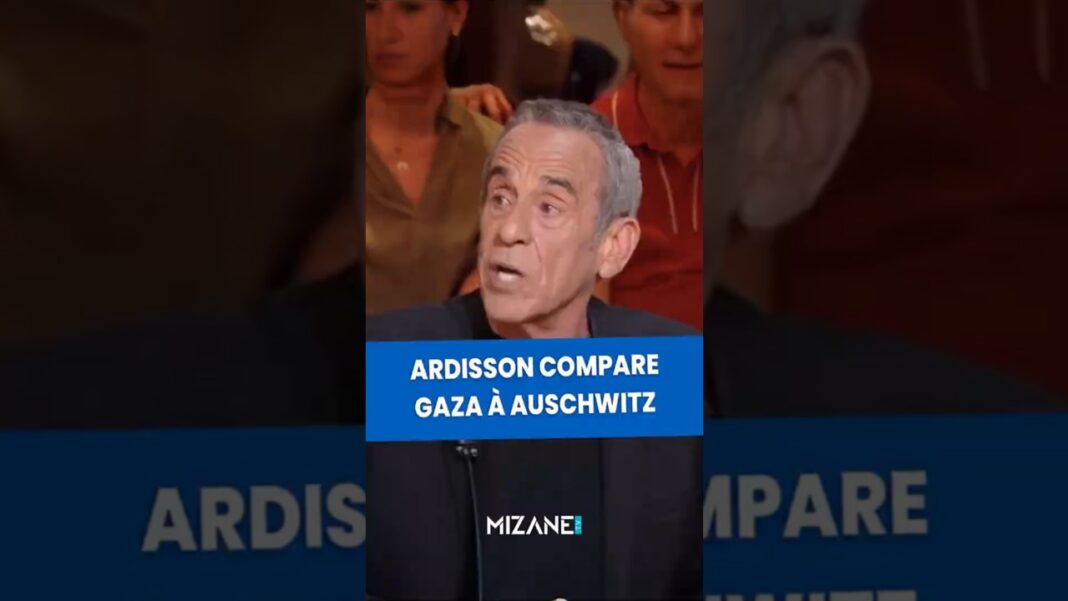
French television personality Thierry Ardisson issued a formal apology this week after drawing widespread condemnation for equating the Gaza Strip with the Nazi extermination camp Auschwitz during a broadcast of France 2’s “Quelle époque!” talk show. The comparison, made during the prime-time Saturday evening program, ignited swift and fierce backlash from Jewish organizations across France and Europe. As reported by The European Jewish Press, the incident has further fueled concerns over the growing trivialization of Holocaust memory in the context of Middle East discourse.
Malheureusement, le mal est fait : les propos d’Ardisson ont été entendus et lus par des milliers de personnes. Ce type, il te crève un œil et, le lendemain, il te dit “excuse-moi”. pic.twitter.com/2gDeYyGtZW
— Collectif des Vigilants (@Ccoolvigi) May 11, 2025
During the broadcast, Ardisson bluntly declared: “The Gaza Strip is Auschwitz, that’s it, that’s all there is to it.” His remarks came in the context of a discussion about the ongoing humanitarian crisis in Gaza but instantly crossed a red line for many viewers and commentators, particularly within the Jewish community, who saw in his words a grotesque distortion of history.
Reacting immediately to the broadcast, Yonathan Arfi, president of CRIF—the umbrella organization representing Jewish institutions in France—denounced Ardisson’s comparison as a dangerous historical revisionism. As The European Jewish Press reported, Arfi emphasized that “Gaza is not Auschwitz” and that Holocaust memory is frequently weaponized by those who wish to turn it against Jews.
“No criticism of Israel justifies Nazifying it,” Arfi stated emphatically. “Since October 7, 2023, I have deplored the suffering of all civilians, Israeli and Palestinian alike. But for what other conflict do we invoke such comparisons to the Shoah?” His comments reflect growing concern that references to the Holocaust are being increasingly misappropriated in political discourse, especially when directed at the Jewish state.
The International League against Racism and Anti-Semitism (LICRA) echoed these concerns, issuing a strong rebuke of Ardisson’s statement. “Nazism and the Shoah are not the alpha and omega of all national and international crises,” the group posted on X (formerly Twitter), condemning what it called “the trivialization of outrageous comparisons.” The European Jewish Press noted LICRA’s longstanding efforts to combat antisemitism and uphold historical integrity in public discourse.
Under mounting pressure, Ardisson issued an apology through a statement distributed to Agence France-Presse and shared with notable public figures, including French-Israeli lawyer and columnist Gilles-William Goldnadel. In his apology, Ardisson acknowledged the insensitivity of his remarks. “The emotion was undoubtedly too strong and my remarks exaggerated,” he said. “I ask my Jewish friends to forgive me,” adding that he had always taken a public stance against antisemitism.
Despite his apology, the damage appears to be done, with criticism extending beyond his comments to the network and program host. Goldnadel, a former president of the France-Israël Association and a member of CRIF’s Steering Committee, condemned “Quelle époque!” host Léa Salamé for failing to immediately challenge Ardisson’s comparison. Speaking to The European Jewish Press, Goldnadel called her silence “inexcusable,” arguing that it contributed to the normalization of antisemitic rhetoric.
“Once again, I see that public broadcasting is becoming the main instrument of hatred of Israel and a manufacturer of antisemitism,” Goldnadel stated. In response, he announced plans to file a formal complaint with ARCOM—the French audiovisual regulatory authority—seeking accountability for what he described as an egregious editorial failure.
ARCOM, the Regulatory Authority for Audiovisual and Digital Communication, is an independent administrative agency tasked with ensuring ethical standards and legal compliance in French media. According to The European Jewish Press, the watchdog may now face pressure to examine whether Ardisson’s comments violated broadcasting regulations related to incitement or the distortion of historical atrocities.
This controversy arrives at a time of heightened sensitivity in France, where antisemitism has sharply risen in the wake of the October 7 Hamas attacks and the subsequent war in Gaza. In this climate, Jewish leaders and institutions are increasingly vigilant about public figures who invoke Holocaust imagery to condemn Israeli policies—an act many view as a veiled form of antisemitism.
Thierry Ardisson’s “Auschwitz” comment is not an isolated incident but part of a broader and worrying trend, The European Jewish Press observed, wherein Holocaust analogies are used not to enlighten but to demonize. Such rhetoric not only desecrates the memory of six million Jews murdered in the Holocaust but also serves to inflame antisemitic attitudes, especially when left unchallenged in mainstream media.
While Ardisson’s apology may offer some measure of closure, Jewish advocacy organizations stress that this must be a teachable moment for both media figures and the general public. As Yonathan Arfi noted, “The memory of the Shoah is sacred. It must never be weaponized—least of all against Jews or the Jewish state.”
For The European Jewish Press, this episode reinforces the urgent need for media literacy, historical education, and responsible broadcasting—particularly in a country that bears the scars of both collaboration during World War II and a deep post-war reckoning with antisemitism. In the face of escalating global tensions and rising hate crimes, comparisons like Ardisson’s not only mislead but cause real harm.
As the French media regulator considers its next steps, and as Jewish leaders continue to push back against the misuse of Holocaust memory, the Ardisson affair serves as a stark reminder: words matter, history matters, and so does accountability.

Don’t be surprised that if Israel did turn Gaza into another Auschwitz at some point in time, nobody would say anything. This is my general rule: If Israel is accused of something in public, it is probably not true. If that something is ignored, then it is probable true.