



|
Getting your Trinity Audio player ready...
|
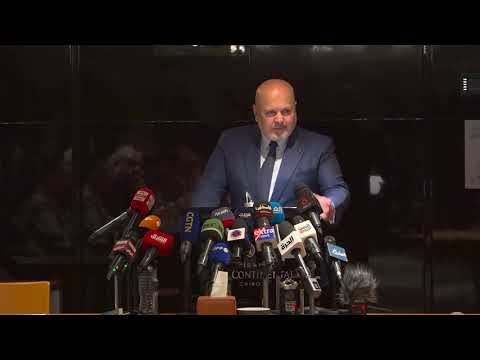
Families of Israeli Hostages Sue ICC Chief Karim Khan, Accuse Him of Aiding Hamas and Obstructing Justice
By: Fern Sidman
The families of three Israeli hostages still held in Gaza have launched a legal offensive against International Criminal Court (ICC) chief prosecutor Karim Khan, accusing him of aiding Hamas, obstructing justice, and providing political cover to one of the world’s most notorious terrorist organizations. The suit, filed in Israel and valued at NIS 20 million (approximately $5.9 million), charges Khan with undermining Israel’s ability to secure the release of its citizens and with transforming the ICC into, in the plaintiffs’ words, “a branch of Hamas.”
As The Algemeiner reported on Thursday, the case has been brought by the prominent Israeli civil rights NGO Shurat HaDin, under the leadership of its founder and president, attorney Nitsana Darshan-Leitner. Filed on behalf of the families of Avinatan Or, Eitan Mor, and Omri Miran — three hostages abducted during Hamas’s Oct. 7, 2023, onslaught — the lawsuit accuses Khan of deceiving victims’ families, protecting Hamas leadership from timely prosecution, and crafting a false moral equivalence between Israel and the perpetrators of the massacre.
In announcing the suit, Darshan-Leitner leveled some of the harshest public criticism yet directed at the ICC chief: “The International Criminal Court has become a branch of Hamas. Through [Khan’s] direct actions, he gave an enormous tailwind to the terrorist murderers.”
The lawsuit alleges that Khan:
Delayed justice by failing for more than eight months to issue arrest warrants for key Hamas leaders responsible for orchestrating the Oct. 7 massacre, including Mohammed Deif, Yahya Sinwar, and Ismail Haniyeh.
Limited the scope of ICC action even when warrants were issued — omitting other senior Hamas and Palestinian Islamic Jihad figures directly responsible for the kidnapping and abuse of hostages.
Granted legitimacy to Hamas by publicly equating the conduct of Israel, a democratic state defending itself, with that of armed groups that deliberately target civilians.
Deflected attention from sexual misconduct allegations against himself by aggressively pursuing charges against Israeli leaders.
Undermined the plaintiffs’ interests by failing to prioritize crimes committed against hostages and their families.
In legal terms, the suit frames Khan’s conduct as actively facilitating Hamas’s strategy of using hostages as leverage while avoiding meaningful accountability.
Central to the lawsuit, as The Algemeiner report highlighted, is the charge that Khan has woven a “blood libel” against the State of Israel by creating what the plaintiffs describe as a “false moral equivalence” between victim and aggressor. The filing argues that this narrative has given Hamas “legitimacy to continue extorting Israel while holding and abusing the hostages,” effectively emboldening the group’s leadership.
The complaint contends that in delaying warrants for Hamas leaders while swiftly targeting Israel’s prime minister and defense minister, Khan has inverted the priorities of justice. Rather than holding accountable those who initiated the war through the Oct. 7 massacre, the ICC, under Khan’s leadership, has — according to the plaintiffs — lent political cover to the perpetrators.
In November 2024, the ICC issued arrest warrants for Israeli Prime Minister Benjamin Netanyahu, former Defense Minister Yoav Gallant, and deceased Hamas military chief Ibrahim al-Masri (also known as Mohammed Deif) for alleged war crimes and crimes against humanity committed during the ongoing Gaza conflict.
The decision, announced months after Khan’s surprise move in May 2024 to request warrants for Netanyahu and Gallant, provoked widespread outrage in Israel, the United States, and allied capitals.
Khan’s announcement was made on the same day he abruptly canceled a long-planned visit to Gaza and Israel — a trip intended to collect evidence and hear Israel’s defense against allegations of war crimes. As The Algemeiner report noted, this last-minute cancellation infuriated US and British leaders, who saw the visit as a critical opportunity for direct engagement.
The ICC has claimed there were “reasonable grounds to believe” that Netanyahu and Gallant bore criminal responsibility for alleged starvation of civilians in Gaza and persecution of Palestinians — charges Israel vehemently denies.
Israel has responded to the ICC allegations with a comprehensive rejection, asserting that it has made unprecedented efforts to avoid civilian casualties while delivering large volumes of humanitarian aid to Gaza, even as Hamas has systematically diverted such aid for its own purposes.
The Israeli government has repeatedly pointed to Hamas’s entrenched military strategy: embedding command centers, rocket launch sites, and weapons caches in densely populated civilian areas — including hospitals, schools, and mosques. This use of human shields, acknowledged even by some of Israel’s critics, has forced the IDF into operational dilemmas that no other military has faced on such a scale.
From Israel’s perspective, the ICC’s simultaneous targeting of its leaders and Hamas officials — rather than prioritizing the group responsible for initiating the war and for ongoing war crimes such as hostage-taking — amounts to an egregious distortion of the facts.
The three hostages whose families are plaintiffs in the case — Avinatan Or, Eitan Mor, and Omri Miran — were among the 251 people abducted during Hamas’s coordinated assault on southern Israel. On Oct. 7, 2023, heavily armed militants stormed Israeli communities, military outposts, and the Nova Music Festival, murdering 1,200 civilians and soldiers and dragging hostages back into Gaza.
Nearly a year later, 50 hostages are still believed to be alive in captivity, where they endure conditions that violate every tenet of international humanitarian law. Others have been confirmed dead, their bodies still held by Hamas as bargaining chips.
The families argue that by failing to act decisively against Hamas’s leadership, Khan has indirectly prolonged their loved ones’ captivity and suffering.
Shurat HaDin has a long record of pursuing creative legal action against terrorist groups and those accused of aiding them. In this case, the NGO is leveraging Israeli civil law to hold an international official personally liable for conduct it claims has materially supported terrorism.
In its statement on X, Shurat HaDin vowed: “We will not allow international courts to turn into sanctuaries for terror. We will not let them rewrite history. We will not stay silent while justice is hijacked.”
Darshan-Leitner has emphasized that the lawsuit is not just about damages but about challenging what she sees as a dangerous precedent: allowing international legal bodies to become tools in the political warfare waged against Israel.
The ICC’s handling of the Gaza conflict has drawn blistering condemnations from both US and Israeli officials. Washington has argued that the court is overstepping its mandate, especially given that Israel is not a signatory to the Rome Statute and has functioning judicial mechanisms capable of investigating its own military conduct.
For many observers, the core problem lies in the ICC’s framing of the conflict. By placing the leaders of a democratic state and the commanders of a genocidal terrorist organization on the same moral and legal plane, the court risks eroding its credibility and diminishing the moral clarity needed to confront groups such as Hamas.
If successful, the lawsuit against Khan could reverberate far beyond Israel. It would mark one of the rare instances in which a senior international prosecutor has been sued by victims’ families for alleged complicity with a terrorist organization. Such a precedent could embolden other victims of armed groups to challenge perceived bias or dereliction of duty by international bodies.
It also raises profound questions about the neutrality and accountability of global judicial institutions in asymmetric conflicts, where one party is a state actor bound by international law and the other is a non-state armed group that systematically violates it.
This legal action underscores the growing chasm between Israel and the ICC — a relationship already strained by years of jurisdictional disputes and politically charged investigations. For the plaintiffs, the case is as much about reclaiming the moral narrative as it is about securing justice for their family members.
In their view, Khan’s failure to act promptly and decisively against Hamas leaders has had tangible consequences: it has emboldened the group, prolonged the suffering of hostages, and undermined international efforts to end the war on terms that secure Israel’s citizens.
As The Algemeiner report observed, the Shurat HaDin lawsuit represents a direct challenge not only to Karim Khan’s leadership but also to the ICC’s legitimacy in the eyes of Israel and its allies. By alleging that the court has effectively become an instrument of Hamas, the plaintiffs are forcing a confrontation over the very principles of international justice: impartiality, proportionality, and the prioritization of the most egregious crimes.
Whether or not the Israeli courts ultimately find Khan liable, the case will sharpen the debate over how international legal bodies engage with democratic states confronting terrorist adversaries — and whether those bodies can be trusted to distinguish between the two.
In the words of Darshan-Leitner, “We will not stay silent while justice is hijacked.” For the families of Avinatan Or, Eitan Mor, and Omri Miran, silence is not an option — and neither, they contend, is inaction from those entrusted with upholding the law.

Readers: Send your email of protest of the UJA donation to Gaza. Ask them to cancel it and redirect to the families of hostages. Thank you.
[email protected]