



|
Getting your Trinity Audio player ready...
|
By: Fern Sidman
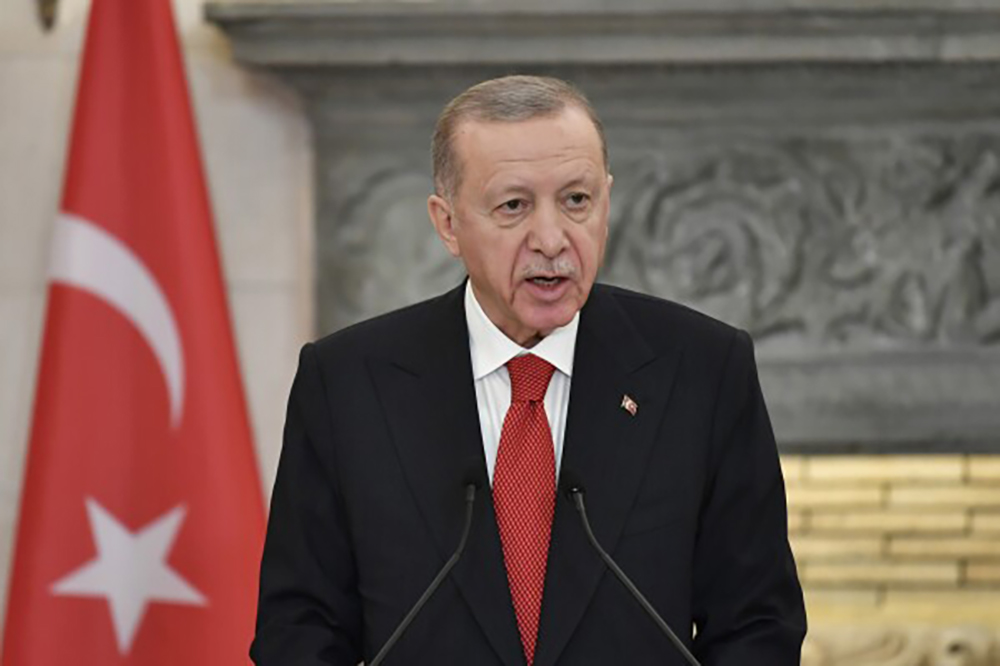
Tensions between two major NATO allies—the Republic of Turkey and the Federal Republic of Germany—flared publicly on Thursday, as Turkish President Recep Tayyip Erdogan launched a blistering critique of Berlin’s stance on Israel’s military campaign in Gaza. His remarks, delivered during a joint press conference with German Chancellor Friedrich Merz, called attention to the growing diplomatic rift within the alliance over the Middle East conflict.
According to a report on Thursday at Israel National News, Erdogan accused Germany of “turning a blind eye” to what he called “genocide” in Gaza, describing Israel’s operations against Hamas as indiscriminate and inhumane. The remarks marked one of the sharpest exchanges yet between the two leaders, whose meeting in Ankara had been expected to focus on NATO cooperation, migration, and regional stability. Instead, it quickly descended into a tense confrontation over Israel’s right to defend itself.
“Hamas does not have bombs or nuclear arms, but Israel has all of these and uses them to hit Gaza, for example with those bombs again last night,” Erdogan declared, visibly agitated. “Do you, as Germany, not see these? Do you, as Germany, not follow these? Besides hitting Gaza, Israel has always sought to suppress it through famine and genocide.”
As the Israel National News report noted, Erdogan’s rhetoric has grown increasingly incendiary since Hamas’s October 7, 2023, terror attack on Israel, which left more than 1,200 Israelis dead and hundreds kidnapped. Despite Ankara’s involvement in subsequent ceasefire negotiations, the Turkish president has consistently framed Israel as the aggressor, even referring to the Jewish state as a “terror entity” earlier this year.
Chancellor Merz, who has sought to balance Germany’s historic support for Israel with calls for restraint in Gaza, responded with calm but unmistakable firmness. “It would have taken only one decision to avoid countless unnecessary casualties,” he said, referring to Hamas’s refusal to release hostages and end its rocket attacks. “Hamas should have released the hostages earlier and laid down its arms.”
According to the information provided in the Israel National News report, Merz went on to reaffirm Berlin’s commitment to Israel’s security, describing it as a “core tenet of German foreign policy.” He emphasized that while Germany supports a two-state solution, it cannot ignore the existential threat Hamas poses to Israel or the atrocities committed during the October 7 massacre.
The encounter between Erdogan and Merz—Merz’s first official visit to Turkey since taking office—was intended to mark a reset in bilateral relations. The two NATO allies have long had a complex partnership, balancing shared interests in defense and migration with stark differences on human rights, press freedom, and Middle Eastern geopolitics.
Yet, as Israel National News reported, the Gaza war has emerged as a defining wedge issue, exposing not only the ideological chasm between Ankara and Berlin but also the broader fragmentation of NATO’s political consensus.
Erdogan, who has positioned himself as a self-styled defender of Palestinian rights, has consistently accused Western nations of hypocrisy and double standards. “When Ukrainians fight back, they are heroes; when Palestinians resist occupation, they are terrorists,” he said in earlier remarks reported by Israel National News. “This is the moral blindness of the West.”
By contrast, Merz has maintained that Hamas bears direct responsibility for the ongoing suffering in Gaza. In his press appearance, he emphasized that any lasting peace must begin with the dismantling of Hamas’s military capacity and the return of all remaining hostages—conditions that align closely with Israel’s own position.
“Criticism of Israel must not become a pretext for antisemitism,” Merz said pointedly, a remark that appeared to rebuke not only Erdogan’s tone but also the broader surge of anti-Israel rhetoric in parts of Europe and the Middle East.
As Israel National News has documented in recent months, Erdogan’s confrontational stance toward Israel has intensified significantly since the October 7 attack. In March, he labeled Israel a “terror state,” and in June, he accused Prime Minister Benjamin Netanyahu’s government of being “the greatest threat to Middle East security.”
These remarks have been accompanied by diplomatic maneuvers that have increasingly alienated Turkey from its Western partners. Despite Turkey’s formal ties with Israel and its role in mediating humanitarian corridors, Erdogan has cultivated close relations with Hamas leaders and provided them with political and financial support.
According to the information contained in the Israel National News report, Erdogan’s government continues to host senior Hamas officials in Istanbul, where the group maintains what many Western intelligence agencies describe as an operational presence.
Ankara’s public posture, analysts say, is an attempt to balance domestic populism with regional ambition. Erdogan’s fiery criticism of Israel plays well among his conservative and Islamist voter base, while his role in ceasefire negotiations allows him to project diplomatic relevance.
However, his comments on Thursday may have pushed relations with Berlin to their lowest point in years. Germany, home to Europe’s largest Turkish diaspora—estimated at over 3 million people—has historically sought to maintain pragmatic ties with Ankara. But Erdogan’s repeated invocation of terms such as “genocide” and “famine” to describe Israel’s actions has strained even that pragmatic patience.
Chancellor Merz, who succeeded Olaf Scholz earlier this year, has sought to restore moral clarity to Germany’s foreign policy after months of internal division over the Gaza conflict. According to the report at Israel National News, while Merz has occasionally voiced criticism of Israel’s handling of the humanitarian crisis in Gaza, he has stopped short of endorsing the more extreme rhetoric used by some European leaders and international organizations.
Earlier this year, Germany temporarily suspended certain military exports to Israel over concerns about escalation but simultaneously reaffirmed its commitment to Israel’s right to self-defense. “Our criticism of specific actions must never be mistaken for neutrality in the face of terror,” Merz told the Bundestag in May. “Germany stands by Israel—not only because of history, but because of moral duty.”
His response to Erdogan on Thursday echoed that conviction. By defending Israel’s position while acknowledging the human toll of the conflict, Merz sought to strike a balance between compassion and realism—a balance Erdogan has shown little interest in maintaining.
The public clash between Ankara and Berlin also highlights growing divisions within NATO over the Gaza war and, more broadly, over the alliance’s engagement in the Middle East. As the Israel National News report observed, Erdogan’s alignment with populist, anti-Western narratives has increasingly placed Turkey at odds with NATO’s strategic objectives.
Turkey’s ongoing cooperation with Russia in energy and defense sectors, coupled with its tense relations with Greece and its obstruction of Sweden’s NATO accession, has already tested the patience of Western allies. Now, Erdogan’s rhetoric on Israel threatens to add a new layer of discord.
“What we are witnessing is not simply a disagreement over Gaza, but a deeper philosophical divide about the West’s role in global conflicts,” one European diplomat told Israel National News. “Erdogan views himself as the champion of a new multipolar world order, even if it means antagonizing his allies.”
Following the tense press conference, neither side issued a joint communiqué—a departure from protocol for such high-level visits. Instead, the Turkish and German delegations released separate statements emphasizing different priorities: Ankara’s focused on humanitarian aid for Gaza and Berlin’s on continued support for Israel’s security and counterterrorism measures.
As the Israel National News report noted, the diplomatic chill may complicate NATO coordination on regional issues ranging from migration control to counterterrorism operations in the Eastern Mediterranean.
Yet, perhaps more consequentially, the exchange reveals how the Israel–Hamas war continues to reverberate far beyond the Middle East, reshaping alliances and testing old friendships.
The Erdogan–Merz confrontation reflects the widening fault lines within the Western alliance, as leaders struggle to reconcile humanitarian concerns with moral clarity in the face of terrorism. While Germany seeks to maintain balance and historical responsibility, Turkey appears intent on redefining its role as both mediator and provocateur.
As the Israel National News report observed, “Erdogan’s rhetoric may win him applause on the streets of Ankara, but it risks deepening his isolation within NATO and undermining Turkey’s credibility as a regional power.”
For Germany, meanwhile, the confrontation serves as a reminder that defending Israel’s right to exist remains not just a political obligation—but a moral imperative born of history.
Whether the alliance can withstand such ideological strains remains to be seen. But as Thursday’s exchange in Ankara made clear, the battle over Gaza is no longer confined to the Middle East—it has become a global test of values, alliances, and truth itself.

Erdogan does not belong in NATO and certainly not in Gaza. I remember years ago, when it was broadcast that he was suspected of having a venereal disease that affected his brain. Nothing has changed except now he is accepted. Shows how our world has degenerated.