



|
Getting your Trinity Audio player ready...
|
By: Svetlana Pincus
Dutch authorities have arrested four young suspects in connection with an apparent arson attack that caused an explosion and fire at the entrance of a synagogue in Rotterdam early Friday morning, in what officials and Jewish community leaders say may be part of a broader surge of antisemitic incidents targeting Jewish institutions across multiple countries.
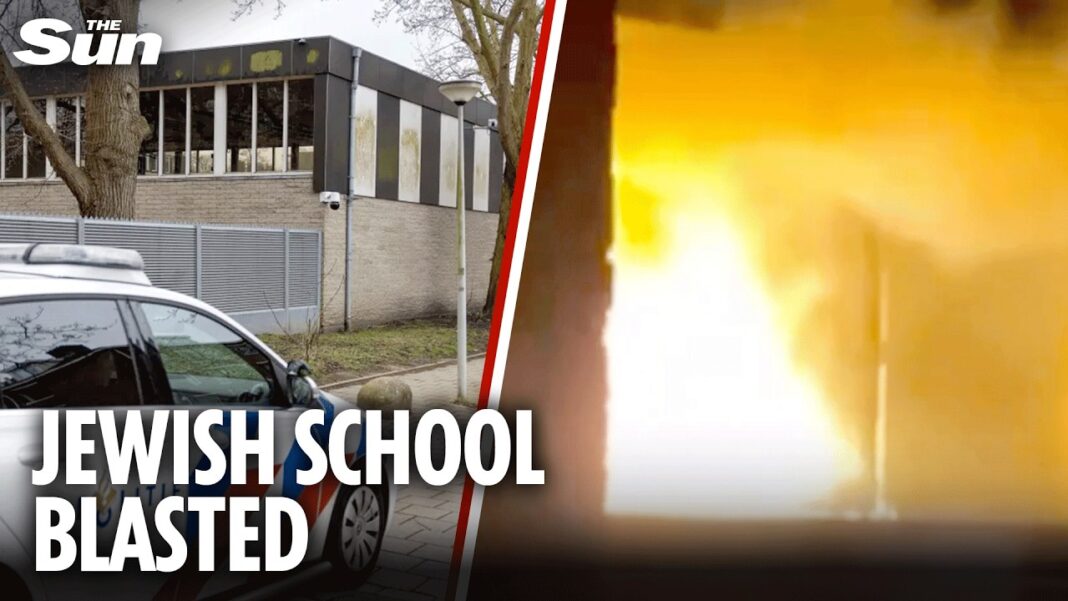
The explosion occurred on Friday at the Synagogue of the Jewish Community of Rotterdam, commonly known as the A.B.N. Davidsplein Synagogue, one of the city’s most prominent Jewish houses of worship. According to initial police reports, the blast took place shortly before dawn and ignited a fire at the building’s entrance. Fortunately, the flames were quickly extinguished, and no injuries were reported.
However, the incident has triggered widespread alarm within the Netherlands and internationally, as authorities investigate whether the attack was ideologically motivated and possibly linked to extremist networks. Reports published on Saturday by The Jewish News Syndicate indicate that the attack comes amid an escalating pattern of violence directed at Jewish communities in Europe and North America.
The blast occurred at approximately 3:40 a.m., when most of the surrounding neighborhood was still quiet. Residents nearby reported hearing a sudden explosion followed by the sight of flames at the synagogue’s entrance.
According to law enforcement statements cited by JNS, emergency responders were dispatched immediately to the scene. Firefighters quickly extinguished the small blaze before it could spread further into the building or adjacent structures.
While the damage to the synagogue appears to have been limited primarily to the entrance area, investigators immediately treated the incident as suspicious and began searching for potential suspects.
Police soon intercepted a suspicious vehicle near another synagogue in the area, which led to the arrest of four individuals believed to be connected to the incident.
Authorities confirmed that four male suspects, all teenagers between the ages of 17 and 19, were taken into custody shortly after the explosion.
According to information cited in the JNS report, police officers stopped the vehicle after noticing behavior they considered suspicious near another Jewish site. The discovery raised concerns that the suspects might have been planning additional attacks.
Investigators have not yet released the identities of the suspects due to their age and ongoing legal procedures, but authorities say the arrests represent a significant development in the investigation.
Dutch police are now working to determine the precise role each individual may have played in the attack, as well as whether others were involved.
The suspects remain in custody while investigators examine potential motives and connections.
While the investigation is still in its early stages, intelligence agencies and security organizations have begun examining whether the attack may have been inspired by extremist groups operating internationally.
According to reports cited by JNS, the Anti-Defamation League (ADL) has identified a troubling development linked to the incident. The Islamist extremist group Harakat Ashab al-Yamin al-Islamiyyah, also known as the Islamic Movement of the Companions of the Right, reportedly circulated video footage of the explosion on social media platforms. The video allegedly features the organization’s logo, raising the possibility that the group is attempting to claim responsibility or use the attack as propaganda.
Security analysts caution that extremist organizations sometimes promote attacks even when they were not directly responsible, in order to amplify fear and recruit supporters.
Nonetheless, the appearance of the footage has heightened concerns that the Rotterdam incident may be part of a broader ideological campaign targeting Jewish institutions.
Jewish advocacy organizations say the Rotterdam attack is not an isolated incident. According to the international advocacy group StandWithUs, the explosion occurred amid a broader wave of violence directed at Jewish communities in several countries. In a statement cited by JNS, StandWithUs said the Rotterdam attack is part of a troubling pattern. “This attack comes amid a wave of violence targeting Jewish communities this week,” the organization stated, referencing incidents reported in the United States, Norway, and other locations.
The group circulated video footage of the Rotterdam explosion as part of its effort to raise awareness about what it describes as an alarming increase in antisemitic threats and attacks worldwide.
Over the past year, Jewish institutions across Europe and North America have faced a rising number of incidents ranging from vandalism and harassment to violent attacks.
Jewish community leaders and international officials have responded swiftly to the attack, condemning the violence and expressing solidarity with Rotterdam’s Jewish population.
Rabbi Yehuda Kaploun, the United States Special Envoy tasked with monitoring and combating antisemitism, issued a strong statement following the arrests. “Jewish communities will not be intimidated by such horrific acts of violence,” Kaploun said, according to the JNS report. He also praised the swift response of Dutch law enforcement authorities. “I am thankful for the rapid action taken by local police,” he added. “The United States stands firmly against antisemitism and this fundamental threat to our religious freedom.” Kaploun emphasized that attacks on synagogues represent not only threats to Jewish communities but also assaults on the principle of religious liberty itself.
The Jewish community in Rotterdam has a long and complex history. Before World War II, the city was home to a thriving Jewish population. However, the Nazi occupation of the Netherlands devastated the community, with thousands of Jews deported to concentration camps.
In the decades since the war, Jewish life in Rotterdam has slowly rebuilt, with synagogues, schools, and cultural institutions once again serving as centers of community life. The A.B.N. Davidsplein Synagogue—targeted in Friday’s attack—stands as one of the city’s central religious institutions.
For many members of the community, the explosion represents a painful reminder that antisemitism remains a persistent threat even decades after the Holocaust.
Across Europe, Jewish institutions have increasingly adopted heightened security measures in response to growing threats. Synagogues, schools, and community centers now often operate under surveillance systems, reinforced entrances, and police patrols. Security experts say such precautions have become necessary due to the growing number of incidents targeting Jewish communities.
The JNS report noted that law enforcement agencies across Europe have expanded security coordination with Jewish organizations. Nevertheless, attacks like the one in Rotterdam illustrate that risks remain.
Dutch authorities are continuing their investigation into the Rotterdam explosion, examining forensic evidence, digital communications, and potential links between the suspects and extremist networks. Police have not yet confirmed whether the incident will ultimately be classified as a terrorist attack or a hate crime, though both possibilities remain under review.
Investigators are also analyzing the suspicious vehicle intercepted near the second synagogue to determine whether additional attacks may have been planned. According to the JNS report, officials are expected to release further details once the initial interrogation of the suspects is complete.
Despite the shock caused by the explosion, Jewish leaders in Rotterdam have emphasized that their community will not retreat in the face of violence. Many see the rapid arrests and strong response from authorities as an important signal that attacks against religious communities will be treated with the utmost seriousness. For residents of Rotterdam and Jewish communities around the world, the message is clear: while threats may persist, resilience and vigilance remain powerful defenses.
As the investigation unfolds, the incident stands as a stark reminder of the continuing need to confront antisemitism and safeguard the institutions that sustain Jewish life in Europe and beyond.
