



|
Getting your Trinity Audio player ready...
|
By: Tzirel Rosenblatt – Jewish Voice News
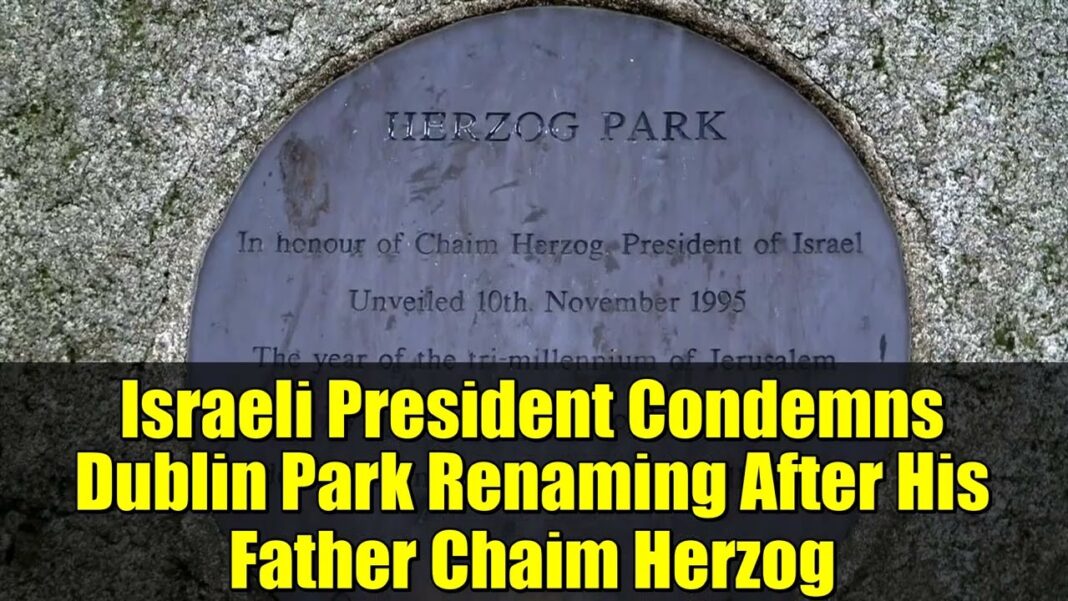
In a decision widely condemned by Jewish organizations and pro-Israel voices, Dublin’s city council has voted to rename a municipal park honoring Israel’s sixth president, the Irish-born statesman Chaim Herzog. The vote—citing the ongoing war in Gaza as its rationale—has intensified an already bitter debate about Ireland’s increasingly acrid political climate around Israel. As i24News reported on Saturday, the vote is being perceived not merely as an administrative exercise but as a symbolic act designed to excise a significant Jewish-Irish legacy from the nation’s cultural landscape.
The park, located in the neighborhood of Rathgar, has long borne Herzog’s name in recognition of the singular trajectory that took him from Dublin’s southside to the presidency of the State of Israel. That trajectory, as i24News emphasized in its coverage, is not just an Israeli story—it is an Irish one. Herzog’s father, Rabbi Yitzhak HaLevi Herzog, served as Chief Rabbi of Ireland and maintained close ties with political luminaries including Taoiseach Éamon de Valera. The younger Herzog, shaped by Ireland’s intellectual, spiritual, and political milieu, carried these formative experiences into his later leadership roles, including his storied tenure as Israel’s ambassador to the United Nations.
But for many on Dublin’s current city council, this shared heritage has been overshadowed—indeed eclipsed—by Ireland’s growing identification with the Palestinian cause. While the council has not yet settled on a replacement name, pro-Palestinian activists have already lobbied aggressively for an explicitly political alternative: “Free Palestine Park.” According to the information provided in the i24News report, the motion’s framing explicitly tied the renaming initiative to the war in Gaza, revealing just how fully the rhetoric of the conflict has seeped into Ireland’s municipal decision-making.
The backlash was immediate, impassioned, and multifaceted. Former Irish justice minister Alan Shatter, long a prominent voice against Ireland’s escalating anti-Israel sentiment, issued what might be the sharpest rebuke yet. “Dublin City Council has now gone full on Nazi,” Shatter declared, according to i24News, arguing that the council’s decision amounted to an effort “to erase Jewish/Irish history.” He reminded the public that Herzog Park commemorated not a political program but a cultural figure whose upbringing in Dublin is an integral part of Ireland’s own historical tapestry.
“Herzog Park in Rathgar,” Shatter noted, “is named after Chaim Herzog, Israel’s sixth president, brought up in Dublin by his father, Yitzhak HaLevi Herzog… Some councillors want the park renamed ‘Free Palestine Park.’” His invocation of the Nazi analogy was provocative by design—a signal that erasure of Jewish heritage under the guise of political activism carries historical echoes that cannot be politely ignored.
The Jewish Representative Council of Ireland, the umbrella body for the country’s small and historically vulnerable Jewish community, expressed deeply felt alarm. In a statement cited by i24News, the Council warned that the renaming effort “sends a hurtful and isolating message to a small minority community that has contributed to Ireland for centuries.” They urged elected councillors to reject the motion outright, stressing that “the removal of the Herzog name from this park would be widely understood as an attempt to erase our Irish Jewish history.”
The fears expressed by the Council are not abstract. The Jewish population of Ireland—now numbering only a few thousand—has faced repeated incidents of antisemitic harassment and vandalism in recent years. The attempt to expunge Herzog’s name, community leaders argue, risks further legitimizing political hostility toward Jews under the sanitized language of “solidarity” or “anti-colonialism.”
The controversy is all the more poignant because Chaim Herzog himself is remembered as a consummate diplomat, an erudite intellectual, and one of the twentieth century’s most eloquent defenders of Israel on the world stage. His 1975 speech at the United Nations, delivered in response to the infamous Soviet-backed resolution branding Zionism as a form of racism, remains one of the most significant moments in Israel’s diplomatic history. Herzog stood before the world body, held up a copy of the resolution, and—in what has become an iconic gesture—tore it in two. His speech, widely regarded as a masterpiece of political oratory, was immortalized alongside the equally searing address delivered that day by U.S. Ambassador Daniel Patrick Moynihan.
Herzog’s contributions were not confined to diplomacy. He served with distinction in the Israel Defense Forces, played key roles in military intelligence, and ultimately presided over the State of Israel from 1983 to 1993—a decade of momentous geopolitical upheaval. His presidency was marked by moral clarity, intellectual rigor, and a steadfast belief in Israel’s right to self-determination. That Dublin would now attempt to disown such a figure strikes many observers as profoundly misguided, if not outright malicious.
Israel’s current Foreign Minister Gideon Sa’ar condemned the Dublin vote in blistering terms. According to the information contained in the i24News report, Sa’ar stated that Ireland’s “antisemitic and anti-Israel obsession is sickening,” portraying the renaming effort as part of a broader pattern in which Irish political discourse has increasingly embraced anti-Israel sentiment that frequently bleeds into full-fledged antisemitism.
Analysts interviewed by i24News argue that the council’s vote must be understood not as an isolated gesture but as emblematic of a deeper ideological shift. Ireland’s political left, particularly in Dublin, has closely aligned itself with the Palestinian narrative, viewing the Israeli-Palestinian conflict through the prism of anti-colonial struggle. This framing has generated an intellectual environment in which expressions of solidarity with Palestinians are often accompanied by condemnations, delegitimizations, or erasures of Israeli history, culture, or presence.
It is within this context that the attempted removal of Herzog’s name should be understood. This is not, critics assert, about Gaza. Nor is it about municipal policy. It is, instead, about redefining Irish identity by selectively excluding parts of its own past. Herzog’s Irishness is not an extraneous detail—it is foundational. The Irish-Jewish heritage embodied in the Herzog family is part of the country’s cultural DNA, a living testament to Ireland’s once-robust Jewish community and to the cosmopolitanism that shaped the nation in the early twentieth century.
To erase that history at a moment of global tension is, as the Jewish Representative Council warned, both “hurtful and isolating.” It signals that Ireland’s Jewish citizens—and their historical contributions—are dispensable in the face of political fashion.
The deeper question raised by this episode is what kind of country Ireland wishes to be in the twenty-first century. A nation that cherishes its multifaceted heritage, including the Jewish figures who shaped its public life? Or one that retrofits its past in service of contemporary ideological narratives? As the i24News report observed, the debate around Herzog Park exemplifies a growing tension within Irish politics: whether the country will maintain a commitment to pluralist historical memory or allow the pressures of global activism to distort its understanding of itself.
For supporters of the renaming initiative, the park has become a symbol of solidarity with Palestinians suffering amid the war in Gaza. But even some pro-Palestinian advocates have quietly acknowledged that targeting a Jewish figure with deep Irish roots risks undercutting their efforts by fueling accusations of antisemitism.
The symbolic stakes are high. Parks and public spaces function not merely as recreational sites but as arenas of national storytelling. The names they bear reflect a nation’s chosen heroes, its moral exemplars, its cultural touchstones. To remove Herzog’s name is to declare, intentionally or not, that Chaim Herzog no longer belongs in Ireland’s public narrative. And to many—Jewish and non-Jewish alike—that declaration is deeply troubling.
Ireland today wrestles with its global identity, its historical memory, and its role in international debates. But in the case of Herzog Park, the city council’s actions appear less like a principled stand and more like an erasure. It is an erasure of heritage, of nuance, and of the deep interconnectedness between Ireland’s Jewish community and Ireland’s political evolution.
As i24News reported, the renaming of Herzog Park is not simply about signage. It is about whether Ireland can honor its past while navigating its present. It is about whether political passion will eclipse historical truth. And most urgently, it is about whether Ireland’s Jewish citizens can feel that their heritage is valued rather than targeted.
For now, the debate continues—but the damage, many fear, has already begun.