



|
Getting your Trinity Audio player ready...
|
By: Fern Sidman
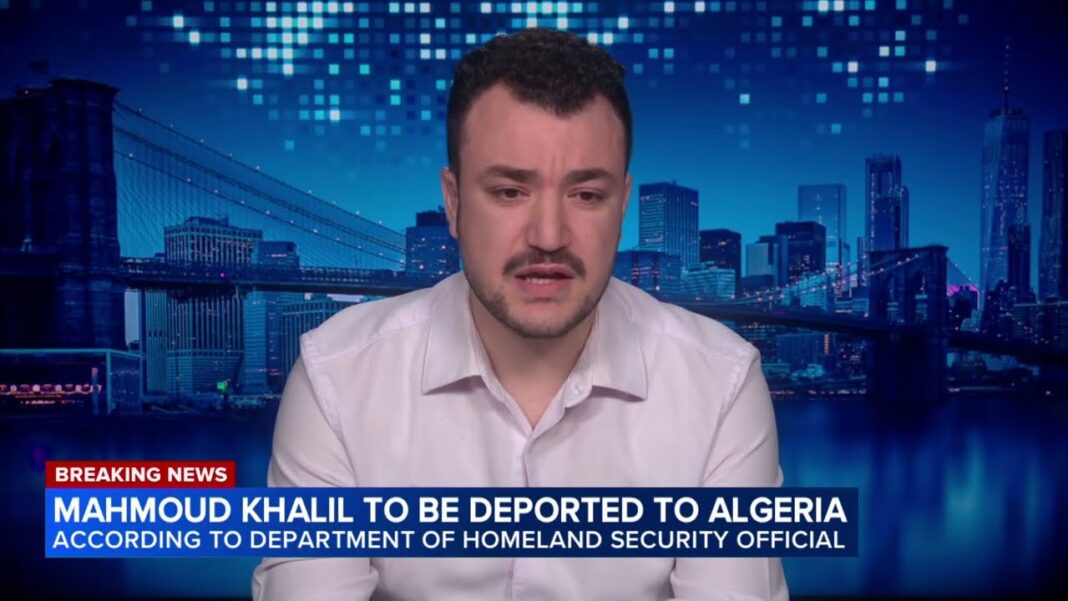
In a case that has come to symbolize the volatile intersection of immigration law, campus activism, and national security politics, Mahmoud Khalil—a former Columbia University graduate student and prominent pro-Hamas activist—now faces imminent deportation from the United States to Algeria. According to a report on Thursday at VIN News, the Department of Homeland Security has confirmed that Khalil’s removal is actively being pursued following a prolonged and complex legal battle over his immigration status.
The saga, which has unfolded over nearly a year of litigation, political controversy, and public debate, has become one of the most closely watched immigration enforcement cases in recent memory. As the VIN News report documented, the case is not merely about one individual’s deportation—it has become a flashpoint for broader national questions about the limits of political activism, the boundaries of protected speech for noncitizens, and the legal obligations that accompany residency in the United States.
Khalil, a Syrian-born green card holder who studied at Columbia University, was arrested by U.S. Immigration and Customs Enforcement (ICE) agents in March 2025. His detention followed his visible participation in a series of pro-Palestinian protests on Columbia’s campus—demonstrations that were part of a nationwide wave of anti-Israel activism in American universities.
As the VIN News report detailed, the Trump administration framed the arrest not as a response to Khalil’s political views, but as an enforcement action grounded in alleged immigration fraud. Federal authorities accused Khalil of misrepresentations on his green card application, specifically his failure to disclose prior affiliations and activities that the government deemed material to his immigration status.
Among the undisclosed connections cited by the Department of Homeland Security were an unpaid internship with the United Nations Relief and Works Agency for Palestine Refugees in the Near East (UNRWA) and his involvement with Columbia University Apartheid Divest, a campus group deeply engaged in anti-Israel activism and divestment campaigns.
The government’s position, consistently emphasized in statements reported by VIN News, is that these omissions constituted fraud—an immigration violation independent of Khalil’s political speech.
In September 2025, an immigration judge in Louisiana ordered Khalil’s deportation to either Syria or Algeria, ruling that the alleged misrepresentations on his green card application were sufficient grounds for removal. The ruling marked a pivotal moment in the case, shifting the focus from protest politics to the technical enforcement of immigration law.
Khalil’s legal team immediately challenged the decision, arguing that the fraud allegations were unfounded and that the proceedings were, in reality, a form of political retaliation. As VIN News reported at the time, his attorneys maintained that Khalil’s detention and deportation process were directly linked to his pro-Hamas activism and constituted a violation of free speech protections.
The case then entered a new phase of judicial complexity. In January 2026, a federal appeals court reversed a lower court ruling that had ordered Khalil’s release from detention, determining that the district judge lacked jurisdiction in the matter. This decision effectively cleared the path for renewed enforcement of the deportation order and re-detention if deemed necessary by federal authorities.
For supporters of the administration’s enforcement approach, the ruling reaffirmed the primacy of immigration law. For Khalil’s advocates, it underscored what they describe as the vulnerability of noncitizens in politically charged cases.
The most definitive public confirmation of Khalil’s likely destination came this week, when Tricia McLaughlin, assistant secretary for public affairs at the Department of Homeland Security, spoke on NewsNation’s “Katie Pavlich Tonight.” Her remarks left little ambiguity.
“It looks like he’ll go to Algeria. That’s what the thought is right now,” McLaughlin stated, signaling that Algeria—where Khalil holds citizenship through family ties—has emerged as the primary destination for his deportation.
Her comments went further, delivering a message that reverberated far beyond Khalil’s individual case. “It’s a reminder for those who are in this country on a visa or on a green card,” McLaughlin said. “You are a guest in this country — act like it. It is a privilege, not a right, to be in this country to live or to study.”
As the VIN News report noted, those words have become emblematic of the administration’s broader immigration philosophy: residency as conditional privilege, not inherent entitlement.
Central to the controversy is Khalil’s claim that he is being punished not for fraud, but for speech. Civil rights organizations and pro-Hamas advocacy groups have framed the case as a dangerous precedent, arguing that it sends a chilling message to noncitizens engaged in political activism.
They emphasize that Khalil has not been charged with any criminal offense, and that the government’s case rests solely on immigration violations. From their perspective, the deportation represents a politicized use of immigration enforcement powers.
The government, however, has maintained a consistent counter-narrative. Officials insist that the case is not about ideology, but about integrity in the naturalization and residency process. As VIN News has reported, DHS sources have stressed that immigration law requires full disclosure of affiliations and activities, regardless of their political nature.
In this framing, Khalil’s activism is incidental; the decisive issue is the alleged falsification of official documents.
Khalil’s undisclosed UNRWA internship has drawn particular scrutiny, especially in the context of heightened concerns about the organization’s political role and links to extremist networks. UNRWA has been the subject of intense international debate, with critics accusing it of facilitating radicalization and legitimizing anti-Israel narratives.
Similarly, Columbia University Apartheid Divest has been identified by watchdog groups as part of a broader ecosystem of campus activism that often blurs the line between political protest and ideological extremism.
As the VIN News report observed, Khalil’s affiliations placed him at the intersection of two highly sensitive fault lines: Middle East geopolitics and domestic campus radicalization.
The choice of Algeria as Khalil’s likely destination carries its own geopolitical and personal implications. Algeria, a country with complex political dynamics and a history of internal unrest, represents a stark contrast to Khalil’s life as a graduate student in New York City.
While Khalil maintains Algerian citizenship through family ties, his supporters argue that deportation would amount to forced exile to a country where he lacks meaningful social infrastructure or professional stability.
From the government’s perspective, however, deportation to a country of citizenship is a standard legal outcome, not a punitive measure.
As the VIN News report emphasized, the Khalil case is not simply about Mahmoud Khalil. It is about the boundaries of American tolerance, the conditional nature of residency, and the unresolved tension between free expression and national sovereignty.
It raises uncomfortable questions: Can noncitizens engage in radical political activism without legal consequences? Where does protected speech end and immigration enforcement begin? And who ultimately decides the line between dissent and disqualification?
For the Trump administration and its supporters, the answer is clear: immigration law is not a platform for political expression—it is a regulatory framework that demands compliance and honesty.
For Khalil’s defenders, the case represents a dangerous fusion of politics and deportation, one that threatens to transform immigration law into an instrument of ideological control.
As of now, no specific timeline for Khalil’s deportation has been announced. His attorneys are expected to explore additional appeals and possible relief options, though legal pathways are narrowing.
VIN News reported that federal authorities remain prepared to enforce the removal order once procedural barriers are cleared.
Whether Khalil ultimately boards a plane to Algeria or secures a last-minute legal reprieve, his case has already entered the national consciousness as a defining moment in contemporary immigration politics.
As VIN News reported, the case has become a symbol of a new era in U.S. immigration enforcement—one in which activism, affiliation, and disclosure are no longer abstract ideals, but legal liabilities.
For the nation, the implications are structural. And for the thousands of noncitizens watching this case unfold, the message is unmistakable: in the eyes of the state, residency is not merely a status—it is a contract, and every contract has conditions.
