



|
Getting your Trinity Audio player ready...
|
By: Fern Sidman
The murder of Rabbi Eli Schlanger, ztk’l, during the horrific terrorist attack at Bondi Beach has left Australia’s Jewish community—and the nation at large—reeling. As new details continue to emerge, the story has come to embody not only the brutality of the violence itself, but also a profound moral struggle over identity, visibility, and the refusal to surrender to fear. According to a report that appeared on Thursday at VIN News, the events of that day revealed extraordinary courage, unbearable loss, and a haunting question that many Jewish Australians are now asking aloud: how much longer must they live with the sense that they are targets in their own country?
Rabbi Schlanger was brutally murdered while attempting to protect his family and others around him during the shooting. His wife, Chaya, was injured by a bullet, and their two-month-old baby suffered shrapnel wounds. The infant remains hospitalized after developing a fever related to the injuries. The VIN News report confirmed that while doctors are cautiously optimistic, the child is “not out of the woods just yet,” a phrase that has become emblematic of the family’s fragile reality in the wake of the attack.
In an emotional interview with Sky News’ Sharri Markson, family members and close friends of Rabbi Schlanger described the harrowing final moments of his life—moments that speak volumes about the savagery of the attack and the extraordinary bravery of a man who chose to confront evil rather than flee from it.
According to eyewitness accounts relayed through VIN News, Rabbi Schlanger’s last actions were marked by a calm resolve that defies comprehension. As the gunman paused to reload, Rabbi Schlanger raised his hands in a universal gesture of surrender and deliberately walked toward him. He pleaded with the attacker to stop shooting.
Moments later, he was murdered.
Those who knew him say this final act was entirely consistent with the man he was: a rabbi deeply committed to the sanctity of life, to communal responsibility, and to moral clarity even in the face of danger. Rabbi Schlanger did not act impulsively or recklessly; rather, he acted with the instinct of a protector, attempting to shield not only his own family but strangers around him.
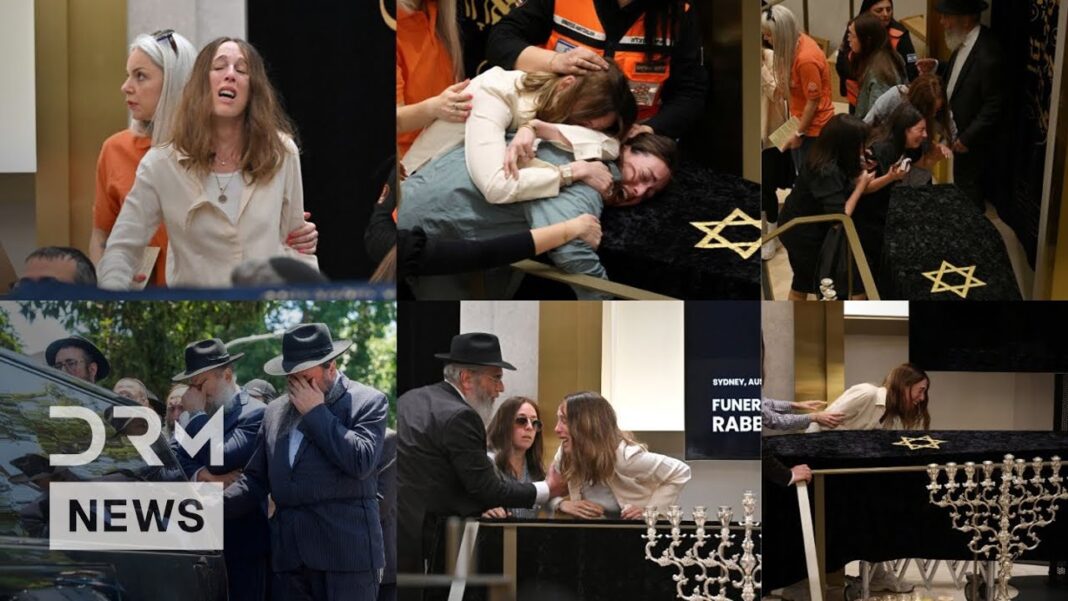
For Chaya, who witnessed the murder of her husband while injured herself, the trauma is layered and unrelenting. As reported by VIN News, she was initially unaware that she had been hit by a bullet, so focused was she on protecting her baby and trying to save her husband’s life.
“Chaya was hiding, trying to protect herself and more importantly her two-month-old baby,” said Sorella, a close friend of Chaya’s, in the Sky News interview cited in the VIN News report. “She does not recall getting hit because of the adrenaline. Suddenly somebody next to her said to her: ‘You’ve got blood on your back.’”
Chaya, a mother of five, had been grazed by a bullet. She spent Sunday night in hospital, while her newborn son was transferred to a children’s hospital for treatment of shrapnel injuries to his calf.
Few details from the attack have struck the public conscience as deeply as the injury to the two-month-old baby. According to the information provided in the VIN News report, the infant was struck by pieces of shrapnel during the shooting and later developed a fever, prompting doctors to keep him under close observation.
Sorella described the situation in stark terms: “The sheer horror and evil for somebody to shoot at babies, at women, at old people—it’s horrific.”
Medical teams caring for the child have been described by the family as “unbelievable,” providing not only expert clinical care but emotional support to parents reeling from shock and grief. Yet even with that support, the uncertainty remains agonizing. The phrase “not out of the woods just yet,” captures the emotional limbo in which the family now lives.
Perhaps the most devastating detail to emerge from the interviews, as emphasized by VIN News, is that Chaya was forced to watch as her husband—the father of her five children—was fatally shot.
“At the same time as Chaya was hit by a bullet, she was also trying to keep her husband alive and begging the local nurse and surfer to keep doing CPR,” Sorella said.
According to the information contained in the VIN News report, emergency responders and bystanders did everything they could, but the injuries were fatal. Still, Chaya refused to let go.
“We had to get her medical help but she kept saying: ‘Please don’t stop. Wake up Eli, you have to wake up,’” Sorella recalled. “Eli was a believer in miracles and she said to him: ‘Make a miracle for me, you can’t leave me. I’ve got five children. I can’t do this on my own.’”
Those words have resonated far beyond Bondi Beach. They are the anguished plea of a woman facing not only widowhood but the lifelong task of explaining to five children why their father did not come home.
Another close family friend, Chana, struggled to contain her emotions during the interview. She described the attack as “inevitable,” a word that carries chilling implications.
“An average Australian doesn’t live with this fear,” she said. “My children are fourth-generation Australian. When are we going to be considered Australian like everybody else?”
As the VIN News report observed, the attack at Bondi Beach did not occur in a vacuum. It took place against a backdrop of rising antisemitism, heightened security fears, and a growing sense among Jewish Australians that visibility itself has become a risk.
Chana’s words articulate a long-simmering anxiety—that no amount of assimilation, contribution, or generational rootedness can fully insulate Jews from being perceived as outsiders or targets.
One of the most emotionally charged moments of the Sky News interview, as shared by VIN News, came when Sorella described what happened after she and her family returned home from the beach that night.
“We have a big menorah outside our home and we keep it up all year,” she said. “Since October 7th especially, we just feel the community needs that.”
But that night, her children were terrified.
“When we finally made it out of the beach and got home, our children were crying and they said: ‘Please turn off the menorah. Our home is going to become a target.’”
The fear expressed by those children was not abstract. It was immediate, visceral, and rooted in the trauma they had just witnessed.
“My husband and I looked at each other and we said: ‘No way. We’re not going down like this. We don’t turn off menorahs. We don’t hide our kippahs. We stand proud and loud,’” Sorella said.
But as a mother, confronted with the terror of her children, she made a painful compromise. She turned the menorah off.
The following day brought an unexpected moment of solidarity. One of Sorella’s neighbors—a Christian—noticed the darkened menorah and was overcome with emotion.
“He sobbed,” Sorella recalled. “They’re turning off their menorahs. The evil can’t win,” the neighbor told her husband.
That encounter became a turning point.
As Sky News host Sharri Markson broke down in tears during the interview, Sorella explained that she and her husband made a decision: the menorah would be turned back on.
“We don’t stop shining light,” she said.
VIN News has described this moment as emblematic of the broader struggle facing Jewish communities worldwide: the tension between protecting one’s family and refusing to retreat into invisibility.
Sorella concluded with words that many believe capture Rabbi Schlanger’s legacy more powerfully than any eulogy.
“I can promise you, I can say it with full certainty—if Eli was standing here today, he would say: ‘We don’t go down in darkness. We shine light. That’s the only way to push out darkness. We look out for each other. We spread goodness and kindness. That’s what we do.’”
Rabbi Schlanger’s final act—walking toward a gunman with hands raised, pleading for life—was itself an expression of that philosophy.
As Australia mourns Rabbi Eli Schlanger, and as his wife and children begin an unimaginably painful journey forward, the questions raised by his murder will not easily fade. What does it mean to live openly as a Jew in the public square? How does a community balance vigilance with visibility, fear with faith?
The VIN News report made clear that the answers will not come quickly. But the story of Rabbi Schlanger—his courage, his compassion, and the light he represented—has already become a defining chapter in the moral history of this moment.
He died trying to stop violence. His family lives on, wounded but unbroken. And in homes where menorahs still glow against the darkness, his legacy continues to burn—defiant, luminous, and resolutely alive.