



|
Getting your Trinity Audio player ready...
|
By: Chaya Abecassis
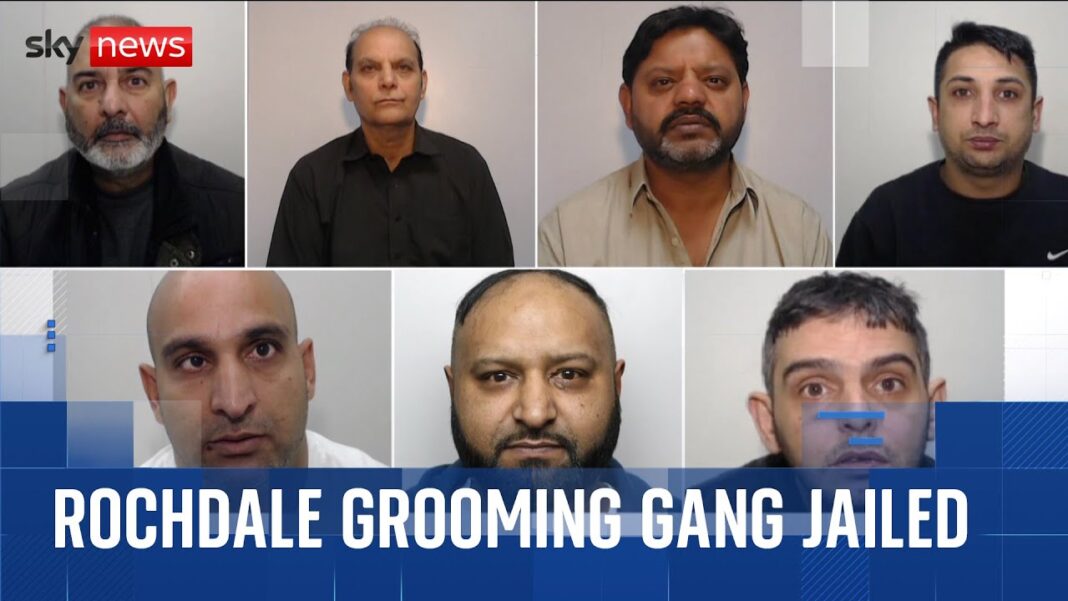
On Wednesday morning in a Manchester courtroom, nearly two decades of anguish found some measure of redress. , a 65-year-old market trader from Rochdale, stood in the dock to hear his fate: 35 years in prison for orchestrating the repeated rape and sexual exploitation of two teenage girls. For many in Britain, Zahid’s sentencing was more than the conclusion of one case. It was the latest chapter in a national reckoning with the phenomenon of “grooming gangs” — organized networks of mostly men who systematically targeted vulnerable young girls, leaving devastation that authorities were slow, sometimes willfully, to confront.
In a report that appeared on Wednesday in The New York Times, which has followed the grooming gangs scandal since its exposure in the early 2010s, the Rochdale proceedings was emblematic of a broader struggle within Britain: how to hold perpetrators to account while also addressing the institutional failures that enabled them. The trial, which lasted four months, required the testimony of two now-adult women who had been abused as children between 2001 and 2006. Their evidence was harrowing. Zahid and his accomplices, prosecutors said, lured them with gifts, alcohol, and promises of care, only to rape them and hand them over to other men as commodities to be used and discarded.
Prosecutors laid out how Zahid befriended his victims when they were just 13 years old. Both came from difficult backgrounds; one was in the care system, the other known to social services. Their vulnerability made them easy targets. Zahid showered them with small gifts — food, cigarettes, cash — in what experts call the “boyfriend model” of grooming. The kindness quickly turned coercive.
Between 2001 and 2006, Zahid and his circle transported the girls to remote addresses around Rochdale and beyond. There, they were plied with alcohol and expected to submit to unprotected sex with men they had never met. Zahid personally raped both girls and forced them into encounters with other offenders, including co-defendants Mushtaq Ahmed, 66, Kasir Bashir, 50, and Roheez Khan, 39.
One of the most chilling accounts involved Mohammed Shahzad, a taxi driver who befriended one of the victims when she was just 13. He offered her rides, then raped her, and later delivered her to groups of other taxi drivers, including Nisar Hussain, 41, and Naheem Akram, 48. In court, prosecutors said Shahzad’s exploitation underscored the systematic nature of the abuse: networks of men, often connected through local industries such as taxis and market stalls, sharing victims between them.
As The New York Times report observed, the case reflected the devastating combination of predatory men and institutional negligence. For years, girls like these were dismissed by local authorities not as victims of sexual exploitation but as “child prostitutes” — language that itself betrayed the system’s indifference.
The sentences handed down Wednesday — Zahid’s 35 years alongside significant terms for six co-defendants — represent one of the most severe punishments yet in grooming gang cases. In total, the Greater Manchester Police announced, specialized child sexual exploitation units have secured convictions against 32 offenders in Rochdale since 2021, amounting to nearly 500 years of prison time. Twenty more men are awaiting trial.
Detective Chief Inspector Guy Laycock, who led the investigation, credited the survivors’ courage: “The men abused, degraded, and discarded the victims when they were just children. The convictions would not have been possible without the painful and difficult testimony of the women who came forward.”
One victim, identified only as “girl B” under British law, attended the sentencing. In a statement, she described years of “shame and guilt” that only lifted when the guilty verdicts were read. “The day I watched the verdicts changed my life,” she said, urging other survivors to come forward.
Her words echoed beyond the courtroom. As The New York Times report highlighted, grooming gang survivors across Britain have long complained that justice was delayed, diluted, or denied. Each conviction, though deeply painful, now serves as both an act of accountability and an invitation for others still living in silence to speak.
The story of grooming gangs first broke into public consciousness in the early 2010s, when investigative journalists revealed how networks of men — often of Pakistani heritage — had targeted white working-class girls in towns such as Rochdale, Rotherham, and Oxford. Inquiries revealed that police and social workers frequently failed to intervene, sometimes ignoring victims’ pleas, for fear of stoking accusations of racism or inflaming community tensions.
As The New York Times has reported in numerous retrospectives, the scandal shook Britain’s sense of itself. It exposed not only the predations of the gangs but also the paralysis of institutions charged with protecting children. Reports showed that some officials deliberately avoided investigating patterns of abuse because they feared the ethnic dimensions of the perpetrators would damage community cohesion.
The Independent Inquiry into Child Sexual Abuse (IICSA), whose 2022 report examined grooming gang dynamics, concluded that “extensive failures” had allowed perpetrators to operate for years. Victims were often criminalized, described as promiscuous or complicit. Police failed to recognize them as children.
The inquiry also highlighted the limitations of existing data. While many high-profile prosecutions involved men of Pakistani or Muslim origin, a lack of consistent ethnicity and nationality records for suspects made it impossible to determine broader patterns. In June 2024, the government announced that police would now be required to log this information in every case.
One of the most damning aspects of the grooming gang scandal is not simply the abuse itself, but how institutions allowed it to continue. An official audit of prior cases, also published in June, cited “many examples of organizations” avoiding scrutiny of ethnicity or cultural factors “for fear of appearing racist, raising community tensions, or causing community cohesion problems.”
In Rochdale, such fears meant that men such as Zahid could abuse with near impunity for years. As The New York Times report noted, victims were often viewed through the lens of prejudice: as wayward teenagers, not as exploited children. This cultural blindness, combined with bureaucratic inertia, created fertile ground for abuse to flourish.
Sharon Hubber, director of children’s services at Rochdale Borough Council, acknowledged the scale of failure in a statement after sentencing. “We are in a very different place to where we once were,” she said. “Today’s sentencing is a reminder of our ongoing commitment, alongside Greater Manchester Police, in bringing these perpetrators to justice.” Yet for survivors, words of contrition cannot erase years of neglect.
The grooming gangs scandal has also become a political lightning rod. In January, billionaire tech entrepreneur Elon Musk used his platform X (formerly Twitter) to post a series of inflammatory remarks about the issue, many of which contained inaccuracies. While Musk’s intervention drew criticism for smearing entire communities, it also reignited public debate, prompting the British government in June to launch a full national inquiry.
The New York Times reported that this inquiry aims not only to review institutional failings but also to address how discourse around grooming gangs has been weaponized politically — sometimes to stigmatize British Muslims wholesale, rather than focusing on the specific failures of protection and accountability.
For victims, however, the political debates are often secondary. Their focus is on recognition, safety, and justice. As “girl B” said in her statement, the true significance lies in knowing that survivors’ voices can no longer be ignored.
The human cost of grooming gang abuse is immeasurable. Survivors often grapple with lifelong trauma, including addiction, broken relationships, and mistrust of authority. Many were revictimized by the very systems meant to protect them.
The New York Times has interviewed survivors in previous cases who described being dismissed by police as troublemakers, or by social workers as making “lifestyle choices.” Some turned to drugs or alcohol to numb the pain; others attempted suicide. For them, justice delivered decades later is bittersweet.
In Rochdale, “girl B” expressed a glimmer of hope. Watching the guilty verdicts, she said, lifted “a massive weight.” Yet even as justice is served, the years of silence remain scars. Survivors now urge others to speak out — not simply for justice, but to prevent future abuse.
The Rochdale case is far from the end of Britain’s reckoning. As Greater Manchester Police confirmed, at least 20 more men are awaiting trial on similar charges. Across England, new investigations continue to uncover historical abuse, often stretching back decades.
The IICSA report emphasized that grooming gang tactics — gifts, alcohol, the illusion of romance — are not confined to any single community or ethnicity. Instead, they exploit vulnerabilities in children and weaknesses in institutions. Recognizing these patterns, without succumbing to broad racial generalizations, remains one of Britain’s greatest challenges.
The government has pledged to implement all of IICSA’s recommendations, including better data collection, improved victim support, and stronger accountability for public officials who fail in their duty of care. Whether those promises translate into tangible protections remains to be seen.
Zahid’s 35-year sentence carries symbolic weight. It signals that Britain’s justice system, however belatedly, is willing to impose the severest penalties on those who orchestrated systemic abuse. For the victims, it is recognition of their suffering, validation that their voices matter.
The New York Times report described the sentencing as “a marker of Britain’s painful journey toward accountability,” one that confronts both the crimes of individual men and the failures of entire systems. It is not only Zahid who stands condemned, but also the culture of silence and bureaucratic hesitation that enabled him.
The Rochdale grooming gang case illustrates the complexity of Britain’s struggle with sexual exploitation. It is a story of monstrous individuals, but also of institutional paralysis, cultural taboos, and the difficulty of confronting uncomfortable truths.
For survivors such as “girl B,” the conviction provides a measure of closure. For Rochdale and Britain as a whole, it serves as a stark reminder: justice delayed can still be delivered, but prevention requires vigilance, transparency, and courage.
As The New York Times has written, grooming gangs are not merely a criminal justice issue — they are a moral reckoning for a society that too often looked away. With Zahid now behind bars and more trials to come, Britain faces the challenge of ensuring that the phrase “never again” is more than a slogan. It must become a promise to its children.
From what I read, years ago, this is the tip of the iceberg. What about the rest they destroyed? 35 years is inadequate for what they did.
Muslims are monsters.