



|
Getting your Trinity Audio player ready...
|
By: Fern Sidman
In a powerful and unprecedented demonstration of unity among Iranian opposition forces, Iran’s exiled Crown Prince Reza Pahlavi convened the Convention of National Cooperation to Save Iran this past Saturday in Munich. According to a report that appeared on Israel National News, the gathering brought together more than 500 political dissidents, activists, academics, entrepreneurs, artists, and athletes in what is being hailed as the most diverse and representative coalition ever assembled to challenge the Islamic Republic.
Held in the symbolic heart of Europe, the event drew participation from across Iran’s complex ideological and sociopolitical spectrum—monarchists and republicans, secularists and religious minorities, leftists and right-leaning thinkers. Delegates represented the ethnic, religious, and linguistic diversity of the Iranian population, from Kurds to Azeris, Baha’is to Christians, and Persians to Baluchis. As Israel National News reported, many participants spoke with a unified voice for the first time, brought together under the common goal of achieving a democratic and secular Iran.
Adding gravity to the proceedings, audio messages of support were played from political prisoners held in Tehran’s notorious prison system. These detainees voiced not only their solidarity with the Munich convention but also their support for Crown Prince Reza Pahlavi’s vision for national transition. Family members of victims of the Islamic Revolutionary Guard Corps (IRGC) took the stage to share personal accounts of loved ones tortured, executed, or disappeared under the regime.
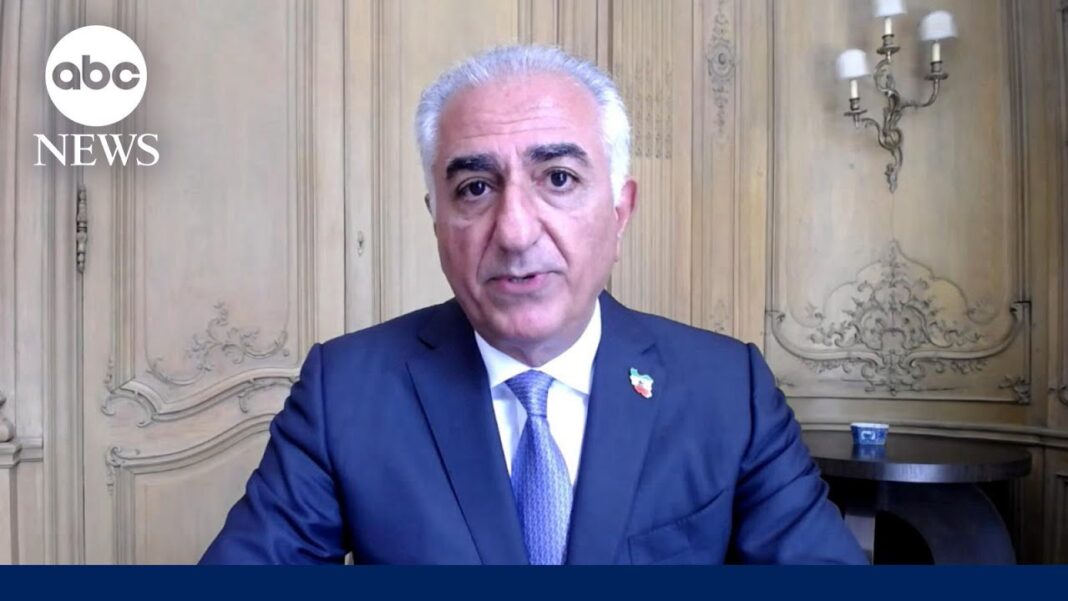
In a keynote address, Pahlavi issued a searing indictment of the current state of Iran. Speaking candidly before the assembly, he painted a picture of a nation in freefall, plagued by environmental devastation, economic collapse, and geopolitical isolation. “Iran’s rivers are dry, its soil eroding, its ground sinking, its air polluted,” he declared, adding, “its skies in the hands of foreign forces, its economy in free fall, its people’s homes without water or electricity.” Quoting directly from his remarks reported by Israel National News, the Crown Prince described the Iranian population as “hostages to the sectarian delusions of an anti-Iranian regime and its foolish leader.”
Pahlavi placed full responsibility for the country’s decay at the feet of Supreme Leader Ali Khamenei, calling him the architect of Iran’s decline. “It is he who step-by-step brought our homeland to this point,” Pahlavi said. “It is Ali Khamenei and his regime who are the warmongers.” He went on to challenge the competence and integrity of the IRGC, stating that the same force which once boasted of defending the nation’s borders “can’t even defend themselves.”
Despite the dark portrait, Pahlavi’s tone remained optimistic. He emphasized that the Islamic Republic is “weaker and more unstable than at any time in its 46-year history,” urging Iranians everywhere to seize the opportunity. As reported by Israel National News, Pahlavi’s speech marked a critical turning point in what many analysts see as an evolving national uprising. “There is no room today for hesitation: the time for neutrality… is over. The lines are clear,” he said.
Consistent with his longstanding commitment not to seek political office, Pahlavi reiterated that his role is to serve as a facilitator, not a ruler. “I want to create a space and structure so that those who wish to serve the nation… can present themselves in a democratic process to the people’s vote,” he said. To that end, he unveiled a five-pillar strategic framework for toppling the regime and initiating democratic reform: maximum pressure on the Islamic Republic, maximum support for the Iranian people, maximum defections from within the regime, maximum mobilization of activists inside and outside Iran, and a detailed plan for national recovery.
The Prince told attendees that significant strides had already been made, particularly with regard to internal defections. “We now have much deeper insight into the regime’s internal structures,” he said. “We are in communication with elements inside the system who are actively accelerating the fall of the Islamic Republic.” As Israel National News reported, a new secure data infrastructure has been developed to monitor this process, and over 50,000 individuals from Iran’s governmental and military institutions are said to have registered with the Crown Prince’s transitional platform.
As part of this broader effort, Pahlavi also introduced the outlines of a future political architecture. A temporary executive team and a National Uprising Council would lead the transition, with the former dissolving once a provisional government is formed and the latter expected to evolve into a transitional legislative body. “This is not about ideology,” Pahlavi emphasized, “but about functionality and sovereignty.”
Pahlavi did not ignore the personal risks he faces. Acknowledging threats against his life, he told the audience, “I have lived with these threats since the day I began this struggle.” He issued a stark warning to Khamenei: “Many of those around him despise him. A large number of IRGC members are looking for a way to jump ship. And the overwhelming majority of the people detest him and his regime.”
In a particularly symbolic statement, Pahlavi promised that even Khamenei would receive a fair trial under international legal standards—a dignity, he added, the regime has never granted to its own people. “Our commitment to holding a fair trial by international standards includes Khamenei himself,” he said.
Closing the convention, the Crown Prince voiced confidence in the eventual triumph of the Iranian people. “We are a united, conscious, and courageous nation,” he said. “A regime like this has never been able to defeat our culture, our history, or our civilization.” As Israel National News reported, his final rallying cry was met with a standing ovation. “The Islamic Republic is going to the dustbin of history. And Iran, and our people, free and proud, will safely pass through this difficult chapter. We are a great nation. We will reclaim Iran. Long live Iran!”
The Convention of National Cooperation to Save Iran may very well mark a decisive moment in the global movement to end the Islamic Republic’s rule, as was observed in the Israel National News report. With Crown Prince Reza Pahlavi at the helm, and with widespread support now documented both inside and outside Iran, the vision of a free, democratic Iran may no longer be a distant aspiration but a rapidly approaching reality.
