



|
Getting your Trinity Audio player ready...
|
By: Fern Sidman
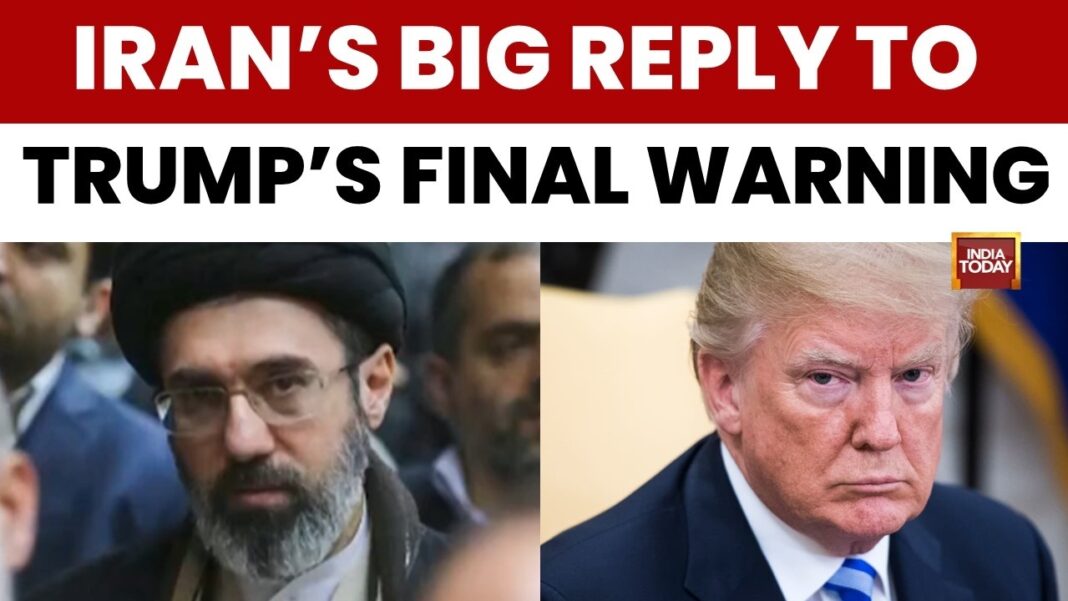
In an atmosphere thick with geopolitical tension and fraught with the specter of wider regional conflict, Iran has issued a sweeping and uncompromising warning in response to an ultimatum delivered by President Donald Trump. The exchange of threats—each more severe than the last—has intensified fears that the Middle East stands on the precipice of a broader and potentially uncontrollable escalation.
According to a report by Israel National News, Iranian officials early Sunday morning signaled a readiness to target American and Israeli infrastructure across the region should their own critical facilities come under attack. The statement, attributed to a spokesperson for the Khatam al-Anbiya Central Headquarters—the body responsible for overseeing Iran’s military operations—outlined a sweeping retaliatory doctrine that extends far beyond conventional battlefield engagements.
“If Iran’s fuel and energy infrastructure is attacked,” the spokesperson warned, “all energy, information technology, and desalination infrastructure belonging to the United States and the Israeli regime in the region will be targeted.” Israel National News has emphasized the breadth of this threat, noting that it encompasses not only military installations but also civilian and economic assets essential to daily life and regional stability.
The Iranian response came within hours of President Trump’s ultimatum, in which he demanded the immediate and unconditional reopening of the Strait of Hormuz—a critical maritime artery through which a significant portion of the world’s oil supply passes. In a post on his Truth Social platform, Trump declared that Iran had 48 hours to comply or face devastating strikes on its power infrastructure. “If Iran doesn’t FULLY OPEN, WITHOUT THREAT, the Strait of Hormuz,” he wrote, “the United States of America will hit and obliterate their various power plants, starting with the biggest one first.”
Israel National News has repeatedly underscored the severity of this warning, characterizing it as one of the most explicit threats issued by a sitting American president in recent years. The specificity of the proposed targets—energy infrastructure—signals a willingness to inflict damage that could have profound humanitarian and economic consequences within Iran.
Iran’s reaction, as detailed by Israel National News, was swift and unequivocal. Foreign Minister Abbas Araghchi declared that Iran would exercise “zero restraint” if its infrastructure were attacked, a phrase that has since reverberated across diplomatic and military circles.
At the heart of this confrontation lies the Strait of Hormuz, a narrow but vitally important waterway connecting the Persian Gulf to global markets. Approximately one-fifth of the world’s oil supply transits this corridor under normal conditions, making it a linchpin of global energy security.
Israel National News has highlighted that the effective closure of the strait—whether through direct action or credible threat—has already disrupted shipping and heightened concerns among energy-importing nations. The economic implications of prolonged disruption are substantial, with potential ripple effects across markets and industries worldwide.
Trump’s ultimatum reflects a determination to restore free passage through the strait, but it also introduces a stark binary choice: compliance or confrontation. Iran’s response suggests that it is prepared to accept the latter, raising the stakes considerably.
Compounding the tension is the divergence in narratives surrounding the progress of the conflict. In a separate statement issued shortly before the ultimatum, President Trump asserted that the United States had effectively neutralized Iran’s military capabilities.
“The United States has blown Iran off of the map,” he declared, dismissing analyses that questioned the success of the campaign. He further claimed that American forces were “weeks ahead of schedule,” portraying the conflict as both decisive and nearing its conclusion.
Israel National News has provided detailed coverage of these assertions, noting that while the United States has achieved significant tactical successes, Iran’s continued ability to issue threats and project power suggests a more complex reality. The outlet has emphasized that the persistence of Iranian retaliatory capacity challenges the notion of total victory.
Trump’s comments also included sharp criticism of media coverage, particularly from major American outlets, which he accused of misrepresenting the situation. Israel National News has observed that such rhetoric serves to reinforce the administration’s narrative while deflecting scrutiny.
Perhaps most consequentially, President Trump has indicated that he is not inclined to pursue a ceasefire at this stage of the conflict. In remarks to reporters, he argued that halting hostilities would be premature given what he described as overwhelming American advantage. “I don’t want to do a ceasefire,” he stated. “You don’t do a ceasefire when you’re literally obliterating the other side.”
Israel National News has interpreted this stance as a clear signal that the United States intends to continue its military operations until it achieves what it considers to be its strategic objectives. This approach, while potentially effective in the short term, carries inherent risks of escalation, particularly in a region characterized by complex alliances and overlapping conflicts.
One of the most striking aspects of the current confrontation is the explicit focus on infrastructure as a primary target. Both the United States and Iran have articulated strategies that involve striking energy facilities and other critical systems, a development that raises significant ethical and practical concerns.
Israel National News has noted that such tactics blur the line between military and civilian targets, as infrastructure often serves dual purposes. The destruction of power plants, desalination facilities, and information networks could have cascading effects on civilian populations, exacerbating humanitarian challenges.
Iran’s warning that it would target desalination infrastructure is particularly noteworthy, given the reliance of many Middle Eastern countries on such facilities for fresh water. Israel National News has highlighted that attacks on these systems could lead to severe water shortages, compounding the already dire consequences of conflict.
The potential for escalation extends beyond the immediate parties involved. Israel National News has consistently emphasized that the inclusion of Israeli infrastructure in Iran’s threat matrix broadens the scope of the conflict, increasing the likelihood of a multi-front confrontation.
Moreover, the presence of American assets across the region—ranging from military bases to economic installations—creates numerous potential flashpoints. Iran’s declaration that it will target “all” such infrastructure suggests a willingness to engage in widespread retaliation, a prospect that could draw additional actors into the conflict.
The strategic calculus for regional states is further complicated by the interplay between deterrence and vulnerability. While alliances with the United States offer security guarantees, they may also render certain assets more attractive targets.
As the 48-hour deadline set by President Trump continues to tick down, the international community faces a moment of acute uncertainty. Israel National News has characterized the situation as a critical juncture, where decisions made in the coming hours could determine the trajectory of the conflict for months or even years to come.
Diplomatic efforts, if any are underway, remain largely out of public view. The prevailing tone, as captured in statements from both Washington and Tehran, is one of defiance rather than conciliation. This dynamic complicates efforts to de-escalate, as each side appears committed to demonstrating resolve.
In the final analysis, the exchange of ultimatums and threats between the United States and Iran encapsulates the precarious nature of the current geopolitical landscape. The focus on critical infrastructure, the centrality of the Strait of Hormuz, and the rejection of ceasefire options all point toward a trajectory of intensifying confrontation.
Israel National News has underscored the gravity of the moment, noting that the convergence of military capability and political will has created a scenario in which the margin for error is exceedingly narrow.
Whether this crisis will culminate in decisive action or give way to last-minute diplomacy remains uncertain. What is clear, however, is that the stakes—measured in human lives, economic stability, and regional security—are extraordinarily high.
As the world watches and waits, the question is no longer whether tensions will escalate, but how far—and at what cost.
