



|
Getting your Trinity Audio player ready...
|
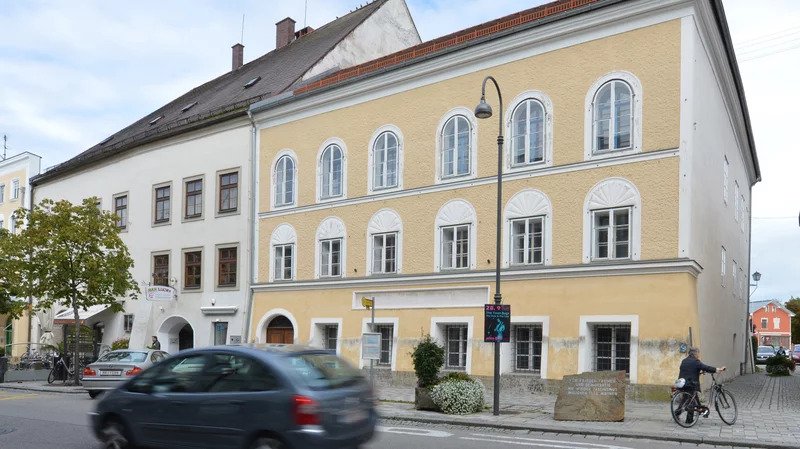
Controversy Erupts in Austria Over Plans to Convert Hitler’s Birth House into a Police Station
Edited by: Fern Sidman
The decision to transform Hitler’s birth house in the small Austrian town of Braunau into a police station has ignited a fierce debate among local citizens and leaders, as was recently reported by the Jewish Telegraphic Agency. The local administration of Branau recently unveiled concrete plans to repurpose the historically significant building, proposing to house a police training program focused on human rights issues. However, the JTA also reported that less than two months before the proposed redesign is set to begin, divisions within the community have come to the forefront.
The three-story house, built in the 19th century, has long been a subject of controversy due to its association with Hitler. Despite the Austrian government’s expropriation of the property in 2017 to deter neo-Nazi gatherings, the site has attracted Hitler supporters and become a pilgrimage destination for them, according to the JTA report.
The current plan to establish a police station in the building is being met with skepticism by various quarters, including local residents and historians. The JTA report noted that filmmaker Günter Schwaiger’s upcoming documentary “Who’s afraid of Braunau?” highlights an assertion that Hitler himself once expressed the desire for local officials to inhabit the rooms where he was born. This revelation fuels concerns that the police station might inadvertently align with Hitler’s wishes, creating a symbolic link between the dictator and the law enforcement presence.
The JTA reported that Schwaiger told the AFP that the police station will “always be suspected” of being “in line with the dictator’s wishes.”
In an e-mail to the JTA, California attorney Cary Lowe, who was born in Braunau to Holocaust survivors said, “To stop those gatherings, the town placed a monument in front of the house, consisting of a block of granite from the Mauthausen concentration camp quarry, inscribed with a message in memory of the victims of fascism.”
He added that, “If the government implements the police station proposal, which includes relocating the anti-fascist monument, I fear that will just suppress the history of the place and trivialize the tragic events that flowed from there.”
The site’s history has prompted a range of proposed uses, with some suggesting a focus on National Socialism, remembrance, anti-fascism, or peace, the JTA report said. A concept known as the “House of Responsibility” has been suggested, focusing on remembrance and addressing contemporary conflicts. This idea resonates with those who believe that Braunau’s identity has been unfairly overshadowed by its association with Hitler.
“There is only one acceptable solution, and that is to realize a ‘House of responsibility’ project,” said retired historian Andreas Maislinger, who comes from the area, according to the JTA report. He added that, “It would be a reframing of the whole town. Up to now, Braunau has only one thing it is known for – Hitler.”
In May, Oliver Rathkolb of the Institute of Contemporary History at the University of Vienna said in a statement issued by Austria’s Interior Ministry that such a program would “do justice to moral, political and legal responsibility. We have to face our past and give this historically burdened place a life-affirming perspective,” the JTA report said.
While there are those who see the police station proposal as an opportunity for law enforcement to learn from history and promote human rights, critics worry that such a move could trivialize the site’s tragic history and suppress its historical significance. The JTA also reported that the Austrian artist collective Total Refusal even suggested using a helicopter to relocate a controversial statue of Vienna’s wartime mayor Karl Lueger to the Hitler birth house site.
Hannah Lessing, secretary general of the National Fund of the Republic of Austria for Victims of National Socialism, was part of the jury that determined the new use of the building. The JTA report said that she acknowledges the various opinions but argues for a broader perspective, stating, “Hitler lived there exactly two months. So why is it so special? We already deal with Hitler on many levels, in organizations and museums.”
The redevelopment is projected to cost around 20 million euros and is expected to be completed by 2025, with the police station and district police headquarters scheduled to move in by 2026, according to the JTA report. Regardless of the outcome, the discussions around Hitler’s birth house highlight the complex and deeply emotional nature of addressing historical sites linked to infamous figures and events.