



|
Getting your Trinity Audio player ready...
|
By: Fern Sidman
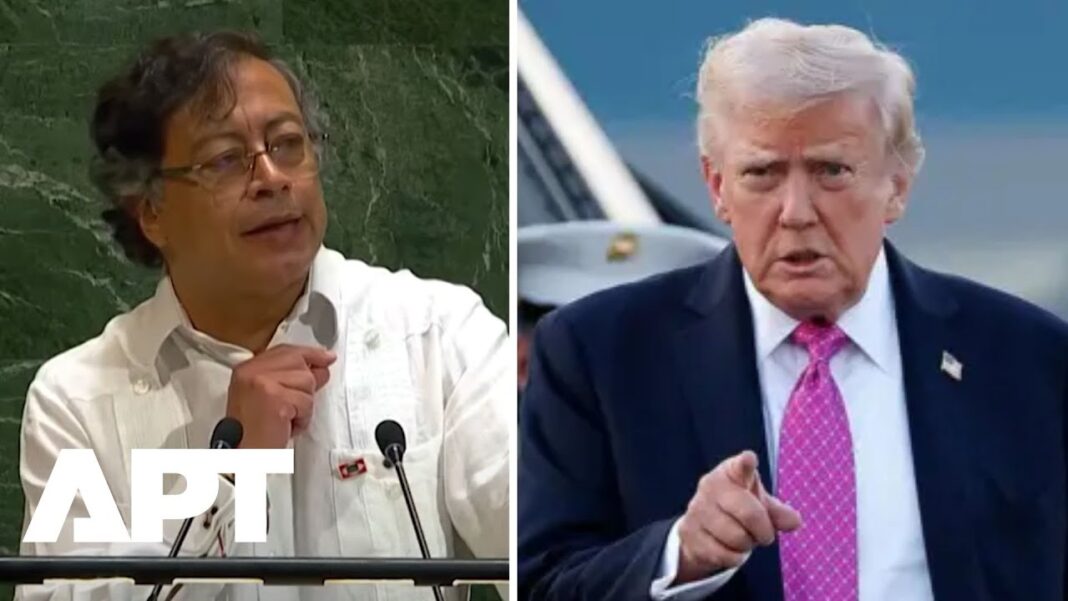
Colombia’s already fraught relationship with Washington has entered a new phase of turbulence after Foreign Minister Rosa Villavicencio announced Monday that she had renounced her U.S. visa in protest of the State Department’s decision to revoke the visa of President Gustavo Petro. The announcement, described in a statement by Colombia’s Foreign Affairs Ministry and reported by The Associated Press (AP), draws attention to the escalating tensions between the Trump administration and Petro’s leftist government over drug policy, Middle East diplomacy, and regional security.
The ministry said Colombia “is not interested in diplomatic visas that limit opinions or curtail sovereignty,” a direct rebuke to Washington’s unprecedented decision to penalize the sitting head of state of one of its closest historical allies in Latin America.
Within hours, Colombian Finance Minister Germán Ávila followed Villavicencio’s lead, declaring in a post on X that he too would no longer use his visa “in solidarity” with Petro and as a reaction to what he called U.S. “aggression.” “To work for our people, we do not need visas,” Ávila wrote.
The AP reported that the series of announcements reflects a clear pattern of deliberate distancing by Bogotá, signaling Petro’s willingness to escalate diplomatic confrontation with Washington at the risk of jeopardizing bilateral ties that have long been considered sacrosanct.
The immediate trigger for the crisis was Petro’s participation in a protest in New York during his visit to the United Nations General Assembly. According to the information provided in the AP report, Petro addressed demonstrators with a megaphone, draped in a kaffiyeh, the Palestinian scarf symbolic of solidarity with the Palestinian cause. He called for the creation of an “international army” to liberate the West Bank and Gaza and urged U.S. soldiers to “disobey” President Donald Trump’s orders, saying they should not “point their rifles against humanity.”
Hours later, the State Department announced on social media that it would revoke Petro’s U.S. visa, citing his “reckless and incendiary actions.” The move stunned Colombian officials and international observers alike. While the United States has long sparred with Petro over his critical stance on Washington’s drug war and regional policy, the visa revocation marked an extraordinary escalation against a sitting head of state.
Petro, who had already returned to Bogotá by the time the decision was made public, dismissed the move. Writing on X, he declared that he “didn’t care” about the punishment, pointing out that he holds dual Italian citizenship and could potentially travel to the United States without a visa.
The AP report noted that the visa dispute comes against a backdrop of worsening U.S.-Colombia relations under Petro. Earlier this month, the Trump administration placed Colombia on a list of countries “not fulfilling their international commitments to curb drug trafficking.” For decades, Colombia was the cornerstone of U.S. counternarcotics strategy in Latin America, anchored by Plan Colombia and billions of dollars in military and development aid.
Petro, however, has pursued a markedly different approach, advocating for a fundamental rethinking of global drug policy and criticizing Washington for what he sees as failed militarized strategies. His stance has infuriated U.S. officials and strained the traditional partnership, the AP reported.
Beyond drugs, Petro has been increasingly vocal about U.S. policy in the Middle East. His fiery comments in New York regarding Gaza and his calls for an international force against Israel aligned him with hardline anti-Israel voices and placed Colombia squarely at odds with the Trump administration’s approach to the war.
Meanwhile, in South America, U.S. military deployments to Venezuela — described by the Pentagon as part of a deterrence strategy — have become another flashpoint. Petro has criticized the buildup as destabilizing, further adding to the litany of disagreements.
Regional experts see the developments as more than symbolic. Geoff Ramsey, a Colombia analyst at the Atlantic Council, told the AP that Villavicencio’s renunciation of her visa adds yet another obstacle to a bilateral relationship already in disrepair. “Petro is not even remotely interested in repairing the relationship with Washington,” Ramsey said. “He’s clearly betting that confrontation with Trump will score points for his coalition in the upcoming election cycle, and is willing to torch the bilateral relationship with the United States in the process.”
Ramsey’s remarks highlight a key point: with Colombia’s congressional and presidential elections approaching next year, Petro appears to be leaning into an anti-U.S. posture as a political strategy, hoping to rally leftist supporters and consolidate his base. The decision to embrace confrontation with Washington, rather than moderation, is viewed by many as a calculated gamble.
From a legal perspective, the renunciations by Villavicencio and Ávila have raised eyebrows. According to the information contained in the AP report, immigration attorneys in Miami noted that there is no formal procedure for renouncing a non-immigrant visa, such as a tourist or diplomatic visa.
David Hart, an immigration attorney, told the AP that non-immigrant visa holders can simply allow their visas to expire or decline to use them. “They are doing this for the media and to show solidarity,” Hart said of Colombia’s ministers, framing their announcements as performative rather than substantive.
Another attorney, Wilfredo Allen, added that Villavicencio will likely need to submit a letter to the U.S. Embassy formally requesting cancellation of her travel permit. “If you don’t want to travel to the U.S. you can simply choose not to come,” Allen told the AP. “I had never seen someone take the time to renounce a non-immigrant visa.”
These unusual gestures highlight the political theater of the moment. The symbolic nature of the renunciations, combined with Petro’s own dismissal of the visa cancellation, suggest that Bogotá is less concerned about the practicalities of travel and more intent on broadcasting defiance.
The visa dispute has already prompted speculation about its long-term implications for U.S.-Colombia ties. For decades, Colombia was described as Washington’s most reliable partner in Latin America, especially in security and counterterrorism cooperation. That partnership now appears to be unraveling.
The AP reported that U.S. officials remain tight-lipped about whether further diplomatic measures are on the table. For now, the State Department’s revocation of Petro’s visa — a dramatic step in itself — stands as the clearest signal yet of Washington’s growing impatience with Petro’s rhetoric and policies.
Meanwhile, Petro’s administration appears to be hardening its stance. The Foreign Ministry’s declaration that Colombia “is not interested in diplomatic visas that limit opinions” was widely interpreted as a warning that Bogotá is unwilling to moderate its positions to accommodate U.S. sensitivities.
Observers note that Petro’s approach also reflects broader regional trends. Several leftist governments in Latin America — including those in Brazil, Mexico, and Chile — have criticized U.S. policy in Gaza and voiced support for Palestinian statehood. Petro’s outspoken activism places Colombia firmly within that bloc, even as it risks alienating Washington.
Domestically, Petro’s strategy could resonate with parts of Colombia’s electorate who see defiance of Washington as a reaffirmation of national sovereignty. The AP noted that Petro’s dual identity as both a former guerrilla fighter and now president imbues his rhetoric with a certain authenticity that appeals to his political base.
But the risks are considerable. Alienating Washington could jeopardize billions in aid, preferential trade agreements, and crucial security cooperation. With elections looming, the gamble could either strengthen Petro’s coalition or deepen Colombia’s isolation at a critical juncture.
The Associated Press has framed the dispute as a historic low point in U.S.-Colombia relations, one that combines personal grievance, political theater, and ideological divergence into a single combustible mix. From the State Department’s unprecedented move to revoke Petro’s visa to the foreign and finance ministers’ dramatic renunciations of their own, the symbolism of the moment cannot be overstated.
For Petro, confrontation with Washington is both a political strategy and an ideological statement. For the Trump administration, the revocation is a blunt tool to signal disapproval. What remains unclear is how the two countries — once described as inseparable partners — will navigate the widening gulf between them.
As the AP report noted, the relationship that once defined U.S. engagement in Latin America now hangs precariously in the balance, hostage to political posturing on both sides. Whether the damage can be repaired — or whether the confrontation will deepen further in the months ahead — may depend on choices made not in Washington or Bogotá, but in the unpredictable terrain of Colombian politics.
